Showing posts with label Penelope Wilton. Show all posts

Sunday, May 12, 2019

Dvd/150: SHAUN OF THE DEAD (Edgar Wright, 2004)

Shaun's having a bad day: nagged by his stepfather not to forget his mum's birthday, ordered by his housemate to throw out their lazy mate Ed, and dumped by his exasperated girlfriend Liz for forgetting to book a table for their anniversary.

It could be worse... there might also be a zombie apocalypse.  Oh...


Edgar Wright delivered an instant classic comedy-horror film which works on all levels; he whip-pans and crash-edits his way through it, but also finds time for quiet, sad moments which rewards repeated viewings.


Wright and co-writer Simon Pegg picked the perfect cast: Penelope Wilton as Shaun's mum Barbara and Bill Nighy as stepfather Philip, Kate Ashfield as long-suffering Liz, Nick Frost as the slobbish Ed, Dylan Moran and Lucy Davis as Liz's flatmates, and above all, Pegg is wonderful as Shaun.


A recognizable London and thumping soundtrack all contribute too.


Shelf or charity shop?  Armed with cricket bats and and shovels, Shaun and co. are holed up on the shelf forever


Wednesday, April 18, 2018

FANNY AND ALEXANDER at the Old Vic - life and death on stage....

Ingmar Bergman, one of the handful of visionary directors whose surname can sum-up a genre of film, was also a renowned theatre director so I suspect he would be bemused that some of his most intensely cinematic works have been adapted for the stage.  Unsurprisingly Ivo van Hove has directed three Bergman adaptations - CRIES AND WHISPERS, PERSONA, AFTER THE REHEARSAL - while there have also been stage versions of THROUGH A GLASS DARKLY and SCENES FROM A MARRIAGE.

The most well-known Bergman adaptation was in 1973 when Stephen Sondheim and Hugh Wheeler transformed his 1955 film SMILES OF A SUMMER NIGHT into the musical A LITTLE NIGHT MUSIC.  Now Matthew Warchus' tenure at the Old Vic gives us a new stage version of Bergman's 1982 epic family drama FANNY AND ALEXANDER which won four Academy Awards, a remarkable feat for a non-English language film.


When I heard about the stage play I did wonder how on earth they were going to make Bergman's highly cinematic semi-autobiographical family comedy-drama which is shot through with themes of supernatural and haunting magic realism work on stage.  What Stephen Beresford - who wrote the wonderful Matthew Warchus film PRIDE - has done with his adaptation is to make it a highly theatrical production with stage effects, jokey front-cloth warnings about the play's length, and choreographed movement replacing realistic playing. 

This immediately makes Beresford's adaptation it's own entity - the original cinema release was shorter than the play - but it's three and a half hour running time swept by thanks to Max Webster's involving production; no mean feat when one considers there are roughly 23 roles.in it. 


Fanny and Alexander are the young children of a theatrical family; their parents Emilie and Oscar Ekdahl own a theatre in Uppsala, Sweden and also are the stars of the theatre company.  Their extended family of uncles, aunts and cousins all live in a large townhouse which is presided over by their Grandmother Helena, a former lead actress who now condescends to playing featured roles such as mothers and queens.  Attended by devoted servants, the Ekdahls gather to celebrate Christmas and plan the upcoming production of HAMLET, also at the table is Helena's old friend and admirer Isaak Jacobi, a puppetmaker.

It takes a while to keep track of all Fanny and Alexander's housemates but through some sharp playing one soon got to know that Uncle Gustav Adolf, although married with a daughter also has designs on the maid Maj - to which she happily complies - and Uncle Carl who is always complaining about his chatterbox German wife Lydia. 


Alexander's worrying visions of a cloaked figure tragically portend Oscar's sudden death from a heart attack which leaves Emilie worried what the future holds for her and her children.  Not long after the funeral however, she announces to Fanny and Alexander that the local bishop Edvard Vergérus has asked her to marry him and she has accepted.  Vergérus, a seemingly gentle if overly-pious man, insists that Emilie and the children move with him to start their new life in his own home where he lives with his infirm aunt, his spinster sister and a maid.

Emilie and her children discover their new home to be a cold and emotionless one, ruled by Vergérus with a puritanical iron fist.  He forbids them from seeing their former family and singles out Alexander for punishment.  When locked in their bedroom, Alexander sees the ghosts of two drowned girls who tell him they are the drowned daughters from Vergérus' first marriage.  The spiteful maid Justina reports this to the bishop who beats Alexander mercilessly.  Emilie manages to escape to see her former mother-in-law Helena to confide her unhappiness but also that she is now pregnant.


Emilie confronts Vergérus and asks for a divorce, he refuses and tells her that if she leaves he will claim custody of Fanny and Alexander on the grounds of desertion.  But there is a greater power than Vergérus' chilly morality... Helena asks her old friend Isaak to help the children escape from their pious prison through his magic illusions and hide them in his puppet workshop.  While there Isaak warns them about his strange nephew Ishmael, who is locked in his own room for safety.

A defiant but weary Emilie tells the angry Vergérus she will never return her children to his house and tricks him into drinking a glass laced with her sleeping powders so she can escape... at the same time as Alexander is drawn to the locked room and meets the mysterious Ishmael who illustrates how thoughts can become reality... 


As I said Max Webster's production remained fast-moving and involving at all times, managing to balance the bleak Vergérus world with the more emotional Ekdahl one; he also knew how to vary the tone from Vergérus' abuse of Alexander to the hilarious scene where Uncles Carl and Gustav Adolf attempted to meet the bishop to try to resolve things only for Gustav Adolf - who had been warned to hide his anger - to explode in foul-mouthed disgust at Vergerus' hypocrisy.  His linking device - of having the servants narrate the events, while putting great emphasis on the different menus served for dinner in each household - was a clever one.

Tom Pye's stylish but simple set designs conjured up Fanny and Alexander's different environments superbly as did Mark Henderson's nuanced lighting.  From a rotating cast of four pairs of child actors, Zaris Angel Hator as Fanny and, in particular, Guillermo Bedward as Alexander were very good.


Among a strong cast, there were fine performances from Thomas Arnold as the mournful Uncle Carl, Karina Fernandez as the drab maid Justina (although not outshining Harriet Andersson in the film), Vivian Oparah as the life-affirming maid Maj, Lolita Chakrabarti as the icy Helena Vergérus, Catherine Walker's passionate Emilie and Sargon Yelda as the fated Oscar.

In a trio of excellent performances, special praise to Jonathan Slinger as the fun-loving and volatile Uncle Gustav Adolf, Michael Pennington as the genial but mysterious Isaak and Kevin Doyle as Edvard Vergérus, who while making you hate him, suggested the emotionally-scared man behind the monster.


But ruling the stage - as well as her character ruled her family - Penelope Wilton was a glorious Helena: it was all there, the former stage leading lady irked at no longer getting the glamorous roles, the indomitable matriarch, and the woman who realizes she is still able to love and be loved.  It was a role made for her to play as it echoed the strong no-nonsense women she has played in THE SECRET RAPTURE, ...BERNARDA ALBA, TAKEN AT MIDNIGHT and THE CHALK GARDEN.

An excellent choice to celebrate Ingmar Bergman's centenary, and his wonderful all-too-human characters, and the perfect production to do it with.  After all, Bergman himself said that film "was the costly, exacting mistress" but theatre was "the faithful wife".

I want to see the film again now!


Wednesday, April 08, 2015

Dvd/150: TALKING HEADS (Stuart Burge/Giles Foster/Alan Bennett/Tristram Powell/Patrick Garland/Udayan Prasad/Gavin Miller, 1988/98, tv)

Alan Bennett's incisive monologues never lose the power to draw you in, make you smile but leave you drained at the quietly desperate lives they depict.


They are performed by a dazzling cast: Bennett, Patricia Routledge (twice), Maggie Smith, Stephanie Cole, Julie Walters (twice), Thora Hird (twice), Eileen Atkins, David Haig and Penelope Wilton.

Standouts from Series 1 are Maggie Smith as the depressed vicar's wife whose secret drinking leads to the arms of an Asian shopkeeper and the BAFTA-winning performance by Thora Hird as Doris, reviewing her life in the dying light of day after suffering a fall.


Series 2 wasn't as consistent but several are stunning: David Haig as the park cleaner struggling to hide his secret, Julie Walters as the sour wife realising her husband is a serial killer, and a second BAFTA-winning performance by Hird as Violet, a stroke victim in her 90s.


Shelf or charity shop?  They can soliloquize from the shelf...


Sunday, February 08, 2015

TAKEN AT MIDNIGHT at Haymarket - remembering the forgotten

Last night we went to see something rare in the West End - a new play by a new author in one of the most prestigious of London theatres.  Nope, not the Donmar or Almeida or some poky over-a-pub fringe venue but in the Haymarket, the sometime home of all-star revivals.


If I am honest I think that although this transfer from Chichester is to be applauded for introducing a new voice with a thoughtful and engrossing new play, I think it was an uneasy fit in the plush surroundings of the Haymarket, a more intimate auditorium would have served the play better and made it more powerful.

Mark Hayhurst is certainly no stranger to the tragic tale of Hans Litten as he has already written a tv drama and documentary about him so he is the right person to bring it to the stage but this time he shifts the focus to Litten's mother Irmgard.


Hans Litten was a young barrister in Berlin who specialised in defending the left-wing working-class in court.  In 1931 he prosecuted three members of the SA for killing three and wounding twenty others in an attack by the paramilitaries on a left-wing dance hall.  His bold coup-de-grace was to call Adolf Hitler to the stand where he was cross-examined on his claims that the Nazi Party did not propagate violence and were a credible political party.

Litten set out to show that Hitler was in fact the leader of a party that terrorised it's opponents.  Hitler's obvious discomfort at being cross-examined was not forgotten.  In 1932 the Nazi party rose to power and the following year, on the night of the Reichstag fire, Hitler exacted his revenge - Litten was arrested at midnight and spent almost five years being shuttled around various prisons and concentration camps, subjected to beatings and torture.  This was done while he was being held without trial in "protective custody" - another fine example of the Nazi's corruption of language.  Eventually moved to Dachau, Litten hanged himself on 5th February 1938.


All the time he was in prison, his mother Irmgard relentlessly pursued the Nazis for his release, haunting their offices with increasing desperation, happy for any information of his whereabouts from released prisoners as proof he was still alive.

There was one moment of real hope when Litten's case was picked up by British politician Lord Clifford Allen but although Allen had a meeting with Hitler, nothing came of it as Allen believed in appeasement with the Nazi party.


After their son's death, Irmgard moved to England while his father relocated to Northern Ireland.  She lived to see her son's tormentors defeated and died in 1953 but her husband had predeceased her in 1940.

The play has them at odds over how to react to their son's fate and indeed, Hans had grown distant from his father, a Jew who converted to Lutheranism to further his legal career.  Baptised a Christian, Hans embraced Judaism to get back at his father although this rebounded on him when he arrived at Dachau as he was classified Jewish and made to wear the yellow star.  Which is also ironic in that the tragedy that overtook Hans Litten, his colleagues and other disaparate groups in the 1930s risks being lost in the wake of the overwhelming later Holocaust.


Some artistic licence has been taken in casting the tall and graceful Martin Hutson as Hans Litten as, in real life, he was more of a Billy Bunter lookalike, but he gave a heartfelt and affecting performance, nuanced enough to suggest that Litten realised that he had been the unwitting agent of his own fate.

The supporting roles have been cast well with solid, experienced actors: Pip Donaghy is very good as Erich Muhsam, the anarchist poet/playwright who shares Hans' cell and who remained unbowed in the face of his own death while Mike Grady plays Carl von Ossietzky, a left-wing journalist who also shares their cell.  Ossietzky was awarded the Nobel Peace Prize in 1935 but remained in prison until he died in the following year from TB.


David Yelland was good as the affable Lord Allen, full of waffle about freedom but doing nothing to anger Hitler while John Light was suitably chilling as Dr Conrad, the Nazi who is Irmgard's one unpredictable link to her son's release.  She has to demur to him in the hope that in doing so Hans will gain freedom but all the time you get the feeling of a sometimes-interested cat playing with a mouse.

There is a final confrontation scene between them when the avuncular mask drops and the real brutal face and mind of Nazism is revealed and it is to the credit of the lean, sinewy writing and committed playing of the actors that in this and similar scenes you could hear a pin drop - apart from the obligatory coughing.


Penelope Wilton was excellent as Irmgard, her unflinching quest for justice reflected in her tense, ramrod posture and her fists clenched.  Lesser actresses would play the sentiment but Wilton remained believably stoic, aware that any sign of weakness would be seized on by her son's captors.  She finally relents in her last meeting with Hans when she begs him to realise that "the time for bravery is over".  Early on in the play it occurred to me that she almost seemed to be channeling her CHALK GARDEN co-star, the late Margaret Tyzack; both in her lower register and speech.  Once I thought that I couldn't shift it from my mind.  I hope she takes it as a compliment that I thought that. 

Jonathan Church's direction has a relentless forward motion to it, moving inexorably towards the inevitable conclusion although after a while I wanted something more than the actors walking on, saying their lines and walking off.  Robert Jones has designed a simple but very effective set which helps the action move seamlessly from scene to scene and is helped enormously by Tim Mitchell's marvellous lighting suggesting the looming shadows of German expressionism.  In one memorable moment, Litten strides off after a reanactment of the 1931 trial with his shadow growing ever larger across the back wall only for it to suddenly change to the shadow of him hanged.
 

As I said, Mark Hayhurst's taut writing kept us subdued and attentive and with mothers across the world plaintively asking madmen for the return of their sons and daughters, the story of Irmgard and Hans Litten will tragically always be relevant but ultimately the play felt at times like a radio play transposed to the stage.

Friday, May 27, 2011

Well I suppose I have to blog about A DELICATE BALANCE... it's been over two weeks since I saw it in the awgoosed company of Andrew & Phil West-End Whinger (of the Vauxhall West-End Whinger clan). I was fully expecting, when we entered the Almeida auditorium, a sudden outbreak of whispering and fluttering of programmes-substituting-for-fans as usually seen when the fallen woman attends the Opera in films like CAMILLE or ANNA KARENINA... but no. Damn the chattering classes of Islington and their unflappable hauteur.

But all good things must come to an end... because the play had to start.


I had seen the play previously in 1998 at the Haymarket when the Battle of the Dames took place between Maggie Smith and Eileen Atkins. I suspect I was too busy experiencing these two blazing divas to concentrate much on the play itself so retained only a vague imprint of it as I watched this revival, it was like watching something on a worn video and seeing vague shadows flickering of what had already been on it.

What I remember most of it was that in Agnes' opening speech she talks about her fear of losing her mind... and Eileen Atkins promptly forgot her words. She apologised to the audience and asked an amused John Standing playing her husband to start the scene again. He did this and as soon as she uttered the words "...losing my mind" she got an enormous laugh and cheer from the audience which she slyly acknowledged.

Needless to say Maggie came on all guns blazing to get the audience back with her and soon you could not see the set for cocked shoulders and flapping wrists. They were both utterly magnificent.

Here Penelope Wilton got through this speech without any problems - her stumbled line-readings came later - and away we went into Edward Albee's intriguing but in equal measure infuriating play. Well it wouldn't be Albee I guess...

Tobias and Agnes live a well-heeled WASP life in their tastefully dull large house in the suburbs where they spend their days drinking from an array of decanters and sharing polished, superior dialogue about the possible break-up of their daughter Julia's fourth marriage and what to do with Claire, Agnes' alcoholic sister who, of course, lives with them for the only discernible reason that it breaks up the days fighting with your dipso sister.After sibling verbal battles that echo George and Martha in his - ahem - superior play WHO'S AFRAID OF VIRGINIA WOOLF? the threesome's evening is interrupted by first the arrival of Julia seeking a return to the family nest - although one suspects it was never that much of a sanctuary and the sudden arrival of their best friends Edna and Harry who suddenly do a dog's hind leg and take the play down the ever-shadowy Pinter Alley by announcing they too have come seeking shelter as they have suddenly both developed a sickening terror of... something.

Far from being docile and invisible presences in the house, soon Edna and Harry are seemi
ngly laying down the law in the house and take great delight in turning on Julia - especially as they make a quick dash back to their house to pack more belongs for their lengthy stay at Agnes and Tobias' House of Fun.In further echo's of WAOVW - one of the characters appears in the living room waggling a gun about and Agnes reveals to us that they had a son who died at an early age, an event that was the turning point from which the family have never recovered.

After another act of polished yakking Edna and Harry come to the conclusion that they would never have let Agnes and Tobias stay with them if the roles were reversed and return home, leaving Tobias bereft of speech as he had just asked them to stay... because that's what friends do.One cannot doubt that Albee is a fine writer and the play occasionally comes to life but in James Macdonald's hermetically-sealed production, seemingly as airless as the mahogany-crammed living room, it is just too dreary and strives for a profundity that resolutely refuses to appear. After the first Act I staggered out into the Almeida foyer never in my life wanting so much to hear some Gangsta Rap. I felt smothered by the interminable yak of insufferable middle-class angst played to an Islington white, middle-class audience. And me. And The Brothers Whinger. And Sian Phillips. It was all I could do to shout out "Who the fuck CARES??" The audience also had that really irritating habit of braying loudly and eagerly at any line that had even the whiff of humour, collectively WILLING it to be a comedy.

Imelda Staunton plays Claire, the alcoholic sister who can blister the varnish with her viperous wit and damn, was she missed when not onstage. She gave it her usual abrasive turn, grasping every opportunity she could in her diatribes against the world, her sister and her family, or a snotty sales woman who she teases mercilessly. I must admit that I was fixated on her, not only for her performance but the odd shape of her bust. No doubt an old Playtex Discontinued was pressed into action but it looked like she had a bumper Arctic log under her jumper.Tim Pigott-Smith as Tobias seemed to be giving us an impression of Corin Redgrave - and made me realise how great Redgrave would have been in it and how Pigott-Smith seems to be theatre's answer to Mogadon, his speeches more often than not had me admiring the interesting thing the woman in front of me had done with her hair.

Penelope Wilton has over the past few years proved herself time and again as being an actress of great power but here - wearing Jill Clayburgh's old hair with a glazed, bland air - she whisked me back to the early 1980s when I would walk a mile in tight shoes to avoid her. The fact she stumbled occasionally on her line-readings really suggested the Duse of the Donmar's heart really wasn't in it.
It's certainly not the part - when Eileen played it she won the Evening Standard Award for Best Actress.
Lucy Cohu as the desperately needy Julia gave another uphill performance which again made me blanch that one day she will probably be giving us her Hedda Gabler. However the biggest surprise was the performance by Diana Hardcastle as Edna. Her rapid transformation from victim to tormentor was very well done from this actress who I have always found a bit mumsy.

The dead-hand direction of James MacDonald was disappointing after his masterly spare production of JUDGEMENT DAY. Laura Hopkins' design probably impressed some but I had to agree with Les Fréres Whinger that it suggested more a funeral parlour than a suburban household.

Needless to say the play has had raves so go know.

Tuesday, November 29, 2005

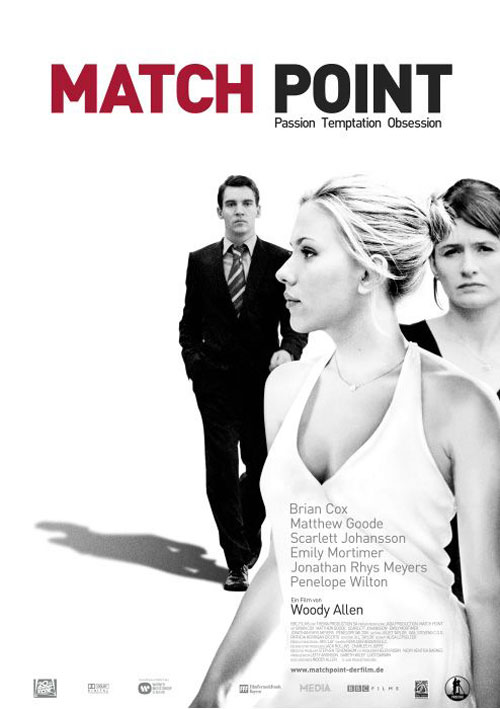
MATCH POINT - Woody Allen's new balls?

This evening I saw an advance screening of Woody Allen's newie MATCH POINT, not released here til January. The film, his first film shot entirely outside New York, stars Scarlett Johansson and an otherwise British cast including Jonathan Rhys-Meyers, Emily Mortimer, Brian Cox and Penelope Wilton.

His new backdrop has invigorated him to a certain extent but the film lost my goodwill when the plot was pitched suddenly into melodrama. The first 45 minutes promised much - Rhys-Meyers is Chris, a tennis player just off the circuit who finds work coaching in a well-heeled tennis club. A friendship develops with upper-class Tom (Matthew Goode) who invites Chris to the opera with his family. There he meets Tom's sister Chloe (Mortimer) who is won-over by his charm which develops at a visit to the family country estate. At the same weekend party, Chris flirts with a sexy girl - who turns out to be Tom's girlfriend Nola (Johansson), an American actress not having the best of success in London. 


Despite his relationship with Chloe he finds himself attracted to Nola who fends him off until, upset with her future mother-in-law's snide remarks, she has sex with him one rain-swept afternoon in the country. Chris is told a few weeks later by Tom that he has dumped Nola as he has found a more acceptable girl for his family and Nola vanishes from London. Chris marries Chloe and accepts a job in her father's business in the city. Then Nola reappears in London and Tom's passion is re-ignited...

The film turns into a love triangle with Chris torn between his wife's desperate attempts to get pregnant and his mistress' increasing desperation at his unwillingness to end his marriage. When Nola gives him the unthinkable - but predictable - news that she is pregnant Chris is forced to choose his fate. The film then lurches abruptly into a cross between Theodore Dreiser's AN AMERICAN TRAGEDY and Dostoyevsky's CRIME AND PUNISHMENT - via Allen's own CRIMES AND MISDEMEANORS.

Needless to say, the film's plotline is played out in front of London's most glamorous locations - the characters only appear to shop in Bond Street (which might explain why they are never seen buying food), Rhys-Meyers' office is in 'The Gerkhin', the apartment Rhys-Meyers and Mortimer move into after their marriage is a huge penthouse affair with enormous windows overlooking the Thames and the cultural life of the couples is viewed at Covent Garden, Tate Modern, The Curzon Mayfair and The Palace Theatre. Indeed there are so many shots of Rhys-Meyers coming out of designer shops that I thought "Why not have him come out of Buckingham Palace and have done with it?"  

 
The absurd melodramatic turn of events also rendered the film's most interesting character, Scarlett Johansson's Nola, into little more than a pathetic shrill creature. Up until then, Johansson had fleshed out the character wonderfully, making her attraction to Rhys-Meyers totally understandable. The casting of Rhys-Meyers is problematic - his inscrutable air keeps his Chris at an emotional distance from the audience and more strangely his Dublin accent is almost untraceable but much is made of his character's Irishness.