Showing posts with label Michael redgrave. Show all posts

Thursday, October 14, 2021

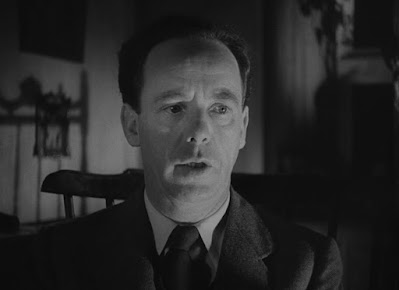
DVD/150: THUNDER ROCK (Roy Boulting, 1942)

An intriguing film version of US writer Robert Ardrey's anti-isolationist play.  

It flopped on Broadway but, unsurprisingly, was a huge success in London in 1940 starring Michael Redgrave as David Charleston, an idealistic journalist who has withdrawn from a world that has allowed Fascism to thrive.

Between appearing in the play and film, Redgrave had joined the Navy but was invalided out after 16 months. 

Boulting's expanding of the backstory slows the plot down but it eventually hits it's stride.


Charleston has become a lighthouse keeper on Lake Michigan, only seeing people during a monthly supplies drop.

Charleston has found the logbook from an 1849 shipwreck and nightly imagines it's victims: Captain Stuart, Doctor Kurtz, Mrs Kurtz and daughter Melanie, Miss Kirby a feminist, and Mr Briggs and his pregnant wife.

He cynically judges them but slowly discovers they were good people and realises life must be engaged with.

Shelf or charity shop?  I think Mr Charleston can hide away from society in my DVD storage box but it's a film that always impresses in my rare viewings. Boulting takes a long time showing Charleston's growing dislike of the world but it does settle down into it's gently unsettling atmosphere of a man living in his mind with the dead, helped by the fine cinematography of German Mutz Greenbaum.  By seeing the '49ers' initially through Charleston's misanthropic eyes then as they actually were, it allows the actors the chance to deliver clever shifts in their performances.  Finlay Currie, Barbara Mullen, Frederick Valk (who co-starred with Redgrave in the Ealing horror film DEAD OF NIGHT two years later) all excel while Lili Palmer is a delight as the initially frivolous then subdued Melanie, also good is James Mason as Charleston's delivery pilot friend; Mason had actually registered as a Concientious Objector at the start of WWII.  Michael Redgrave gives one of his finest screen performances as Charleston, unafraid to play a shut-down and disdainful character until he subtly shifts to show a man willing to face the world again. THUNDER ROCK is an under-rated gem.

Sunday, May 23, 2021

DVD/150: THE IMPORTANCE OF BEING EARNEST (Anthony Asquith, 1952)

Anthony Asquith's sparkling adaptation of Oscar Wilde's THE IMPORTANCE OF BEING EARNEST is 70 next year - an ageless film of an ageless play.

Asquith's screenplay captures the essence of Wilde, his direction creates a perfect 'High Comedy' world for the dazzling firework display of his cast of actors.

They act without any camp condescention; they enter the reality of Wilde's world and deliver definitive performances of their characters.

The film is dominated by Edith Evans' Lady Bracknell, and while her "A handbaaaaaaag?" line has haunted every Lady Bracknell since, she plays the role with such nuance that she makes all her lines memorable.

Michael Redgrave is perfect as Ernest/Jack while Michael Dennison is a revelation as the facile Algernon.

Margaret Rutherford and Miles Malleson shine as Miss Prism and Canon Chasuble.

Newcomer Dorothy Tutin is delectable as Cecily but outshining them all, Joan Greenwood's delicious Gwendolen steals every scene.

Shelf or charity shop?  Worthy of a shelf all on it's own, this is one of my desert island films.  In a world of ghastly reimaginings and modern-dress reductiveness, the film stands as a record to a cast and film-makers honouring the material. Exquisitely shot by Desmond Dickinson and gloriously costumed by Beatrice Dawson, the film looks as good as it sounds - and it sounds absolutely glorious, no better than in the scene where Gwendolen and Cecily duel over their supposed engagements to Earnest, to hear Joan Greenwood say these lines in quick succession is to witness perfection:

“I never travel without my diary. One should always have something sensational to read on the train"

"I am glad to say that I have never seen a spade.  It is obvious that our social spheres have been widely different"

"You have filled my tea with lumps of sugar, and though I asked most distinctly for bread and butter, you have given me cake".

It is the bitterest irony that Anthony Asquith's father, Herbert Asquith, as Home Secretary signed Oscar Wilde's arrest warrent.


Sunday, February 07, 2021

DVD/150: THE INNOCENTS (Jack Clayton, 1961)

Jack Clayton had read Henry James' ghost story THE TURN OF THE SCREW when young; as a director he only made eight films, luckily THE INNOCENTS was one of them.

20th Century Fox owned the rights having bought a 1950 Broadway adaptation called THE INNOCENTS by William Archibald.  Clayton had Archibald write a screenplay but was disapponted he delivered a straight ghost story with no ambiguity.

John Mortimer gave it a more Victorian flavour, but it was Truman Capote who wrote the final chilling adaptation. 

With Freddie Francis' astonishing cinematography and Jim Clark's editing, Clayton made an extraordinary, disturbing film that haunts the memory.

Onscreen throughout, Deborah Kerr subverts her prim screen persona as Miss Giddens, the inexperienced parson's daughter who becomes the governess of two small orphans.

She soon suspects the house is haunted by two dead servants and determines to save the children... but from what... and whom?

Shelf or charity shop?  Haunting the shelf; the perfect combination of director, script, cast, cinematography and editing, THE INNOCENTS' ominous shadows grow longer and more chilling as the years go by.  Having to use Fox's Cinemascope process, Freddie Francis keeps the focus in the centre of the screen but one is always aware of the shadows at the edges which might hold terrors.  The film's triumph is it's ambiguity: are Miles and Flora haunted by the malevolents ghosts of Quint and his mistress or is Miss Giddens projecting it onto them through her inexperience and puritanical upbringing?  Clayton leaves it up to the viewer - exactly how he told Deborah Kerr to play it.  Kerr is sensational, slowly becoming unhinged by the forces around her - or inside her.  Clayton was gifted with two remarkable child actors Martin Stephens and Pamela Franklin, he never gave them a full script but only gave them the lines for the scenes as they filmed them so they play their characters totally in the moment. Megs Jenkins is fine as housekeeper Mrs Grose who cannot protect the children from Miss Giddens' suspicions, and there is a marvellous cameo from Michael Redgrave as Miles and Flora's uncaring, London-based uncle, more than happy to give the untried Miss Giddens complete control over them.  The ghosts are memorably played by Peter Wyngarde and  Clytie Jessop.


Tuesday, September 29, 2020

DVD/150: THE BROWNING VERSION (Anthony Asquith, 1951)

Of the ten films made by director Anthony Asquith and writer Terence Rattigan, the most resonant remains THE BROWNING VERSION, released three years after Rattigan's one-act play opened.


Rattigan deservedly won the Best Screenplay Award at the Cannes Film Festival for his adaptation.

Michael Redgrave won the Cannes Best Actor Award while also giving one of the great screen performances as Andrew Crocker-Harris, a classics master who, after 18 years teaching in a boys school, has atrophied into a pedantic, remote man.  When it's announced that Crocker-Harris is leaving the next day due to ill health, he is made aware of the dislike of pupils and colleagues.

His wife Millie is also openly contemptuous, barely hiding an affair with science teacher Frank, but when she learns Andrew has been refused an expected school pension, she goes on the attack.

But a pupil's unexpected goodbye present changes everything...

Shelf or charity shop?  Currently living in my plastic storage box, THE BROWNING VERSION is a film that delivers a quietly devastating emotional punch.  Beautifully directed by Asquith, his film allows you to slowly side against the malign forces facing Crocker-Harris both professionally and personally.  As I said, Michael Redgrave delivers not only his best screen performance but one of the truly great screen performances; staying within the strict parameters of the character but by through the smallest, precise timing of gesture and voice, you will be totally on his side by the end of the film.  There is excellent support from Jean Kent as the vindictive Millie, Nigel Patrick as her lover Frank who makes amends for their deception and Wilfred Hyde White as the smoothly unfeeling headmaster.  A special mention for Brian Smith as young Taplow whose unexpected farewell present to Crocker-Harris starts a chain reaction.  This scene where his small act of kindness causes Crocker-Harris to finally break down in halting sobs is the film's devastating core.

Saturday, September 05, 2020

DVD/150: DEAD OF NIGHT (Alberto Cavalcanti / Charles Crichton / Robert Hamer / Basil Dearden, 1945)

TALES FROM THE CRYPT, VAULT OF HORROR... No, the best British portmaneau horror film remains Ealing's 1945 film DEAD OF NIGHT which can still chill.

An architect is invited by a potential client to stay for a weekend. He feels déja vu when he arrives and tells the assembled guests he feels he knows them from his dreams.  One by one they recount unsettling incidents that happened to them...

They include a racing driver's strange dream saving him from a deadly accident; a young girl's ghostly encounter during a party game; a woman's gift of a mirror to her fiancée drives him murderously deranged; and two golfing friends extend their rivalry beyond the grave.

But the best remains Michael Redgrave's nightclub venriloquist driven schizophrenic by his doll's persona.

Only after all these are told does the architect realise why it is all familar to him...

Still haunting after 75 years...

Shelf or charity shop? DEAD OF NIGHT resides in the limbo of my plastic storage case - scaring the bejeebus out of the other dvds. Basil Dearden directed the linking story as well as the racing driver sequence, Robert Hamer directed the haunted mirror sequence, Charles Crichton directed the golfer's story (which is the only segment that outstays it's welcome) while Alberto Cavalcanti directed the Christmas party and the ventriloquist sequences.  There are memorable contributions from Mervyn Johns as the fearful architect, Miles Malleson as a cherubic harbinger of death, Sally Ann Howes as the pert teenager, Googie Withers as the buyer of the mirror, Frederick Valk as the pragmatic psychiatrist, Elisabeth Welch as the owner of the Chez Beulah cabaret, and above all Michael Redgrave's schizo ventriloquist - his final scene confrontation with Hugo the dummy remains genuinely disturbing.