On Thursday evening I went with Owen and Angela to the minuscule Jermyn Street Theatre to see a new production of ANYONE CAN WHISTLE, the legendary 1964 flop musical written by Stephen Sondheim. It was thought-provoking but for all the wrong reasons.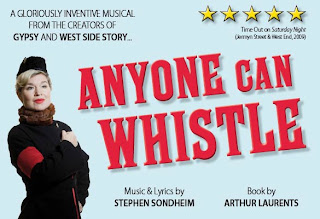 To set the scene: Sondheim's first score was for the musical SATURDAY NIGHT which was ready to be staged in 1955 but was scrapped when the leading backer suddenly died. He was then the lyricist for two shows which are now considered classics WEST SIDE STORY in 1957 and GYPSY in 1959 - he had hoped to write the full score for GYPSY but Ethel Merman coalboxed that idea as she wanted a proven composer so Jule Styne was brought on board.
  Finally in 1962 he wrote music and lyrics for a Broadway show - A FUNNY THING HAPPENED ON THE WAY TO THE FORUM. Although it was successful and won the Tony Award for Best Musical, his score was largely overlooked and wasn't even nominated for Best Score. So, teaming up again with Arthur Laurents, the writer of WEST SIDE STORY and GYPSY, he started work on ANYONE CAN WHISTLE.
 Laurent's would-be-satire is set in an American town bankrupted by the corrupt mayoress and her cronies. They fake a 'miracle' - a rock that spouts water - to get the tourists flocking. There is uproar when the inmates of the town's insane asylum or 'Cookie Jar' escape into the crowd while visiting the shrine - a situation made worse when a stranger is assumed to be the new head of the 'Cookie Jar' who wins the public over with his theory that we are all mad and all authority is to be mistrusted. Hapgood is labelled an undesirable by the corrupt politicians and has to fight off the romantic attentions of the mayoress as well as the equally mysterious "Lady From Lourdes" who has come to investigate the miracle.
 He soon guesses she is in fact the idealistic head nurse Fay who refuses to hand over her 'cookies' to the authorities. Their love is compromised however by Fay's inability to be able to live for the moment, to "whistle". The show ends with the corrupt politicians still in power, the 'cookies' under the control of a new strict doctor, Hapgood exposed as a 'cookie' and Fay finally able to "whistle".The show's three stars all made their musical debuts - Lee Remick as Fay, Harry Guardino as Hapgood and Angela Lansbury as the corrupt mayoress Cora Hoover Hooper. After a troubled try-out tour - one of the main supporting actors died on stage! - they opened to mostly bad reviews and the show closed after a mere 9 performances. And that should have been that.However Sondheim's score was immortalised by a cast album, recorded as the tradition had it then, on the first Sunday after opening night.
 Goddard Lieberson was not only the President of Columbia Records but also produced the cast recordings of the period and although he could have passed on the option to record the show, he felt it was intriguing enough to warrant being kept for posterity. Thank God he did as, although not the full score, it saves the vocal performances of Lee Remick - heartbreakingly wistful in her two ballads - and of course Angela Lansbury who punts her numbers ME AND MY TOWN and A PARADE IN TOWN into greatness.
 So ANYONE CAN WHISTLE joins Jerry Herman's MACK AND MABEL in being a show that closed early but that has gained it's popularity and a cult following from it's recorded score. However what only becomes evident when you watch these shows in performance is that the book is far-from-memorable. Such is the case at Jermyn Street - added to a production which seems to misguidedly pursue an artistic vision which the slight book can't sustain.First the venue. Now I am all for spaces being reclaimed for performance but c'mon - the playing area here is about 7 foot deep so any show that has a large dance element - and there are two long numbers in ANYONE CAN WHISTLE that require a lot of stage traffic - is compromised by the choreography having to be curtailed to a stage the width of a tube train - this was also made glaringly apparent where we were seated at the side of the stage. Although the seats are ok, I was always aware of my surroundings - and by the fact that the Stygian witches have found gainful employment as front-of-house attendants. A smile costs nothing ladies...Now to the production. The director Tom Littler obviously has a vision as to what the show is REALLY all about which is the rise of fascism. So the show is set in 1930 for no other reason than the town is going through a depression and twice during the second act the show stops dead for no other reason than for one of the 'peasants' to daub an anti-Cora message on the auditorium's wall by torchlight - only to have it converted later into the symbol the ministers are wearing on their armbands - again by torchlight, again s-l-o-w-l-y. The finale is the real jaw-dropper. Instead of Fay and Hapgood finally embracing while the water from the rock reappears only this time by magic - ergo a happy ending - we have the lights all go red, the music turning into a military beat and Cora and her ministers all appear stern faced and facing us with a clenched-fist martial salute - ergo unhappy end.Now it's up to Littler if he wants to do a revisionist take on the show - as Sam Mendes then Rufus Norris did with CABARET - but trying to tack this onto Laurents' hopelessly twee book of ham-fisted political satire where the insane are always given the cutesy 'cookie' name and the final round-up of 'cookies' include people such as Agnes Brecht, Brian Kirkegaard, Hyacinthe Engels etc. is really giving it a poe-facedness that beggars belief. Be warned - this is a production where the music is played by the supporting cast - I am hoping they play the score in so squeaky and Brechian a way due to the general air of misery that the production is aiming for and not due to their inept musicianship. May I state again - I loathe this approach to musical staging - if you can't afford a band then don't do the damn show! It's not a stunning new reinterpretation of the score - it's cheap and half-arsed.
 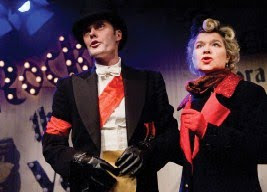 The best performances were given by Issy van Randwyck - once on the books of the actor's agency I worked for - as Cora and Alistair Robins as the venal Comptroller Shub. Rosalie Craig and David Ricardo-Pearce were ok as Fay and Hapgood as were the rest of the supporting cast - apart from the cast-member who plays her character as Catherine Tate's nan who should be ashamed of herself.This is now the second time I have seen the show - the equally financially-challenged Bridewell Theatre staged it in 2003 with Paula Wilcox singing the role of Cora in the key of Yale but at least they had a band from what I remember.If anyone wants to do a new production I will see it again if they drastically re-write the unworkable book - otherwise I will be at home with Lee and Angela on my cd player.
In closing, last night I watched Julien Temple's REQUIEM FOR DETROIT? a fascinating and disturbing documentary on the lingering death of what was once America's fourth largest city and is now half-deserted with old car factories literally crumbling to nothingness and being consumed by trees and vegetation - a fine example, Mr. Director, of how with a little imagination this show's setting could have been made relevant to today.
 Earlier this week Owen and I made a return to our London theatregoing when we went to the Vaudeville - again! - to see Richard Eyre's production of Noel Coward's PRIVATE LIVES.From it's original production in 1930, the play has become one the most beloved comedies - by both audiences and actors! This time Kim Cattrall and Matthew Macfadyen are playing Amanda and Elyot, the lovers who can't live with each other - or without each other.
 Coward wrote the roles with himself and Gertrude Lawrence in mind and a flavour of these two individual performers haunt the teasing, darting repartee, the illusion being of a soapy bubble being kept floating in midair by the most delicate of touches.
 Like THE IMPORTANCE OF BEING EARNEST the reason for the play's longevity is that it just works - the effortless wit and frothy air hides the play's solid foundation within the classic three-act structure, no line superfluous, no action out of place. Remarkable then that when it first opened that it received mixed reviews at best from the London critics.The glittering wit and sharp-as-knives barbs also conceal a fascinating central story of two people who are constantly aware that while they are ideally suited, yet they can't stop the arguments that regularly erupt between them. Life imitated art in the 1972 London revival when Maggie Smith and Robert Stephens' marriage crumbled away during the run and in a 1983 New York revival this love you-hate you aspect was more than played up with the casting of Elizabeth Taylor and Richard Burton, seven years after their second divorce. It was a box office hit even though as Frank Rich said in The New York Times "it had all the gaiety of a tax audit".
 Luckily you are in safe hands at the Vaudeville. Richard Eyre brought his usual clarity of vision to the play - the first act slowly but surely gathering momentum until we too were swept up in the giddy excitement of Amanda and Elyot eloping to Paris. The second act is again paced carefully as we ride the rollercoaster that is the couple's determined efforts to stay in love and not fight until all Hell finally breaks loose.
 His handling of the third act was interesting, not playing up the slapstick elements but again leading effortlessly up to the final famous image - Amanda and Elyot slipping away together again as Victor and Sibyl have a stand-up fight. Eyre makes sure that the bittersweet regret at the heart of the play is never far from the surface froth.Eyre also has elicited interesting non-Coward performances from his two leads. Matthew Macfadyen still strikes me as an odd choice - he initially seems far too sturdy, too proletarian for Elyot and his understated performance sometimes throws the play's inner motor off but he does suggest the core of doubt under the witty banter and he made the fight scenes quite believable - this Elyot certainly makes you believe that he would "strike certain women, like gongs".
 Kim Cattrall - who luckily did not receive the round of applause on her delayed entrance that I was dreading - also is hardly the brittle, angular and waspish Amanda of tradition. She possessed a worldly air that made you believe her distrust of convention and 'the done thing'. Her Amanda fully makes you understand how both Elyot and Victor would want this maddening, erratic woman as their own. I enjoyed her performance very much.
 The hapless Sibyl and Victor - who by Coward's own admission are only there as skittles to be knocked down and put back up again are played by Lisa Dillon and Simon Paisley Day.If Lisa Dillon didn't totally convince as Sibyl it's maybe because she is too intelligent a performer to fully convince as a prattling ninny. Simon Paisley Day followed up his scene-stealing role as brother Ed in last year's ENTERTAINING MR. SLOANE with a delightful turn as the hopelessly out-of-his-league Victor. While hitting all the obviously comic moments with aplomb - the things he can do with a vowel sound - he also managed to suggest the sadness behind the buffoonery when he haltingly suggested that he would let Amanda divorce him to save any scandal - as if Amanda would mind!
 Rob Howell's designs were suitably lavish for Amanda's Paris flat and how the triple-sphere upright goldfish tank stays in one place is beyond me.I cannot recommend this production enough. It has the wit and panache one would hope but also the sadness behind the frivolity which can make a line like “Let’s be superficial and pity the poor philosophers, let’s blow trumpets and squeakers, and enjoy the party as much as we can, like very small, quite idiotic school-children” quite heartbreaking.
 The day after receiving very positive reviews, what is the best the American company of HAIR can look forward to? Me and Owen in the audience of course!
 If anything, I thought it was even better at the Gielgud. I was a bit worried how a London audience would take to the show but the audience were up for it from the get-go and I suspect the prospect of performing this very American-themed show with all it's now-obscure cultural references to a London audience made the cast go for it a little harder.
 It was great to become re-acquainted with the cast members from NY such as Will Swenson's Berger and in particular Gavin Creel's Claude - his torment over what is his ultimate destiny is palpable in an excellent rendering of WHERE DO I GO at the end of the first act, so good he pulls the focus from the company stripping off behind him! His choice leaves him invisible to his former compadres and leads to a stunning coup-de-theatre.
 It was a pleasure to see Caissie Levy again as Sheila, the political activist doomed to be disappointed in love and life - her soaring voice turns EASY TO BE HARD into a genuine showstopper as well as sparkling in I BELIEVE IN LOVE and GOOD MORNING STARSHINE.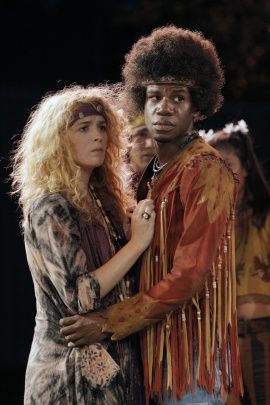
 It was sad that Bryce Ryness didn't make the trip as he was great as Woof but it was delight to see Allison Case as Chrissy as she had left the cast by the time we saw the NY production. She gave a winning performance as the love-lorn Chrissy and carefully managed to steer her rendition of FRANK MILLS through the lines that elicited laughs to the touching last line. I happily "Woo"ed at the end.
 Oh and the cherry on the cake?


