Saturday, September 05, 2020

DVD/150: DEAD OF NIGHT (Alberto Cavalcanti / Charles Crichton / Robert Hamer / Basil Dearden, 1945)

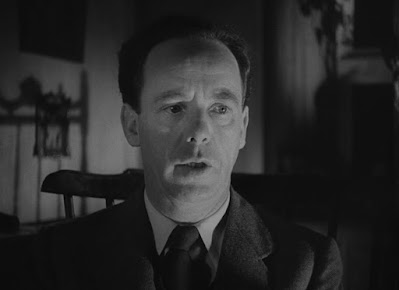
TALES FROM THE CRYPT, VAULT OF HORROR... No, the best British portmaneau horror film remains Ealing's 1945 film DEAD OF NIGHT which can still chill.

An architect is invited by a potential client to stay for a weekend. He feels déja vu when he arrives and tells the assembled guests he feels he knows them from his dreams.  One by one they recount unsettling incidents that happened to them...

They include a racing driver's strange dream saving him from a deadly accident; a young girl's ghostly encounter during a party game; a woman's gift of a mirror to her fiancée drives him murderously deranged; and two golfing friends extend their rivalry beyond the grave.

But the best remains Michael Redgrave's nightclub venriloquist driven schizophrenic by his doll's persona.

Only after all these are told does the architect realise why it is all familar to him...

Still haunting after 75 years...

Shelf or charity shop? DEAD OF NIGHT resides in the limbo of my plastic storage case - scaring the bejeebus out of the other dvds. Basil Dearden directed the linking story as well as the racing driver sequence, Robert Hamer directed the haunted mirror sequence, Charles Crichton directed the golfer's story (which is the only segment that outstays it's welcome) while Alberto Cavalcanti directed the Christmas party and the ventriloquist sequences.  There are memorable contributions from Mervyn Johns as the fearful architect, Miles Malleson as a cherubic harbinger of death, Sally Ann Howes as the pert teenager, Googie Withers as the buyer of the mirror, Frederick Valk as the pragmatic psychiatrist, Elisabeth Welch as the owner of the Chez Beulah cabaret, and above all Michael Redgrave's schizo ventriloquist - his final scene confrontation with Hugo the dummy remains genuinely disturbing.


Friday, September 04, 2020

DVD/150: FROM HELL (Albert Hughes / Allen Hughes, 2001)

The Hughes Brothers, whose previous films were urban crime dramas, swapped one ghetto for an earlier one by bringing Alan Moore and Eddie Campbell's graphic novel about Jack The Ripper to the screen.

Their vision of Whitechapel in 1888 is wonderfully gothic with blood red skies looming over a shadowy London and the the desperate lives of the women who became the victims.

FROM HELL follows Stephen Knight's theory that the women were murdered for knowing about the Duke of Clarence's secret marriage to a shop-girl and her subsequent baby; this was also used in the 1979 Sherlock Holmes film MURDER BY DECREE.

FROM HELL goes beyond this suggesting that the last victim Mary Kelly managed to escape her fate through a relationship with Inspector Abberline.  I guess that's one way of getting a happy ending...

Johnny Depp rehearses his cockney accent ready for SWEENEY TODD six years later.

Shelf or charity shop? It doesn't hold up as well as I remembered but I will keep it for the fantastic production design by Martin Childs; a standing set was built outside Prague of the Whitechapel known to the victims which allowed for fluid cinematography within a believable world.  Johnny Depp as the opium addict Inspector holds the attention, but while Heather Graham maintains a believeable Cockney accent she is fairly colourless.  Much better are the sympathetic performances of the actresses playing the victims: Samantha Spiro, Annabelle Apsion, Kristin Cartlidge (sadly her last filn appearance), Lesley Sharp and Susan Lynch.  Two late Sir Ians turn in their usual good performances: Holm as the deadly Sir William Gull and Richardson as the disdainful Sir Charles Warren.

Tuesday, September 01, 2020

DVD/150: DEATH ON THE NILE (John Guillermin, 1978)

The second of EMI's Agatha Christie adaptations was based on her 1937 novel and featured a new Poirot.

Albert Finney was unable to repeat his Hercule Poirot so Peter Ustinov replaced him and gives a more humane performance of the character and does not over-pitch it as he tended to do.

Heiress Linnet Ridgeway steals her best friend Jacqueline's boyfriend Simon, but Jacqueline appears on their Egyptian honeymoon, taunting them at every turn.

They elude her by boarding a Nile cruise whose passengers all bear Linnet a grudge: a German doctor she has ridiculed, a widow jealous of her pearls, the widow's companion whose family was ruined by Linnet's father, a romantic novelist sued by Linnet for libel, Linnet's embezzling lawyer - even her maid!

Jacqueline suddenly reappears and joins the cruise.  That night, in drunken hysterics, she shoots Simon in the leg.  The next morning, Linnet is found dead...


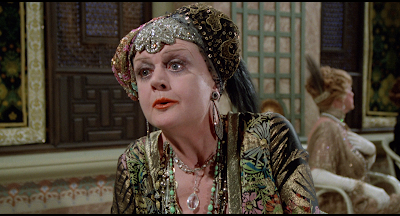
Shelf or charity shop? A much-loved film of mine so one for the shelf.  The pace sometimes seems to match the leisurely cruise - in ORIENT EXPRESS, Sidney Lumet's suspects appeared to have no connection to the victim, here Guillermin has to have each of his confront Linnet with their grievance and then, when questioned by Poirot, he shoots possible scenes of each one killing her; it does get a bit repetitive.  But any time spent watching Angela Lansbury's gloriously drunk novellist, the delicious sparring of Bette Davis and Maggie Smith, and Mia Farrow's quite remarkable performance of the playfully obsessive Jacqueline, is marvellous. Added to this, Anthony Powell's Oscar-winning costumes, Nino Rota's sweeping score and Jack Cardiff's lush cinematography makes it a joy to experience.  Guillermin's best sustained sequence is the build-up to the attempt on Linnet's life in the Karnak's Hypostyle Hall as the suspects slowly drift from sunlight into the shadows, seemingly circling Linnet and Simon, in echoing silence...


DVD/150: MATA HARI (George Fitzmaurice, 1931)

Not CAMILLE, not ANNA KARENINA, not NINOTCHKA... nope, MATA HARI was the most financially succesful of Greta Garbo's films.  Maybe it's success was due to Mata Hari's execution taking place only 14 years before so she was still in the public's memory. 


Despite a running time of only 89 minutes, George Fitzmaurice's film feels heavy-handed.  Garbo is as watchable as ever but her trademark rueful half-smile and raised eyebow are over-used.


The love scenes never feel believable with Swedish Garbo playing Dutch Mata Hari and Mexican Ramon Navarro as her devoted Russian air pilot, while Lionel Barrymore chews the opulent scenery.
 
 
This was the second attempt at filming her story followed by later star vehicles for Jeanne Moreau and Sylvia Kristel, none of which seemed bothered with the true story of the hapless Margarethe Zella.
 
 
Whenever Lewis Stone's treacherous German spymaster appears, the film shows it's potential.

 
Shelf or charity shop? A tentative keeper for Garbo - remarkable to think she was only 26 when she filmed MATA HARI as she seems to act so effortlessly - and the outlandish costumes by MGM costume supremo Adrian. A skull-cap to match each frock, heavily-beaded backless costumes, huge sable collar coats. velvet emboidered outfits with matching boots, skimpy Javanese dancing costumes... I wonder if any survive?
 

Monday, August 31, 2020

DVD/150: MOVIE STAR: THE SECRET LIVES OF JEAN SEBERG (Garry McKee / Kelly Rundle, 2020)

Garry McKee and film-makers Kelly and Tammy Rundle started MOVIE STAR in 2007, based around McKee's 1991 interview with Seberg's sister Mary Ann. Their 2014 film has now been revised for a DVD release, a definite labour of love.

It easily eclipses the biopic SEBERG which made up it's own lies to show how Jean was ruined by lies.

 
It shows how Jean, aged 17, was chosen by Otto Preminger to star in ST JOAN, and how that instant celebrity backfired when her two Preminger-directed films failed.

 
But after starring in Godard's A BOUT DE SOUFFLE, Jean became sought after in European and American films.


But in 1970, the FBI started a covert smear operation against her after she financially supported the Black Panthers.  A planted Newsweek story questioning the parentage of her expected baby led to Jean miscarrying.  In 1979, Jean was found dead aged only 40.


Shelf or charity shop? A definite keeper - well I am in the end credits for helping support it.  McKee and the Rundles' tenacity in getting MOVIE STAR made and distributed is to be applauded as the result is visually appealing and stimulating in it's recounting the rollercoaster short life of one of my favourite actresses.  Owing to Jean's instant fame in 1957, the film-makers can tell Jean's story through a wide range of film clips, tv interviews, photographs, and newspaper & magazine cuttings.  They also have the good fortune to have McKee's interviews with Mary Ann Seberg (interviewed only 12 years after Jean's death, Mary Ann's emotions are all too understandable), Marshaltown contemporaries and others including BONJOUR TRISTESSE co-star Mylene Demongeot, Jean's first husband Francois Moreuil and a remarkably frank contribution from former Black Panther leader Elaine Brown.  The constant presence of Jean's Iowa background seems odd at first but it slowly evolves into another fascinating story of how small-town Marshaltown became ambivalent towards her, her European lifestyle and her lifelong activism for disadvantaged people while Jean, in local press interviews when returning to see her family, always talked up her career prospects, even in the late 1970s when her films became more obscure.  If you wish to support the last fundraising appeal to complete the DVD release, please click here - MOVIE STAR deserves to be seen.