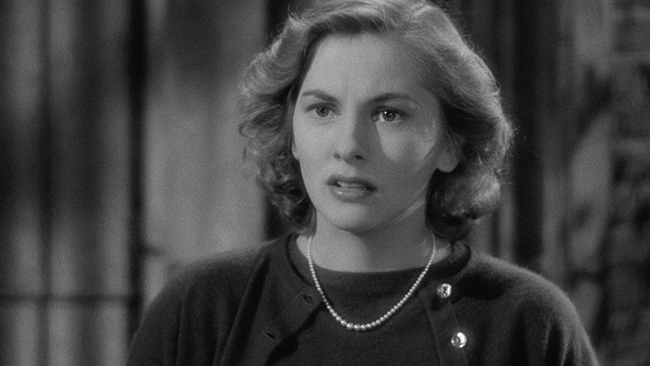
Jean Seberg's films are so rarely available that it is a pleasure to finally see one that she was the main star in, Mervyn LeRoy's 1966 thriller MOMENT TO MOMENT.
Yes it's a vehicle that would have fitted any 1960s actress but Seberg brings warmth and intelligence to it and is well partnered by Honor Blackman, fresh from GOLDFINGER.
Kay lives on the Riviera with her psychiatrist husband and son, and is friends with divorcee Daphne. During one of husband Neil's absences, she befriends Mark, an American ensign.
She tries to keep Mark at arm's length but one night they make love, but when Kay tells him they must never meet again, his violence results in him being accidentally shot.
Kay and Beryl dump his body but when Neil returns home, the police ask him to interview a sailor recovering from a shooting but now amnesiac...
Hollywood hokum but watchable...
Shelf or charity shop? An oddly unthrilling thriller but it's a keeper for radiant Jean, looking wonderful in Yves Saint-Laurent.
Tuesday, December 18, 2018
Monday, December 17, 2018
50 Favourite Musicals: 32: ME AND MY GIRL (1937) (Noel Gay, Douglas Furber & L. Arthur Rose)
The 50 shows that have stood out down the years and,
as we get up among the paint cards, the shows that have become the cast
recording of my life:
First performed: 1937, Victoria Palace, London
First seen by me: 1985, Adelphi Theatre, London
Productions seen: one
Score: Noel Gay, Douglas Furber & L. Arthur Rose
Book: Furber, Rose (Stephen Fry/Mike Ockrent: 1984 revision)
Score: Noel Gay, Douglas Furber & L. Arthur Rose
Book: Furber, Rose (Stephen Fry/Mike Ockrent: 1984 revision)
Plot: The 1930s: Cockney barrow-boy Bill Snibson is discovered to be the sole heir of the title of Earl Hareford. A clash of class cultures ensues with Bill being expected to become a proper gentleman before he acquires the title, but can he say goodbye to his roots and his sweetheart Sally?
Five memorable numbers: ME AND MY GIRL, THE SUN HAS GOT HIS HAT ON, THE LAMBETH WALK, THINKING OF NO ONE BUT ME, TAKE IT ON THE CHIN
I must admit I was tempted to go down to Chichester this year to see their revival of Noel Gay's classic British musical ME AND MY GIRL but I stayed my booking hand as I wanted to hang on to the memory of the late Mike Ockrent's glorious production which made a home at the Adelphi Theatre for an amazing eight year run, improbably making nearly 50 year-old chestnuts like "Leaning On A Lampost", "The Sun Has Got His Hat On" and "The Lambeth Walk" popular again. This gender-reversal of MY FAIR LADY was given a zinger-overhaul by Stephen Fry and was blessed with a terrific cast who brought new life to some fairly hackneyed stereotypes; anyone who has seen 1930s British films will recognize them all: cheeky cockney, sensible girlfriend, posh man-eater, old codger, formidable dowager, upper-class twit, etc. What Ockrent did was keep the show moving with peppy choreography by Gillian Gregory, who gave "The Lambeth Walk" a new shine and sent the actors out with it into the auditorium to close the first act, and to cast it with performers who knew how to connect the material to the audience. Robert Lindsay found Bill a role perfect for his abrasive persona and went on to win both the Olivier Award (then called the SWET Award) and Tony Award when he transferred to Broadway with it. ME AND MY GIRL gave me my first exposure to Emma Thompson - then known as an alternative comedian - and was lucky to meet her several times through a friend who was a huge fan of the show. She had a delightful quality on stage - a great chemistry with Lindsay - she was funny of course but with a touching vulnerability when singing her big number "Once You Lose Your Heart"; she has recently been disparaging about having to be so relentlessly upbeat onstage for the length of her run which I think is rather churlish. I must also mention the delicious Susannah Fellows who played the role of the vampish Lady Jacqueline with a brittle high-comedy elegance and a crystal-like singing voice. Maybe if a West End revival happens I might go - I think the time is right for some true escapism - but when you have seen the best..
Here are that original cast on the 1984 Royal Variety Performance negotiating the dull stage set while giving a curtailed version of "The Lambeth Walk". Still, great to have as a memory...
Sunday, December 16, 2018
DVD/150: REBECCA (Alfred Hitchcock, 1940)
Hitchcock ended his British career with the misjudged JAMAICA INN based on a novel by Daphne du Maurier and his Hollywood career began with another, REBECCA, and it remains one of his greatest - his only film to win the Best Picture Oscar.
Despite producer David O. Selznick's interference, Hitchcock's film is a triumph of sustained mystery.
A timid orphan, a paid companion to an overbearing American, is befriended in Monte Carlo by the suave widower Maxim de Winter who proposes to her; although he is occasionally remote, she accepts.
At his mansion Manderley, she finds everywhere the oppressive presence of Maxim's first wife Rebecca who drowned a year before. Her nemesis is the disdainful, obsessed housekeeper Mrs Danvers who keeps Rebecca's bedroom as a shrine to her beloved mistress.
Vivien Leigh lobbied for the lead role but was considered too forceful a presence, leaving Joan Fontaine to triumph in it.
Shelf or charity shop? An absolute keeper, for Hitchcock's masterly storytelling as well as Franz Waxman's swooning score, and the performances of Fontaine, Laurence Olivier, the wonderful Judith Anderson as Mrs Danvers, sexy George Sanders as Rebecca's cousin and lover, and delightful support from Gladys Cooper, Nigel Bruce and Florence Bates.
Despite producer David O. Selznick's interference, Hitchcock's film is a triumph of sustained mystery.
A timid orphan, a paid companion to an overbearing American, is befriended in Monte Carlo by the suave widower Maxim de Winter who proposes to her; although he is occasionally remote, she accepts.
At his mansion Manderley, she finds everywhere the oppressive presence of Maxim's first wife Rebecca who drowned a year before. Her nemesis is the disdainful, obsessed housekeeper Mrs Danvers who keeps Rebecca's bedroom as a shrine to her beloved mistress.
Vivien Leigh lobbied for the lead role but was considered too forceful a presence, leaving Joan Fontaine to triumph in it.
Shelf or charity shop? An absolute keeper, for Hitchcock's masterly storytelling as well as Franz Waxman's swooning score, and the performances of Fontaine, Laurence Olivier, the wonderful Judith Anderson as Mrs Danvers, sexy George Sanders as Rebecca's cousin and lover, and delightful support from Gladys Cooper, Nigel Bruce and Florence Bates.
Saturday, December 15, 2018
Redux: CAROLINE OR CHANGE at Playhouse / THE NUTCRACKER at Covent Garden
Now we are at the end of 2018 it was interesting to be able to look back at productions previously seen which are now revived: the Tony Kushner and Jeanine Tesori musical CAROLINE, OR CHANGE which transferred from Chichester to Hampstead earlier this year and is now shouting out at the Playhouse Theatre and also the Royal Ballet's evergreen - or ever-snowy - THE NUTCRACKER with choreography by Peter Wright.
It was good to see CAROLINE, OR CHANGE again and I found it again to be a musical that resists the urge to make it easy for it's audience, with five characters all locked in their own private mental spaces and who find connecting to be fraught with suspicion and defensiveness which makes for a difficult first act as it's hard to see where the audience's sympathies should lie. However the second act reveals cracks in the characters' carapaces giving them the possibility of connecting: mother to daughter, stepmother to stepson.
Sharon D. Clarke is still playing the Louisiana single mother Caroline Thibodeaux who supports her daughter and two sons by being the 'daily' for the Jewish Gellman family. Caroline spends most of her time in the basement service room with the washing machine, the dryer and the radio - unsurprisingly the creators have these appliances personified and they sing songs that illustrate and comment on Caroline's situation.
Caroline is a defensive, guarded woman, quietly angry at the world and finds it hard to accept affection from any quarter, while her eldest daughter Emmie is quietly angry with society's attitudes and her mother's inability to accept change, Stuart Gellman is a widower still grieving for his dead wife although his has since remarried, his new wife Rose is growing more and more unhappy with her distant husband and his guarded son Noah who is himself still grieving for his dead mother and who constantly tries to engage with Caroline who is amiable but keeps him at arm's length. In the aftermath of the Kennedy assassination, the characters all have to face up to change and all the implications of their actions.
Practically all the original cast have transferred to the Playhouse and the performances have grown with their exploration of the deeply woven characters: Lauren Ward and Alastair Brokenshaw as Rose and Stuart Gellman, Teddy Kempner as Rose's firebrand father from New York and Naana Agyei-Ampadu as Caroline's more outgoing fellow domestic Dotty. There is also stand-out support from Me'sha Bryan as the bubbly Washing Machine and Angela Caesar as the ever-watchful Moon.
Abiona Omonua is marvellous as Emmie who yearns to break free from her mother's demands to be submissive and to stay in her place; she has a lovely singing voice and has a vital presence on stage. However the show is dominated by the mighty Sharon D. Clarke as Caroline, her solitary pain burns off the stage and you are on the edge of your seat waiting for her eventual explosion and indeed when she breaks and sings the searing "Lot's Wife" Clarke releases a tsunami of pent-up anger and pain that hits hard. With this role, Sharon D. Clarke ascends to being a true theatre great, and her recent tv appearances in the new DOCTOR WHO will surely bring her a much-deserved wider fame.
Nigel Lilly's music direction brings Tesori's challenging score to vibrant life, Fly Davis' set and costumes look fine in their new home, Ann Yee's choreography is still thrilling and Michael Longhurst's direction holds the whole production together, quite the more remarkable for this being his first musical. CAROLINE, OR CHANGE is booking until 6th April and I recommend it highly.
In a different world totally to Caroline and her basement is Peter Wright's glorious version of Tchaikovsky's THE NUTCRACKER at Covent Garden. This was our third time seeing it but it is so magical it is always worth a re-visit. I don't think I can improve on what I blogged in 2015 after my first visit to it: "The production is simply enchanting, radiating warmth and goodwill like a
particularly large glass of mulled wine. Helped immeasurably by the
late Julia Trevelyan Oman's designs, Wright's take on the story has the
magician Drosselmeyer mourning that his nephew has been transformed by
an enemy into a nutcracker, as you do! His chance to undo the spell
comes with a Christmas invitation to a family where he gives the
nutcracker to the young daughter Clara."
Clara and the newly-restored nephew have adventures before visiting the court of the Sugar Plum Fairy and her Prince and also experience the the divertissements organized by Drosselmeyer, and all danced to Tchaikovsky's magical score which features some of ballet's greatest hits.
We were spoilt in 2015 as we saw Francesca Hayward as Clara, Alexander Campbell as The Nutcracker, Gary Avis as Drosselmeyer, Iana Salenko as The Sugar Plum Fairy and Steven McRae as her Prince, a truly memorable cast which has not been replicated since, this year we had Emma Maguire as a vivacious Clara, Luca Acri as an athletic Nutcracker, Christopher Saunders as Drosselmeyer, Yasmine Naghdi as Sugar Plum and Ryoichi Hirano as the Prince. They were all fine but lacking the star wattage of the 2015 cast, however we were lucky to have the wonderful Itziar Mendizabel as the focal point of the Arabian dance, sinuous and statuesque.
Christopher Carr staged it wonderfully again and the ROH Orchestra made Tchaikovsky's score flood the auditorium to the rafters under the baton of Barry Wordsworth. If you have never experienced this production you really are missing a magical experience: all performances appear to be sold out for the rest of the run but it does get revived occasionally on cinema screens and the DVD of the production is also available.
Clara and the newly-restored nephew have adventures before visiting the court of the Sugar Plum Fairy and her Prince and also experience the the divertissements organized by Drosselmeyer, and all danced to Tchaikovsky's magical score which features some of ballet's greatest hits.
We were spoilt in 2015 as we saw Francesca Hayward as Clara, Alexander Campbell as The Nutcracker, Gary Avis as Drosselmeyer, Iana Salenko as The Sugar Plum Fairy and Steven McRae as her Prince, a truly memorable cast which has not been replicated since, this year we had Emma Maguire as a vivacious Clara, Luca Acri as an athletic Nutcracker, Christopher Saunders as Drosselmeyer, Yasmine Naghdi as Sugar Plum and Ryoichi Hirano as the Prince. They were all fine but lacking the star wattage of the 2015 cast, however we were lucky to have the wonderful Itziar Mendizabel as the focal point of the Arabian dance, sinuous and statuesque.
Christopher Carr staged it wonderfully again and the ROH Orchestra made Tchaikovsky's score flood the auditorium to the rafters under the baton of Barry Wordsworth. If you have never experienced this production you really are missing a magical experience: all performances appear to be sold out for the rest of the run but it does get revived occasionally on cinema screens and the DVD of the production is also available.
Wednesday, December 12, 2018
DVD/150: KIKA (Pedro Almodóvar, 1993)
It feels like Verónica Forqué's Kika was supposed to be the focus but Almodóvar changed his mind to focus on a satirical take on reality television.
Kika is a Madrid make-up artist who loves photographer Ramón although she occasionally sleeps with his father, American writer Nicholas, who has a strained relationship with Ramón who suspects him of being involved in his mother's suicide.
Nicolas provides storylines to an exploitative reality show presented by Ramón's former lover, Andrea Scarface, When an escaped prisoner rapes Kika, footage of it is shown on Andrea's show but as Kika's life crumbles, Andrea realizes that Nicholas is not all he seems...
Forqué and Rossy de Palma shine but are swamped by the lacklustre performances of Victoria Abril as Scarface and miscast (and dubbed) Peter Coyote as Nicholas.
Shelf or charity shop? Will stay on the shelf as it's part of an Almodóvar box-set but not viewed much.. Gaultier's frocks are as outrageous as one might expect!
Tuesday, December 04, 2018
Theatre of War: WAR HORSE at the Lyttelton Theatre; THE UNKNOWN SOLDIER Mixed Programme at Covent Garden
As was expected, the theatre also marked the Centenary of the end of Word War I in November and I saw two of the productions that marked the event.
First off was the more obvious one, the National Theatre's game-changing production of WAR HORSE which had been on manoeuvres around the country before reaching the Lyttelton Theatre stable for an extended stay until the start of January.
As Mr and Mrs World know by now, WAR HORSE is based on the novel by Michael Morpurgo about Albert Narracott who, although under-age, joins up to find his beloved horse Joey who has been sold to the army and is somewhere on the Western Front; while there boy and horse both experience the carnage of war at first hand. I was lucky to see both the original 2007 production and the 2008 revival, both at the Olivier Theatre and both were very moving, involving productions - just ask Stephen Sondheim who was a blubbing wreck in 2007 on the night we went!
It then moved to the New London Theatre where it had an amazing run from 2009 to 2016. Joey has since become a mainstay of many Remembrance celebrations, a genuine iconic presence. I had such vivid memories of the show that it was a surprise that it was nearly ten years since I had seen it last so another visit was definitely on the cards.
The good news is that Marianne Elliott and Tom Morris' production - here re-directed by Katie Henry - still delivers the emotional crescendo which had the Lyttelton audience sobbing and sniffing and there are certain images that are indelible once you have seen them, however... it is a given that no one really goes to see WAR HORSE for the cast's performances - Nick Dear's adaptation is more weighted towards Joey, his equine rival Topthorn and the Narracott's family goose - but even by these standards the anonymity of the performances was quite astonishing.
Thomas Dennis as Albert hardly registered and, as his irascible father Ted, Gwilym Lloyd huffed and puffed to very little effect. There is also a very odd performance from Ben Ingles as the supposedly-sympathetic officer Lt. Nicholls who promises to care for Joey - it was nothing I could really pinpoint but I wouldn't trust him with a My Little Pony toy, let alone our plucky Joey. Even the usual laugh-generator role of the f-ing Sgt Thunder went for nothing in Jason Furnival's hands.
However I would like to praise Peter Becker as the caring German officer Friedrich Muller who helps Joey and Topthorn when they are captured on the wrong side of No Man's Land, he at least convinced that Muller was a three-dimensional character. Jo Castelton as Rose Narracott also found some depth as Albert's careworn but worried mother and the John Tams' songs were well sung by Bob Fox.
The best performances were unsurprisingly by the Handspring life-size puppets of Joey, both foal and horse, Topthorn and - yes - the goose. The puppeteers invested them all with character and emotions which made it very easy to forget the actors and concentrate on them. In particular, the scenes where Joey and Topthorn were commandeered by the German army as pack-horses were full of unspoken pathos, none more so than Joey's gentle nuzzling of Topthorn as he dies, exhausted and broken. The excellent touch of Topthorn's demise being made real by having his puppeteers slowly emerge from the puppet and slowly walking offstage is incredibly effective.
I did feel something was lost in the transfer to the proscenium stage but Rae Smith's spare design, Basil Jones and Adrian Kohler's remarkable puppet design and Paule Constable's lighting still delivered, as did Adrian Sutton's score. I am glad I experienced WAR HORSE again, but just wish that most of the human cast had invested their roles with the passion that the puppeteers did.
A few days later we saw a more intriguing response to the Centenary, the Royal Ballet's premiere of THE UNKNOWN SOLDIER, which was part of a mixed programme with Wayne McGregor's INFRA and the late George Balanchine's SYMPHONY IN C.
The ballet took as it's inspiration the recorded memories of WWI veteran Wally Patch and a contemporary of his, Florence Billington, who in voice-over remember the quiet and lonely devastation they felt at the deaths of friends and a boyfriend respectively. These spoken memories are interwoven with the lush, sombre score by film composer Dario Marianelli to create an absorbing soundscape to Alastair Marriott's choreography which illustrates the story of Florence and her beau Ted Feltham; from their meeting at a social dance before the war to his enlisting and subsequent death on the battlefield, cradled by Patch as he dies, to Florence receiving the news by telegram to Ted viewing it all from another place.
The ballet was visually stunning with a fractured, broken video playing on the scrim of contemporary footage of the call to arms in 1914 to the solemn procession of the coffin of the Unknown Soldier in 1920, which eventually raised to reveal Es Devlin's minimalist design of rotating flat panels which were played upon by Bruno Poet's stark lighting to create sweeping changes of tone across the stage while the reminiscences of Patch and Billington were heard.
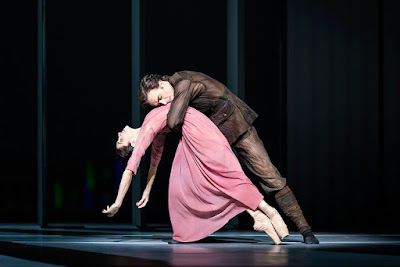
There were good performances from William Bracewell as Ted and Anna Rose O'Sullivan as Florence but in the cold light of day the ballet failed to move; Marriott's choreography was nice to watch but detracted from the pathos of the spoken testimony of individual loss. There was no profundity in the thoughts behind the movements but more importantly the very real disconnect between the spoken remembrances of the Western Front's living Hell and the precision and athleticism of the male dancers was too strong to ignore. The piece ultimately felt like there was no real artistic need for being there, it was a commission to fill a brief in the programming. I also read somewhere the jibe that he can't be THE UNKNOWN SOLDIER if we know his name was Ted Feltham!
The three ballets in the mixed programme seemed to have been selected to counter-point each other, there was no linear connection between them other than to show off the versatility of the Royal ballet company. McGregor's INFRA from 2008 had twelve dancers hyper-extending in solos and groups to McGregor's signature taxing choreography while above them Julien Opie's illuminated silhouettes walked in solipsistic silence left and right. It's an obvious leap to get what McGregor is illustrating - the tortured souls underneath those anonymous walkers - but after a while you long for a resolution. But always good to hear Max Richter's music...
But then the mood was turned on it's head again with George Balanchine's glorious SYMPHONY IN C, danced to the music of Georges Bizet. Premiered in 1947 in Paris but extensively re-thought for New York City Ballet the following year, Balanchine drew on his extensive knowledge of the Russian classical tradition from his teenage years with the Imperial Ballet and from his years with the Ballet Russes in the 1920s.
Broken down into four movements with new performers for each, SYMPHONY IN C is a whirlwind extravaganza of pure classical technique: it's like every classical ballet finale with the narrative and named characters removed so you can just concentrate on solos, pas de deux and ensemble routines. With over 50 dancers onstage as it reaches it's conclusion, it felt so impossibly sumptuous and showy that I almost expected a camera crane to swoop in and a director to yell "cut", such is it's feel of a Hollywood musical idea of a big ballet number.
The four couples were excellently danced by Natalia Osipova, Sarah Lamb, Reece Clarke, Marcelino Sambé, William Bracewell, Anna Rose O'Sullivan, Yuhue Choe and Luca Acri. It was by far the most memorable piece of the evening and rather put the others in their place.
I would definitely see SYMPHONY IN C again, I am happy to have seen THE UNKNOWN SOLDIER and INFRA but think I would pass on seeing them again. However as I said earlier, the mixed programme was a wonderful showcase for the talents of the whole Royal Ballet company.
First off was the more obvious one, the National Theatre's game-changing production of WAR HORSE which had been on manoeuvres around the country before reaching the Lyttelton Theatre stable for an extended stay until the start of January.
As Mr and Mrs World know by now, WAR HORSE is based on the novel by Michael Morpurgo about Albert Narracott who, although under-age, joins up to find his beloved horse Joey who has been sold to the army and is somewhere on the Western Front; while there boy and horse both experience the carnage of war at first hand. I was lucky to see both the original 2007 production and the 2008 revival, both at the Olivier Theatre and both were very moving, involving productions - just ask Stephen Sondheim who was a blubbing wreck in 2007 on the night we went!
It then moved to the New London Theatre where it had an amazing run from 2009 to 2016. Joey has since become a mainstay of many Remembrance celebrations, a genuine iconic presence. I had such vivid memories of the show that it was a surprise that it was nearly ten years since I had seen it last so another visit was definitely on the cards.
The good news is that Marianne Elliott and Tom Morris' production - here re-directed by Katie Henry - still delivers the emotional crescendo which had the Lyttelton audience sobbing and sniffing and there are certain images that are indelible once you have seen them, however... it is a given that no one really goes to see WAR HORSE for the cast's performances - Nick Dear's adaptation is more weighted towards Joey, his equine rival Topthorn and the Narracott's family goose - but even by these standards the anonymity of the performances was quite astonishing.
Thomas Dennis as Albert hardly registered and, as his irascible father Ted, Gwilym Lloyd huffed and puffed to very little effect. There is also a very odd performance from Ben Ingles as the supposedly-sympathetic officer Lt. Nicholls who promises to care for Joey - it was nothing I could really pinpoint but I wouldn't trust him with a My Little Pony toy, let alone our plucky Joey. Even the usual laugh-generator role of the f-ing Sgt Thunder went for nothing in Jason Furnival's hands.
However I would like to praise Peter Becker as the caring German officer Friedrich Muller who helps Joey and Topthorn when they are captured on the wrong side of No Man's Land, he at least convinced that Muller was a three-dimensional character. Jo Castelton as Rose Narracott also found some depth as Albert's careworn but worried mother and the John Tams' songs were well sung by Bob Fox.
The best performances were unsurprisingly by the Handspring life-size puppets of Joey, both foal and horse, Topthorn and - yes - the goose. The puppeteers invested them all with character and emotions which made it very easy to forget the actors and concentrate on them. In particular, the scenes where Joey and Topthorn were commandeered by the German army as pack-horses were full of unspoken pathos, none more so than Joey's gentle nuzzling of Topthorn as he dies, exhausted and broken. The excellent touch of Topthorn's demise being made real by having his puppeteers slowly emerge from the puppet and slowly walking offstage is incredibly effective.
I did feel something was lost in the transfer to the proscenium stage but Rae Smith's spare design, Basil Jones and Adrian Kohler's remarkable puppet design and Paule Constable's lighting still delivered, as did Adrian Sutton's score. I am glad I experienced WAR HORSE again, but just wish that most of the human cast had invested their roles with the passion that the puppeteers did.
A few days later we saw a more intriguing response to the Centenary, the Royal Ballet's premiere of THE UNKNOWN SOLDIER, which was part of a mixed programme with Wayne McGregor's INFRA and the late George Balanchine's SYMPHONY IN C.
The ballet took as it's inspiration the recorded memories of WWI veteran Wally Patch and a contemporary of his, Florence Billington, who in voice-over remember the quiet and lonely devastation they felt at the deaths of friends and a boyfriend respectively. These spoken memories are interwoven with the lush, sombre score by film composer Dario Marianelli to create an absorbing soundscape to Alastair Marriott's choreography which illustrates the story of Florence and her beau Ted Feltham; from their meeting at a social dance before the war to his enlisting and subsequent death on the battlefield, cradled by Patch as he dies, to Florence receiving the news by telegram to Ted viewing it all from another place.
The ballet was visually stunning with a fractured, broken video playing on the scrim of contemporary footage of the call to arms in 1914 to the solemn procession of the coffin of the Unknown Soldier in 1920, which eventually raised to reveal Es Devlin's minimalist design of rotating flat panels which were played upon by Bruno Poet's stark lighting to create sweeping changes of tone across the stage while the reminiscences of Patch and Billington were heard.
There were good performances from William Bracewell as Ted and Anna Rose O'Sullivan as Florence but in the cold light of day the ballet failed to move; Marriott's choreography was nice to watch but detracted from the pathos of the spoken testimony of individual loss. There was no profundity in the thoughts behind the movements but more importantly the very real disconnect between the spoken remembrances of the Western Front's living Hell and the precision and athleticism of the male dancers was too strong to ignore. The piece ultimately felt like there was no real artistic need for being there, it was a commission to fill a brief in the programming. I also read somewhere the jibe that he can't be THE UNKNOWN SOLDIER if we know his name was Ted Feltham!
The three ballets in the mixed programme seemed to have been selected to counter-point each other, there was no linear connection between them other than to show off the versatility of the Royal ballet company. McGregor's INFRA from 2008 had twelve dancers hyper-extending in solos and groups to McGregor's signature taxing choreography while above them Julien Opie's illuminated silhouettes walked in solipsistic silence left and right. It's an obvious leap to get what McGregor is illustrating - the tortured souls underneath those anonymous walkers - but after a while you long for a resolution. But always good to hear Max Richter's music...
But then the mood was turned on it's head again with George Balanchine's glorious SYMPHONY IN C, danced to the music of Georges Bizet. Premiered in 1947 in Paris but extensively re-thought for New York City Ballet the following year, Balanchine drew on his extensive knowledge of the Russian classical tradition from his teenage years with the Imperial Ballet and from his years with the Ballet Russes in the 1920s.
Broken down into four movements with new performers for each, SYMPHONY IN C is a whirlwind extravaganza of pure classical technique: it's like every classical ballet finale with the narrative and named characters removed so you can just concentrate on solos, pas de deux and ensemble routines. With over 50 dancers onstage as it reaches it's conclusion, it felt so impossibly sumptuous and showy that I almost expected a camera crane to swoop in and a director to yell "cut", such is it's feel of a Hollywood musical idea of a big ballet number.
The four couples were excellently danced by Natalia Osipova, Sarah Lamb, Reece Clarke, Marcelino Sambé, William Bracewell, Anna Rose O'Sullivan, Yuhue Choe and Luca Acri. It was by far the most memorable piece of the evening and rather put the others in their place.
I would definitely see SYMPHONY IN C again, I am happy to have seen THE UNKNOWN SOLDIER and INFRA but think I would pass on seeing them again. However as I said earlier, the mixed programme was a wonderful showcase for the talents of the whole Royal Ballet company.
Friday, November 23, 2018
HADESTOWN at Olivier, National Theatre - Fire Down Below....
Every so often the ominous words "prior to it's Broadway opening" appear on a National Theatre production which always strikes me as slightly irksome: should the National Theatre stages and resources be used for a production's out-of-town tryout when there is a whole canon of drama that it is the National's remit to stage as no one else will?
The latest to get this treatment is a new musical written by Anáis Mitchell, a folk singer who is hitherto unknown to me, The really bizarre thing is that the show has already played Off-Broadway in 2016 so it is being road-tested here before transferring to Broadway (allegedly). It is a very convoluted journey and I am not sure what the National is getting out of the deal - although it does fill the Olivier repertoire which has frequently been a béte noire for Rufus Norris. However, with no preconceptions on what I was about to see, I was very impressed with a lot of what I saw and heard.
Mitchell released the original concept album in 2010, retelling the myth of Orpheus and Eurydice as a pair of young lovers in the Great Depression played out in a hybrid of blues, New Orleans jazz, country and rhythm 'n' blues. She met director Rachel Chavkin in 2012 and after several years of working on it, the stage show debuted in 2016 in New York, it was again staged Off-Broadway last year where it was nominated for and won several fringe awards. And now it's here...
Hermes, our narrator, introduces us to Orpheus, a down-and-out singer with his guitar slung over his back. One day he meets the homeless Eurydice, they fall instantly in love and attempt to set up home together but things go awry as Eurydice struggles to find work while Orpheus spends all his time writing songs. In the meantime, summer arrives with the appearance of the exuberant goddess Persephone who is visiting for her allotted six months on earth bringing warm weather, joy and prosperity. When her time is up she sadly returns back to her husband Hades in his underworld factory, but this time she is followed by Eurydice in search of a better life. Orpheus is broken-hearted at her departure and follows her down to the underworld to bring her back, which no mortal has ever done before.
The lovers are reunited but Hades refuses to let Eurydice leave, however Persephone intercedes on the couple's behalf and Hades allows Orpheus to sing for him. Moved by the song, Hades dances with Persephone and let's the couple leave the underworld but with conditions attached: Orpheus must lead the way with Eurydice following but if he turns to look at her, she will vanish into the underworld forever...
I had deliberately not read any of the reviews as I wanted to experience the show with no preconceived ideas and I am glad I did, as I said there was a lot to enjoy. Anáis Mitchell's score is an intriguingly dense affair, at no time can you guess where the show is going to go musically. Her combination of country blues, New Orleans jazz, Southern rhythm 'n' blues and pop is a heady mix, the only thing it is missing is a memorable song. They sound great in the auditorium but by the time I had got home I couldn't remember one of them. It would also have been possibly better to have a separate lyricist, her's are the weakest part of the score.
Rachel Chavkin's production is big and bold with all energy focused on the performers however as the show reached it's double climax - first with Hades and Orpheus and then with Orpheus and Eurydice's flight from the underworld - the tension slackened and no real crescendo was reached, it all felt played at the same pace; indeed when the show ended, it felt to have been a long time coming.
In case anyone was wondering, there is life after the Broadway debacle SPIDERMAN: TURN OFF THE DARK as two of it's leads Reeve Carney and Patrick Page have turned up here: Carney is an impassioned though not terribly charismatic Orpheus and Patrick Page is a marvellous Hades, with a deep bass voice echoing out like coming from the underworld itself.
As Eurydice, Eva Noblezada - the star of the recent revival of MISS SAIGON - has a powerful voice and a nice stage presence, while Amber Gray was a wild and rollicking Persephone - as indeed she should be as she has played the role since 2016 in all the previous productions. With her crazy hair and bright green dress she was huge fun.
Musicals veteran André De Shields was an elegant, sinister, slippery Hermes and there was fine support from the three sassy, mean Fates: Carly Mercedes Dyer, Rosie Fletcher and Gloria Onitiri, and a special mention too for the excellent, hardworking ensemble.
David Neumann's choreography is inventive and striking, Rachel Hauck's large wooden set design is impressive but ultimately one wishes for something more striking for the underworld, and Bradley King's lighting is atmospheric and suits the ominous tone of the work. The seven onstage musicians are excellent and fully deserved the large ovation at the curtain.
Owen and I agreed that it might be good to see the show again before it finishes it's run in January to see how they have settled into the Olivier and hopefully ironed out some of the longueurs of the second act.
It certainly deserves to be seen...
The latest to get this treatment is a new musical written by Anáis Mitchell, a folk singer who is hitherto unknown to me, The really bizarre thing is that the show has already played Off-Broadway in 2016 so it is being road-tested here before transferring to Broadway (allegedly). It is a very convoluted journey and I am not sure what the National is getting out of the deal - although it does fill the Olivier repertoire which has frequently been a béte noire for Rufus Norris. However, with no preconceptions on what I was about to see, I was very impressed with a lot of what I saw and heard.
Mitchell released the original concept album in 2010, retelling the myth of Orpheus and Eurydice as a pair of young lovers in the Great Depression played out in a hybrid of blues, New Orleans jazz, country and rhythm 'n' blues. She met director Rachel Chavkin in 2012 and after several years of working on it, the stage show debuted in 2016 in New York, it was again staged Off-Broadway last year where it was nominated for and won several fringe awards. And now it's here...
Hermes, our narrator, introduces us to Orpheus, a down-and-out singer with his guitar slung over his back. One day he meets the homeless Eurydice, they fall instantly in love and attempt to set up home together but things go awry as Eurydice struggles to find work while Orpheus spends all his time writing songs. In the meantime, summer arrives with the appearance of the exuberant goddess Persephone who is visiting for her allotted six months on earth bringing warm weather, joy and prosperity. When her time is up she sadly returns back to her husband Hades in his underworld factory, but this time she is followed by Eurydice in search of a better life. Orpheus is broken-hearted at her departure and follows her down to the underworld to bring her back, which no mortal has ever done before.
The lovers are reunited but Hades refuses to let Eurydice leave, however Persephone intercedes on the couple's behalf and Hades allows Orpheus to sing for him. Moved by the song, Hades dances with Persephone and let's the couple leave the underworld but with conditions attached: Orpheus must lead the way with Eurydice following but if he turns to look at her, she will vanish into the underworld forever...
I had deliberately not read any of the reviews as I wanted to experience the show with no preconceived ideas and I am glad I did, as I said there was a lot to enjoy. Anáis Mitchell's score is an intriguingly dense affair, at no time can you guess where the show is going to go musically. Her combination of country blues, New Orleans jazz, Southern rhythm 'n' blues and pop is a heady mix, the only thing it is missing is a memorable song. They sound great in the auditorium but by the time I had got home I couldn't remember one of them. It would also have been possibly better to have a separate lyricist, her's are the weakest part of the score.
Rachel Chavkin's production is big and bold with all energy focused on the performers however as the show reached it's double climax - first with Hades and Orpheus and then with Orpheus and Eurydice's flight from the underworld - the tension slackened and no real crescendo was reached, it all felt played at the same pace; indeed when the show ended, it felt to have been a long time coming.
In case anyone was wondering, there is life after the Broadway debacle SPIDERMAN: TURN OFF THE DARK as two of it's leads Reeve Carney and Patrick Page have turned up here: Carney is an impassioned though not terribly charismatic Orpheus and Patrick Page is a marvellous Hades, with a deep bass voice echoing out like coming from the underworld itself.
As Eurydice, Eva Noblezada - the star of the recent revival of MISS SAIGON - has a powerful voice and a nice stage presence, while Amber Gray was a wild and rollicking Persephone - as indeed she should be as she has played the role since 2016 in all the previous productions. With her crazy hair and bright green dress she was huge fun.
Musicals veteran André De Shields was an elegant, sinister, slippery Hermes and there was fine support from the three sassy, mean Fates: Carly Mercedes Dyer, Rosie Fletcher and Gloria Onitiri, and a special mention too for the excellent, hardworking ensemble.
David Neumann's choreography is inventive and striking, Rachel Hauck's large wooden set design is impressive but ultimately one wishes for something more striking for the underworld, and Bradley King's lighting is atmospheric and suits the ominous tone of the work. The seven onstage musicians are excellent and fully deserved the large ovation at the curtain.
Owen and I agreed that it might be good to see the show again before it finishes it's run in January to see how they have settled into the Olivier and hopefully ironed out some of the longueurs of the second act.
It certainly deserves to be seen...
Sunday, November 18, 2018
50 Favourite Musicals: 33: SWEET CHARITY (1966) (Cy Coleman, Dorothy Fields)
The 50 shows that have stood out down the years and,
as we get up among the paint cards, the shows that have become the cast
recording of my life:
First performed: 1966, Palace Theatre, NY
First seen by me: 2009, Menier Chocolate Factory, London
Productions seen: one
Score: Cy Coleman, Dorothy Fields
Book: Neil Simon
Score: Cy Coleman, Dorothy Fields
Book: Neil Simon
Plot: Charity Hope Valentine is an unlucky-in-love but ever-optimistic taxi dancer in a run-down Manhattan dance hall. One day she gets trapped in a stalled lift with a shy but panicky tax advisor called Oscar. Slowly a romance blossoms... is this Charity's moment?
Five memorable numbers: BIG SPENDER, RHYTHM OF LIFE, THERE'S GOTTA BE SOMETHING BETTER THAN THIS, I LOVE TO CRY AT WEDDINGS, IF MY FRIENDS COULD SEE ME NOW
There are plenty of videos of SWEET CHARITY but I thought I'd stick with the trailer for the Menier production - it's a nice reminder of the winning performances of Tamzin Outhwaite, Marc Umbers and Josefina Gabrielle, as well as the excellent pairing of Ebony Molina and Paul J Medford who made THE RICH MAN'S FRUG such a thrilling experience.
Monday, November 12, 2018
THE HEIGHT OF THE STORM at Wyndhams Theatre - Squall in the family...
When it was announced that Jonathan Pryce and Eileen Atkins were to appear onstage in a new play by French writer Florian Zeller, adapted by Christopher Hampton and directed by Jonathan Kent, I knew it was going to be something to see. Then I saw the prices... nothing in the stalls for under £74 - and it only lasts 80 minutes! Luckily Owen nabbed some Upper Circle tix though of course they were restricted view with the edge of the stage obscured. And the play? Well...
This is the first play I have seen by Florian Zeller but I know of his work - all translated by Christopher Hampton in the UK. While I appreciate what he is trying to do with the form, bending narrative structures and giving you characters who might not be the most trustworthy of narrators, however THE HEIGHT OF THE STORM feels annoyingly slight, like a writer cruising on his tricks, thinking "Oh I can do the same to this situation" rather than it feeling in anyway new and revelatory; just narrative guessing games for the sake of it.
Andre and Madeleine have been married for over 50 years and have two daughters. Andre is beginning to show signs of confusion and although both daughters have arrived at the family home at the same time, he is vague as to why. Marianne wanders in and out speaking to the family as she busies herself with dinner but the emphasis is on Andre who listens but doesn't really take in what his daughters are saying about a house that they have seen which might suit him better. They even bring home a woman who vaguely knows Andre and Marianne - much to the latter's consternation as she has always thought she had been in an affair with Andre once - to talk about the house. An appearance from the younger daughter's latest boyfriend who is a estate agent only makes the situation clearer to all but Andre.
It very soon becomes apparent (through the play and knowledge of Zeller's past work) that one of the couple has died - but which one? I will not be the spoilsport and reveal who but it's all quite obvious really. So in actual fact, I left thinking that the play could have been shorter, there seemed to be a lot of re-stating what was fairly obvious before, so much so that at times I felt like saying "Yes we get it, that person is dead!!"
Yes the play reverberates once the curtain has come down, but I think that has more to do with Jonathan Kent's taut direction - despite the several 'interludes' to show time passing - and of course his remarkable lead performers. That said, credit is due to the fine supporting performances from Amanda Drew and Anna Madeley as the concerned daughters but Lucy Cohu is, as per, a trifle over-ripe as the mysterious friend of the family.
Needless to say there was enough coughing for the duration of the play to make it seem like Scutari Hospital on a wet Wednesday, but as a tribute to Jonathan Pryce and Eileen Atkins you could hear a pin drop in their scenes together, especially the final scene when all the threads come together. To be honest, it is this final scene that has stayed with me as it was so beautifully pitched and played.
Jonathan Pryce was remarkable and heartbreaking as Andre, a man slowly losing himself in his own mind, given to panicked confusion as he gets stuck in painful repetitions of a sentence, not able to comprehend recent events despite the clues in front of him. Onstage for most of it's running time, Pryce radiated an intense charisma. Eileen Atkins was frustratingly under-used, drifting in and out of the action to drop some withering lines but as I said, the last scene was breathtaking as she took flight with a warm delicacy as Madeleine reminded Andre that she once said she would never leave him.
I'm glad I got the see these two favorite performers again on stage, it was just a shame the play was so maddeningly slight.
This is the first play I have seen by Florian Zeller but I know of his work - all translated by Christopher Hampton in the UK. While I appreciate what he is trying to do with the form, bending narrative structures and giving you characters who might not be the most trustworthy of narrators, however THE HEIGHT OF THE STORM feels annoyingly slight, like a writer cruising on his tricks, thinking "Oh I can do the same to this situation" rather than it feeling in anyway new and revelatory; just narrative guessing games for the sake of it.
Andre and Madeleine have been married for over 50 years and have two daughters. Andre is beginning to show signs of confusion and although both daughters have arrived at the family home at the same time, he is vague as to why. Marianne wanders in and out speaking to the family as she busies herself with dinner but the emphasis is on Andre who listens but doesn't really take in what his daughters are saying about a house that they have seen which might suit him better. They even bring home a woman who vaguely knows Andre and Marianne - much to the latter's consternation as she has always thought she had been in an affair with Andre once - to talk about the house. An appearance from the younger daughter's latest boyfriend who is a estate agent only makes the situation clearer to all but Andre.
It very soon becomes apparent (through the play and knowledge of Zeller's past work) that one of the couple has died - but which one? I will not be the spoilsport and reveal who but it's all quite obvious really. So in actual fact, I left thinking that the play could have been shorter, there seemed to be a lot of re-stating what was fairly obvious before, so much so that at times I felt like saying "Yes we get it, that person is dead!!"
Yes the play reverberates once the curtain has come down, but I think that has more to do with Jonathan Kent's taut direction - despite the several 'interludes' to show time passing - and of course his remarkable lead performers. That said, credit is due to the fine supporting performances from Amanda Drew and Anna Madeley as the concerned daughters but Lucy Cohu is, as per, a trifle over-ripe as the mysterious friend of the family.
Needless to say there was enough coughing for the duration of the play to make it seem like Scutari Hospital on a wet Wednesday, but as a tribute to Jonathan Pryce and Eileen Atkins you could hear a pin drop in their scenes together, especially the final scene when all the threads come together. To be honest, it is this final scene that has stayed with me as it was so beautifully pitched and played.
Jonathan Pryce was remarkable and heartbreaking as Andre, a man slowly losing himself in his own mind, given to panicked confusion as he gets stuck in painful repetitions of a sentence, not able to comprehend recent events despite the clues in front of him. Onstage for most of it's running time, Pryce radiated an intense charisma. Eileen Atkins was frustratingly under-used, drifting in and out of the action to drop some withering lines but as I said, the last scene was breathtaking as she took flight with a warm delicacy as Madeleine reminded Andre that she once said she would never leave him.
I'm glad I got the see these two favorite performers again on stage, it was just a shame the play was so maddeningly slight.
Subscribe to:
Posts (Atom)