The irritating proliferation of films-turned-into-stage-musicals in recent years had several forerunners. In 1987 Richard Eyre, five years after his magnificent production of GUYS AND DOLLS at the National Theatre, gave musicals another go - only this time in the West End - with his own stage adaptation of the 1956 film HIGH SOCIETY at the Victoria Palace.
It proved a disappointing affair despite the luminous Natasha Richardson as Tracy, she wore a Sue Blane-designed yellow dress in the second act that has stayed long in the memory.
Another adaptation, this time by US playwright Arthur Kopit, opened and closed on Broadway in 1998 and this version appeared in 2005 at the Open Air Regents Park which then unsuccessfully transferred to the Shaftesbury.
And now the Kopit version is revived at the Old Vic, rather puzzlingly ending Kevin Spacey's tenure as Artistic Director. In his first season, Spacey revived the musical's source play THE PHILADELPHIA STORY so he obviously has some affection for the piece but not enough to appear in the musical version.
It is on for a rather ambitious four month run but from the look of the Dress Circle on the night we went it will be interesting to see if it stays the course. As I watched the show something niggled away at me, a thought that had come to me when blogging about another show - but what show? What niggle? Luckily for you, Constant Reader, I remembered.
Last December we saw the stage adaptation of WHITE CHRISTMAS - oddly enough another film-to-stage version of a Bing Crosby musical. I have always thought HIGH SOCIETY a fairly innocuous film musical but one that seems to be held in high regard. Along with WHITE CHRISTMAS, what the film succeeds in is being a star vehicle with the performers all playing up to their persona's: Crosby is witty and wise, Frank Sinatra is cynical and wisecracking, Celeste Holm is a friendly sidekick, Louis Armstrong is all grins and eye-popping and Grace Kelly... well, she's just Grace Kelly.
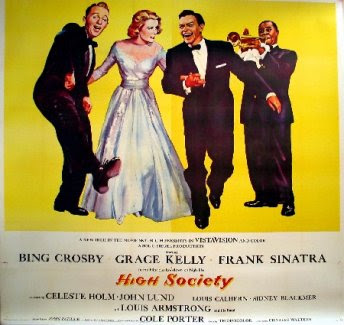
And here is the troubling thing when films like these are transplanted to the stage... where are the Star performers needed to make them work - genuine stars with comparable persona's to make you forget the originals who we all know? You can cast perfectly fine actors but if they do not have that pure star wattage how will they ever eclipse the originals and if they cannot do that, what is the point in staging it in the first place?
Both the Eyre and the current version go the fine actor route: Eyre cast Trevor Eve, Richardson, Stephen Rea and Angela Richards as the four leads while here director Maria Friedman has picked the lesser-wattage of Rupert Young, Kate Fleetwood, Jamie Parker and Annabel Scholey.
But both productions have seemed to be in denial, they want to stage HIGH SOCIETY but too often what they really want to do is THE PHILADELPHIA STORY with songs which are too different things completely.
Of the ten songs in Cole Porter's film score, Richard Eyre used eight adding five other Porter compositions while Friedman uses only seven from the film with a whacking twelve others interpolated. It all smacks of not being sure of their source doesn't it? As Eyre did with Richardson, Maria Friedman has directed Kate Fleetwood to play it as Katharine Hepburn but Fleetwood's strangled attempt at a Bryn Mawr accent at times made her sound retarded which was a shame because when she sang she had a very strong voice.
Friedman directed the last revival of MERRILY WE ROLL ALONG in 2012 which had critics raving but I found to be horribly over-pitched and she has done the same thing here - what should be champagne fizz is more like Iron Bru. By and large loud and over-stated, it all smacks of Friedman's own over-emphatic singing style where consonants are hit like a cow's arse with a banjo.
Fleetwood playing effervescent comes across as a loud woman waving her arms over her head and there is horrible over-playing from Richard Grieve as Tracy's soon-to-be husband and Ellie Bamber as the know-it-all younger sister. The impossibly tall Rupert Young is personable in the Crosby role but little more and the best performances come from Barbara Flynn as Mrs Lord and the double act of Jamie Parker and Annabel Scholey as the gossip magazine journalists gate-crashing the wedding. But again Parker who is usually so reliable, had moments when he over-pitched the performance not only to the back of the theatre but to Waterloo Station up the road.

In lieu of Louis Armstrong Friedman has jazz pianist Joe Stilgoe appear occasionally and like his father Richard, a little of him goes a long way. Friedman's over-emphasis stretches to the dance numbers too, they seem so set on being showstopping that they go on and on and on, losing the shape of the actual song and one claps more out of relief that they have stopped than anything else. The very long second act opener at least showcased the excellent tapping of dancer Omari Douglas.
There is no reason I can think of for this production to be staged in the round unless it was to cram more people in to their hoped-for money-spinner but Peter Mumford's lighting helps set some atmosphere.
Can we now please put this show to bed as non-workable and stick to the original film?


