Showing posts with label Playhouse. Show all posts

Saturday, June 15, 2019

50 Favourite Musicals: 21: THE HARDER THEY COME (2006) (Jimmy Cliff / various)

The 50 shows that have stood out down the years and, as we get up among the paint cards, the shows that have become the cast recording of my life:

First performed: 2006, Stratford East, London
First seen by me: 2008, Barbican, London
Productions seen: one

Score: Jimmy Cliff / Frederick Hibbert / various
Book: Perry Henzell
Plot:  Country boy Ivan arrives in Kingston, Jamaica to seek his fortune but finds life hard.  He lands a recording contact with a crooked record producer but the producer short-changes him.  He starts smuggling cannabis with a friend which alerts the police to him.  Ivan is soon Kingston's Most Wanted Man but when the record publisher puts out Ivan's records to cash in, he becomes a Robin Hood figure to the public... but the police are closing in...

Five memorable numbers: THE HARDER THEY COME, YOU CAN GET IT IF YOU REALLY WANT, SWEET AND DANDY, PRESSURE DROP, 007 (SHANTY TOWN)

It is interesting how this list is repeatedly throwing up the problem of whether it is the material or the production that makes it stay on my list of favourite musicals; here it is probably the former as Kerry Michael's wonderful production brought me back several times.  The production was first staged at the Theatre Royal, Stratford East by Artistic Director Michael and was so successful it transferred to the cavernous Barbican Theatre and then to the more intimate Playhouse Theatre where sadly it could not find an audience - apart from us!  However the show proved successful on a UK tour and made it to NY and Canada too.  The original film's director Perry Henzell had written the first version of the stage musical but sadly died in 2006, the year it was first staged.  The show is told in flashback: Pedro is hosting the Nine Night wake for the sorrowing friends of Ivan and their collective thoughts take them back to the day when he arrived fresh and naive from the country on the mean streets of Kingston.  The production was played on an empty stage, the onstage band upstage surrounded by the tables and chairs that made up the scenery, the walls of the stage painted in faded red, gold and green, for all intents like a drab church hall - they even projected a scratchy print of Franco Nero in DJANGO on the back hall during the interval.  The joy of the show was the wonderful cast - Rolan Bell was wonderfully charismatic as Ivan and the show gave marvellous opportunities to three black actors who have mostly worked in UK black theatre, film and tv since the 1980s - Marcus Powell was deliciously slippery as Hilton the corrupt record producer, Victor Romero Evans was splenetic as the preacher who makes Ivan's life misery when he first arrives in Kingston (although we also saw him play the laid-back Pedro at the Barbican) and Chris Tummings was fantastically scary as Roy Pierre, Kingston's chief of police and also was responsible for one of the night's highlights, singing a storming version of Toots and The Maytal's PRESSURE DROP.  It was a show that, again, highlighted the wealth of UK black performers and also delivered a wonderful immersive, inclusive night every time.

As usual there is not much video available on the stage version of THE HARDER THEY COME but luckily for me the legendary Jimmy Cliff came along one night to see the show based on his film and he joined the hard-working cast onstage for a reprise of the title song!  Go deh!

Friday, April 19, 2019

FIDDLER ON THE ROOF at the Playhouse - Fathers and Daughters...

I couldn't get terribly worked up over seeing Trevor Nunn's revival of FIDDLER ON THE ROOF when it originated at the Menier Chocolate Factory as, while I admire the stagecraft that went into it's creation, it's not really one of my favourite musicals.  But it's glowing reviews, it's transfer to the Playhouse Theatre - and the fact that I had seen every other show in the West End that interested me - meant that my birthday theatre event found me journeying back to the Russian shtetl of Anatevka in the early 1900s.


In it's transfer to the Playhouse, director Trevor Nunn has reconfigured the stalls to echo his Menier staging so a raised meandering path runs through the stalls to bring you into the middle of the small Jewish town, it's a bit cumbersome in finding your seat but very effective and for once, I felt engaged with the show.  Of course being a Trevor Nunn production, it's very lengthy which for me only highlighted the repetitions in Joseph Stein's book, but as I said, I was engaged.

I have only seen the show once before onstage - a jaw-dropping 14 years ago in New York in a Chekhovian production directed by David Leveaux starring Harvey Fierstein and Rosie O'Donnell - and, of course, the Norman Jewison film version starring Topol. As I said, it's not a particular favourite of mine, mostly because I find the plot device of a Jewish village milkman finding the traditions he lives by erode through his three daughters marrying against his wishes too repetitive.  I will agree that this is done by degrees: the first falls in love with a nebbish Jewish tailor, the second to a Bolshevik, the third to a gentile - but, particularly in this production, the three daughters are played exactly the same, sound exactly the same - typical west end soprano - and are so resolutely two-dimensional, that it's like you are seeing one actress on a revolve.  The three boyfriends are all given different shadings but the daughters get no personalities at all.


I also am not the biggest fan of Jerry Bock and Sheldon Harnick's score which has it's standards - "Tradition", "If I Were A Rich Man", "Sunrise Sunset", "Do You Love Me" - but otherwise I find it fairly anonymous and repetitive. But as I said, I found Nunn's production to be involving with very good musical direction from Paul Bogaev which serves the score well, apart from the endless "Tevye's Nightmare" which proves that time is not always a continuum.

Nunn has chosen Andy Nyman for his Tevye and he is excellent, making him a very human-sized character, unlike the usual Star turn from actors taking their lead from the originator of the role, the larger-than-life Zero Mostel.  Without the character being figuratively spot-lit downstage while the other actors huddle upstage, it makes for more integrated story-telling with the town of Anatevka coming fully to life.


Like the daughters, the role of Tevye's wife Golde is a fairly thankless one; for ever careworn and kvetching at her husband's foolish dreams, but Broadway actress Judy Kuhn suggested more depth to the character than is on the page.  In particular the duet "Do You Love Me?" where Tevye finally plucks up the courage to ask Golde whether their 25-year marriage is based on love or just circumstance is a touching, almost embarrassed moment between Nyman and Kuhn rather than being played for comedy.

The other stand-out in the cast is Louise Gold as Yente, the gossipy matchmaker of the village; another two-dimensional female character but imbued by the ever-reliable Gold with a vibrant personality who again had colour and depth that was not suggested by the script.  I also liked Stewart Clarke as Perchik the stern Bolshevik student who is smitten by the middle daughter Hodel.


Of course the spirit of Jerome Robbins, the show's original director/choreographer, is ever-present in the big dance routines for "To Life" and "The Wedding / Bottle Dance"; for a man who has been dead 21 years, it's not bad that he gets named three times on the poster.  Matt Cole is responsible for the rest of the enjoyable choreography.

Robert Jones' set design brings the crowded Anatevka to vibrant life both onstage and off, while Tim Lutkin's subtle, shifting lighting gives the town the warmth of summer and the dark of winter.  None more so than in the final scenes when the mood turns sombre with the forced eviction of the Jews from the town.  Despite my problems with the show, it is impossible not to be moved by the final scene where lifelong friends and families say their goodbyes knowing they will probably never see each other again as they scatter over Europe and America.


As the snow falls on Tevye's shattered community slowly trudging out of their hometown, clutching their few possessions on a long journey to who knows what fate, Nunn shows his production is sadly very relevant to today's world of displaced people and the search for home in a world of prejudice and fear.

I am not always a fan of Trevor Nunn's work but here he gives us a memorable production of FIDDLER ON THE ROOF, maybe one to see again...


Saturday, December 15, 2018

Redux: CAROLINE OR CHANGE at Playhouse / THE NUTCRACKER at Covent Garden

Now we are at the end of 2018 it was interesting to be able to look back at productions previously seen which are now revived: the Tony Kushner and Jeanine Tesori musical CAROLINE, OR CHANGE which transferred from Chichester to Hampstead earlier this year and is now shouting out at the Playhouse Theatre and also the Royal Ballet's evergreen - or ever-snowy - THE NUTCRACKER with choreography by Peter Wright.


It was good to see CAROLINE, OR CHANGE again and I found it again to be a musical that resists the urge to make it easy for it's audience, with five characters all locked in their own private mental spaces and who find connecting to be fraught with suspicion and defensiveness which makes for a difficult first act as it's hard to see where the audience's sympathies should lie.  However the second act reveals cracks in the characters' carapaces giving them the possibility of  connecting: mother to daughter, stepmother to stepson.

Sharon D. Clarke is still playing the Louisiana single mother Caroline Thibodeaux who supports her daughter and two sons by being the 'daily' for the Jewish Gellman family.  Caroline spends most of her time in the basement service room with the washing machine, the dryer and the radio - unsurprisingly the creators have these appliances personified and they sing songs that illustrate and comment on Caroline's situation.


Caroline is a defensive, guarded woman, quietly angry at the world and finds it hard to accept affection from any quarter, while her eldest daughter Emmie is quietly angry with society's attitudes and her mother's inability to accept change, Stuart Gellman is a widower still grieving for his dead wife although his has since remarried, his new wife Rose is growing more and more unhappy with her distant husband and his guarded son Noah who is himself still grieving for his dead mother and who constantly tries to engage with Caroline who is amiable but keeps him at arm's length. In the aftermath of the Kennedy assassination, the characters all have to face up to change and all the implications of their actions.

Practically all the original cast have transferred to the Playhouse and the performances have grown with their exploration of the deeply woven characters: Lauren Ward and Alastair Brokenshaw as Rose and Stuart Gellman, Teddy Kempner as Rose's firebrand father from New York and Naana Agyei-Ampadu as Caroline's more outgoing fellow domestic Dotty. There is also stand-out support from Me'sha Bryan as the bubbly Washing Machine and Angela Caesar as the ever-watchful Moon.


Abiona Omonua is marvellous as Emmie who yearns to break free from her mother's demands to be submissive and to stay in her place; she has a lovely singing voice and has a vital presence on stage.  However the show is dominated by the mighty Sharon D. Clarke as Caroline, her solitary pain burns off the stage and you are on the edge of your seat waiting for her eventual explosion and indeed when she breaks and sings the searing "Lot's Wife" Clarke releases a tsunami of pent-up anger and pain that hits hard.  With this role, Sharon D. Clarke ascends to being a true theatre great, and her recent tv appearances in the new DOCTOR WHO will surely bring her a much-deserved wider fame.

Nigel Lilly's music direction brings Tesori's challenging score to vibrant life, Fly Davis' set and costumes look fine in their new home, Ann Yee's choreography is still thrilling and Michael Longhurst's direction holds the whole production together, quite the more remarkable for this being his first musical.  CAROLINE, OR CHANGE is booking until 6th April and I recommend it highly.


In a different world totally to Caroline and her basement is Peter Wright's glorious version of Tchaikovsky's THE NUTCRACKER at Covent Garden.  This was our third time seeing it but it is so magical it is always worth a re-visit. I don't think I can improve on what I blogged in 2015 after my first visit to it:  "The production is simply enchanting, radiating warmth and goodwill like a particularly large glass of mulled wine.  Helped immeasurably by the late Julia Trevelyan Oman's designs, Wright's take on the story has the magician Drosselmeyer mourning that his nephew has been transformed by an enemy into a nutcracker, as you do!  His chance to undo the spell comes with a Christmas invitation to a family where he gives the nutcracker to the young daughter Clara."

Clara and the newly-restored nephew have adventures before visiting the court of the Sugar Plum Fairy and her Prince and also experience the the divertissements organized by Drosselmeyer, and all danced to Tchaikovsky's magical score which features some of ballet's greatest hits.


We were spoilt in 2015 as we saw Francesca Hayward as Clara, Alexander Campbell as The Nutcracker, Gary Avis as Drosselmeyer, Iana Salenko as The Sugar Plum Fairy and Steven McRae as her Prince, a truly memorable cast which has not been replicated since, this year we had Emma Maguire as a vivacious Clara, Luca Acri as an athletic Nutcracker, Christopher Saunders as Drosselmeyer, Yasmine Naghdi as Sugar Plum and Ryoichi Hirano as the Prince.  They were all fine but lacking the star wattage of the 2015 cast, however we were lucky to have the wonderful Itziar Mendizabel as the focal point of the Arabian dance, sinuous and statuesque.

Christopher Carr staged it wonderfully again and the ROH Orchestra made Tchaikovsky's score flood the auditorium to the rafters under the baton of Barry Wordsworth.  If you have never experienced this production you really are missing a magical experience: all performances appear to be sold out for the rest of the run but it does get revived occasionally on cinema screens and the DVD of the production is also available.


Friday, August 03, 2018

50 Favourite Musicals: 41: LA CAGE AUX FOLLES (1983) (Jerry Herman)

The 50 shows that have stood out down the years and, as we get up among the paint cards, the shows that have become the cast recording of my life:


First performed: 1983, Palace Theatre, NY
First seen by me: 1986, London Palladium
Productions seen: four

Score: Jerry Herman
Book: Harvey Fierstein

Plot:  Georges and Albin, a middle-aged, long-term gay couple who run a Riviera drag club, find their public and private worlds clash when Georges' son falls in love with the daughter of a homophobic politician who wants to close the area's gay clubs.

Five memorable numbers: I AM WHAT I AM, SONG ON THE SAND, WE ARE WHAT WE ARE, THE BEST OF TIMES, LOOK OVER THERE

The 1984 Tony Awards for musicals were seen as a clash between tradition and modernity as the two most obvious nominees were Jerry Herman's musical comedy LA CAGE AUX FOLLES and Stephen Sondheim's more austere SUNDAY IN THE PARK WITH GEORGE.  SUNDAY was to lose out - apart from the Design and Lighting awards - to the LA CAGE juggernaut.  When Herman scurried onstage to receive the Best Score award he crowed that it put paid to the rumour that "the simple, hummable show tune was no longer welcome on Broadway" - a not-so-subtle dig at Sondheim.  That certainly coloured my opinion of the show when I saw it's UK premiere at the London Palladium although I certainly enjoyed the delightful starring performances of George Hearn (recreating his Best Actor Tony-winning role as the flamboyant Albin) and Denis Quilley, as well as the fantastic drag chorus 'Les Cagelles' which spotlit performers like Scott St. Martyn as Chantal and Andy Norman as Hanna.   That production famously closed early citing it's failure on the public worry of AIDS; I never bought that reason as the show ran on Broadway for four years - I still suspect that the Palladium was just the wrong house for it.  It was only when I saw Terry Johnson's more intimate - alright, smaller - revival at the Menier then also when it transferred to the Playhouse - that the show's charm really showed.  It's sheer relentless optimistic tone can eventually be wearing - the second act really doesn't know where to go - but with the right performers, Fierstein's book can still make you laugh and Herman's self-referencing score can still charm.  I last saw the show when the Menier production transferred to Broadway and Harvey Fierstein played Albin.  Despite LA CAGE's longevity - the only Broadway musical to win Tonys for Best Musical and then Best Musical Revival for each of it's two subsequent incarnations - Jerry Herman has never written another original musical.  And where do I stand on the LA CAGE versus SUNDAY face-off?  Watch this space...

There is fair amount of video on LA CAGE but here is Denis Quilley from 1986 on the stage of the London Palladium introducing 'Les Cagelles' for the great opening number "We Are What We Are" - I first saw the show on a pro's matinee with West End Legend Nicola Blackman and I still remember the sheer excitement of watching this for the first time...

Sunday, January 18, 2015

Screen To Stage: WOMEN ON THE VERGE OF A NERVOUS BREAKDOWN


I was in two minds whether I wanted to see WOMEN ON THE VERGE OF A NERVOUS BREAKDOWN at the Playhouse.  I knew that, despite it's unsuccessful Broadway production, David Yazbek's score had it's admirers but there was one major problem with seeing it - I loved it's source material too much.


Pedro Almodóvar's 1988 hit film was the one that truly brought him to the world's attention although I had already fallen under his spell with his previous film LAW OF DESIRE (LA LEY DEL DESEO).  It confirmed to me how magnetic and talented his muse Carmen Maura was and marvelled at her emotionally true but luminous performance as Pepa which was the epicentre of the farcical action of the film with it's array of madcap characters.

So how did I end up seeing the musical?  Because after last Saturday's performance there was the particular thrill of Pedro himself being interviewed on the Playhouse stage joined by the show's director Bartlett Sher, star Tamsin Greig and Almodóvar veteran Rossy de Palma - like, wow!


So... how does it transfer?  I cannot say I am a big fan of Greig - I always feel she is standing outside of her character, 'commenting' on it rather than playing it - or Haydn Gwynne who played the dangerously sidelined wife Lucia, but by the end I was won over by the élan of Bartlett Sher's staging and the obvious respect for Pedro's work.

Actress Pepa is dumped by her lover Ivan which throws her into emotional turmoil and her attempts to contact him are frustratingly unsuccessful.  Pepa's despair is disrupted by ditzy model Candela who wants to hide in Pepa's flat as she has discovered her Arab boyfriend is a Shiite terrorist sought by police.  Both their traumas are disrupted by the arrival of Carlos and Marisa, a young man and his controlling girlfriend who are looking to buy Pepa's flat.  In the true spirit of farce, Carlos is revealed to be Ivan's son!  if that wasn't enough, they all have to contend with the arrival of Lucia, Ivan's deserted wife who is out for revenge... Oh did I mention the blender full of drugged gazpacho?


Despite committed performances from the cast and Bartlett Sher's smoothly stylish direction, the action cannot help but stop for the frequent musical numbers.  Yazbek's songs have a vibrant salsa vibe and are socked across by the onstage musicians, but it's difficult to keep the farce moving along like an express train when both female leads are given impressive but slow solo numbers.

Despite my misgivings I have to admit that Greig certainly held the stage as the distraught Pepa but never felt she really was ever out-of-control and Gwynne's Lucia was certainly a larger-than-life scene-stealer.  Anna Skellern was great fun as the hysterical Candela and Ricardo Afonso was very good as the sometime-narrator and Pepa's ever-ready taxi-driver.


I also liked Seline Hizli's bossy Marisa and Willemijn Verkaik's hissable solicitor Paulina, Ivan's new mistress, but Jérome Praden and Hayden Oakley were both a bit too anonymous as father and son Ivan and Carlos.

There was also a lot to like in Anthony Ward's economical set design of Pepa's split level apartment, Caitlin Ward's character-led costumes and Peter Mumford's bright and eye-popping lighting.


The after-show Q&A was a delight with Pedro being very gracious about the show and explaining where the inspiration for the show had come from while Rossy de Palma was great fun reminiscing about the filming of what was only her second film.  Bartlett Sher was insightful as to the show's creation and Tamsin Greig explained that the singing didn't come naturally!

I am already beginning to think that I might want to see it again,,,

Friday, June 24, 2011

Memorable Theatre Performances #10:
Chris Tummings as 'Ray Pierre' in THE HARDER THEY COME (Barbican/Playhouse, 2008)

Friday, November 25, 2005

RICHARD II / AS YOU DESIRE ME

It sounds like the start of an odd love letter but it in fact heralds the fact that I have done two theatre trips with Mr. Guy Thomas in the past week.

Last Thursday was RICHARD II at the Old Vic which finally saw Kevin Spacey delivering a performance worthy of that stage's history. Although not one of the most poetic of Kings - and I think some of the speechs could have done with more introspection and less tart snittiness - he really excelled in the deposition scene where his cry of anguished frustration "I have no name" was all the more powerful for seemingly coming from nowhere. He was ably supported by Ben Mles whose Bolingbroke slide smoothly into power after his exercise in regime change in a strangely Blairite manner. There was excellent support from Julian Glover as John of Gaunt as well as Oliver Cotton and Peter Eyre.


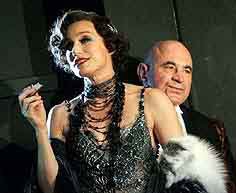
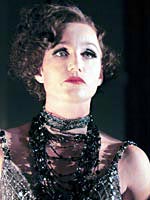
Tonight we saw Pirandello's AS YOU DESIRE ME at the Playhouse Theatre with Kristin Scott Thomas and Bob Hoskins, slickly directed by Jonathan Kent. I had seen the film starring Greta Garbo yonks ago so knew the story - Elma is an amnesiac singer in a Berlin cabaret, one night she is followed by a man who tells her that she is in fact Lucia, the wife of an Italian count who had disappeared from their villa in WWI when she was raped and kidnapped by some German soldiers. Bored by her decadent life as a mistress to a violent writer she goes to Italy where she is greeted by the count, her aunt and uncle. 

Four months later she agrees to meet her sister who had regretfully allowed the missing woman's death certificate to be signed. However what was at the heart of that decision was who gained control of the villa, as it was part of the wife's dowry on her death it reverted to her sister. Is Lucia really Lucia or is she simply being used as a pawn? When her ex-lover Santer arrives at the villa with an insane woman who can only speak the name of the aunt the whole question of identity is blown apart.

Sadly it reads and lives in the mind better than it does on stage - at 90 minutes it still seemed padded and repetitive. However it was worth seeing for the livewire performance of Scott Thomas - almost bursting out of her slinky 30s dresses with frustration of not knowing who she is. Hoskins was strangely muted as Santer but there were memorable performances by Margaret Tyzack and John Carlisle as the woman's older relatives.