Showing posts with label David Hare. Show all posts

Thursday, January 19, 2017

THE RED BARN at the Lyttelton Theatre - dead behind the eyes...

After what has seemed an interminable wait - 19 DAYS! - I have broken my 2017 theatrical duck.  By the way Constant Reader, don't you think 2017 is a very ugly number?  Hopefully that doesn't influence the next 50-odd weeks.  I also hope THE RED BARN does not prove an omen for my theatre-going this year... oops, showed my hand there eh?


David Hare grew up reading the novels of George Simenon and found himself drawn to the writer's stand-alone psychological thrillers more than his Maigret crime novels and now he has adapted the little-known novel "La Main" (The Hand) for the National Theatre stage.  I know what he means.. give me the stand-alone novels of Ruth Rendell of a seemingly normal person going wrong over the neatly-packaged Inspector Wexford books. 

THE RED BARN is the National Theatre debut of director Robert Icke who is the new *hot* director at the Almeida and his production shows all the signs of a director being given all the opportunities the National Theatre can offer - video projections, elaborate scenery possibilities and lighting, special effects...  The trouble is when these are what one remembers of the piece itself...


THE RED BARN is set in a Connecticut town in 1969, the seemingly unflappable community hides a jittery, nervous feeling of unwanted change in the country while on the verge of Richard Nixon's presidency.  Two married couples - Donald and Ingrid Dodd, Ray and Mona Sanders - attend a dinner party which takes an embarrassing turn when Donald stumbles unseen upon Ray having sex with the host's wife.  They all leave the party early due to a flash snowstorm but Ray vanishes when they all have to walk the last mile back to the Dodd's home.

Donald braves the storm again but returns after an hour without Ray and, so Mona will not be alone, Ingrid arranges that they all sleep on mattresses by the fire.  Days later, the snow is cleared and Ray is found dead.  However in the Dodd's nearby barn, the Police also discover a number of cigarette butts which lead to Donald confessing to be his - rather than hunt for Ray during the storm he sheltered in the barn for over an hour smoking.


His motives for this are possibly shown when, while visiting Mona in her Manhattan apartment to offer his professional help, they start a sexual relationship.  However it's not long before Donald starts to slowly become engulfed by his emotions and secrets and when, Mona casually tells him that she is going to marry another man, he suspects that somehow Ingrid is behind it all...

It certainly sounds like a well-told tale; the plot feels very old-fashioned for such a prestige production which might explain the flashy look of Icke's production.  The stars of the show are actually Bunny Christie's set design and Paule Constable's moody, atmospheric lighting - a massive shout-out too for the Lyttelton's tech crew who make the filmic quality of Icke's production work.


But - and it's a very big but - it feels like the one thing Icke is reticent to do is give us a thriller.  Oh no... that's too obvious, too common - no this, is an existential, slow-moving story of the destruction of a dull man's psyche.  The fact that the play features two deaths hardly registers in the frigid air atmosphere.   It all felt like one of those independent films where acting is dialed down to a minimum, the score is usually 'ironic' use of pop songs and the cinematography tends to linger on 'artistic' static set-ups just a little too long. 

The actors do not pull focus under this poe-faced concept (imagine Pinter meets Dennis Lehane): Mark Strong is obvious casting for Donald bearing in mind his last stage role was as the equally obsessed Eddie Carbone in VIEW FROM THE BRIDGE and with his unprepossessing brown wig and nerdy glasses he hardly seems equipped for the passion that allegedly grips him in his desire for his dead friend's wife.  But Strong is playing him on such a low light that his despair rarely registers, apart from an overly dramatic STAGGER SLUMP as he leaves Mona for the last time.


Hope Davis as Donald's emotionally controlled wife Ingrid certainly gives her an icy exterior but again is played in such a colourless way that you cannot care for her.  However she does make some impression, which is more than can be said for Elizabeth Debicki as the recently widowed Mona.  Her banal performance leaves you utterly clueless as to why Donald would throw up his life to be with her - he would surely be equally at home with a showroom mannequin.  I am sure she is supposed to be a blank canvas that Donald projects all his fantasies on but any interior life is totally missing from her phoned-in performance.

As I said the real star of the show is it's design; Bunny Christie has utilized black screens that move up and down, left and right to create a theatrical version of film pans and zooms which makes it enjoyable to watch - although this technique for making a show more filmic is not original - and has also designed the set to change in an instant: from the long and low cabin of the Dodds, to the Sanders' wide open and expansive Manhattan apartment.


Paule Constable's moody and atmospheric lighting is almost too much at times - in the final scene you are squinting at the stage to make out what is going on in the log cabin - but she does deliver, and Tom Gibbons' soundscape comes into it's own at the end, sounding louder and more discordant to signal to you that something shocking is about to happen.... and it does. If it had not been for this you would hardly be aware there was about to be a violent conclusion as Icke's production is played at such a glacial rate.

Something which only struck me later was how insidiously misogynistic it was - Donald is seemingly trapped between the primly efficient Ingrid (who looked astonishingly like Hilary Clinton at times from where I was sitting) and the icy beanpole Mona.  The drama is all his and after the offstage afternoon sex scene between Mona and Donald it is of course Debicki who enters topless... why?  What did that possibly add to the scene bearing in mind Strong was fully clothed.  Added to the violence of the climactic act it really did make me wonder on whether this crossed Hare or Icke's mind at all.


Sunday, September 04, 2016

IVANOV at the Olivier Theatre, National Theatre - Earlier Early Chekhov

After enjoying Jonathan Kent's production of THE SEAGULL I wanted to see how he approached Chekhov's earlier drama IVANOV. especially as he was using the David Hare translation that was the basis of his starry production at the Almeida nearly 20 years ago where Ralph Fiennes was an impassioned anti-hero.


Geoffrey Streatfeild, who had been a very urbane Trigorin in THE SEAGULL, here played the tormented lead character, a hard part to play as nothing makes him happy - and by extension, potentially the audience too.  Since Ralph Fiennes I have also seen Kenneth Branagh play the role, well... half of it.

It was in 2008, in the balcony of the Wyndhams Theatre, during Michael Grandage's production when I started to feel strange... was I going to faint, be sick, both?  More importantly, was I going to do it sitting dead centre in a long row?  I could not have negotiated my way along the narrow leg room in the dark, half way through the first act.  So I sat it out, staring at the chandelier which was on eye-level, daring not to look down at the stage in case I toppled forward with the vertigo I was experiencing.  God it seemed to last forever, all the time enduring Branagh's whiny performance.  The interval came and I left...


Ivanov is on the edge of the financial abyss; his acres of farmland are failing thanks to the progressive methods he championed when younger - a fact that his unctuous land manager never fails to mention - and his creditors are getting louder.  More troubling, he has fallen out of love with his Jewish wife Anna who is also succumbing to consumption.  Ivanov had expected to inherit her family's fortune but her father disinherited her when she not only married a gentile but also changed her name.  The town's thinly-veiled anti-Semitism is beginning to infect Ivanov too.  Anna's strait-laced young doctor Lvov hates Ivanov for his negligence and also delights in telling him.

There is one last chance for financial escape; Sasha, the daughter of his sympathetic friend Pavel Lebedev and his hard-hearted but wealthy wife Zinaida.  Every night Ivanov goes to their house to be belittled and patronized by their boorish friends but also is succeeding in wearing Zinaida down.  Sasha is bored living with her parents and is eager to be married to Ivanov but what of Anna?


Oddly I remember Kent's Almeida production as more light-hearted despite the moments of anguish for Ivanov and Anna but here the sombre tone is more prevalent.  The overall gloom is signalled by Streatfeild's Ivanov, rarely varying the pitch of his performance even when romancing Olivia Vinall's Sasha.  For once I liked Vinall's performance, her usual overly-declamatory style matched the character's nervy desperation to be married to her beloved older man.

Kent certainly showed the division between the two households: the depressive air at Ivanov's house and the boorish clamour of the Lebedev parties - at the former Des McAleer was delightfully awful as the overseer Borkin, James McArdle impressed as Doctor Lvov, whose high-minded self-righteousness takes no prisoners, and Nina Sosanya was a gentle Anna Petrovna, blazing into an anger that consumes her.


The excruciating Lebedev household featured fine performances from Brian Pettifer as the dull gambler Kosykh, Beverley Klein as the ghastly widow Avdotya, Debra Gillet's steel-hearted Zinaida and Emma Amos as the predatory widow Marfusha although I kept looking through her down the years to see the late and very great Diane Bull who played the role at the Almeida, an indelible stage image was Bull picking her nose with boredom then trying to get rid of the evidence on her black dress when spoken to.

There was also fine performances from Peter Egan as Ivanov's emotional uncle Shabyelski who agrees to marry widow Marfusha for her money - echoes of Ivanov and Sasha - but has the good sense to back out at the end, something the ever-vacillating Ivanov cannot do.  Possibly the performance of the evening however was Jonathan Coy as Lebedev, saddled with a penny-pinching wife but unable to get angry at his friend Ivanov; the scene where he offers a dejected Ivanov money to pay some debts was beautifully played: Lebedev's embarrassment at offering it meeting Ivanov's rigid mortification at being offered it.


Tom Pye's set seemed to have more seamless transitions than when we saw THE SEAGULL so were all the more effective as were Emma Ryott's lived-in costumes; Mark Henderson's lighting illuminated the stage wonderfully, visually linking to the characters' inner turmoil.

Rufus Norris is to be applauded for giving the Chichester Theatre's season of early Chekhov plays a wider audience and a home in the Olivier Theatre.


Sunday, August 07, 2016

THE SEAGULL at the Olivier, National Theatre - David Hare meets Chekhov...

Can it really be 19 years since I saw one of my favourite plays?

Yep Constant Reader, it looks like I last saw Chekhov's THE SEAGULL in 1997 at the Donmar in a production by the English Touring Theatre. That is far too long bearing in mind the regularity I see other plays so the news that the acclaimed Young Chekhov season was transferring from Chichester to the National Theatre had me leaping to see it.  Would it be worth the leap however?


It didn't start well when one of my favourite lines - the downbeat Masha is asked why she always wears black and replies "I am in mourning for my life" - does not appear in David Hare's adaptation so I was thrown by that.  However Tom Pye's set design diverted me from my opening shock, a flooded Olivier stage brings the lake where Konstantin and Nina stage their avant-garde play right into the middle of the action although the walls of the country estate's rooms seemed to be causing trouble when we took our seats for the second half - always interesting to see a phalanx of stage techies and the sound of banging and drilling coming from behind a wall!

It's not often I say this but I think the Olivier was the wrong stage for the production - everyone seemed to have do an awful lot of travelling to get into position.  Once it is established that Olivia VinalI's Nina lives on the other side of the lake, her every appearance was made splashing noisily through the water.  She'll have trenchfoot by the end of the run. I think the more traditional Lyttelton would have been better fit. 


Although Hare's version is a bit colourless I still found much to enjoy in Chekhov's tale of wasted lives and lost opportunities for happiness.  I guess I was spoilt by my first exposure to the play: I saw a benefit performance for the Socialist Worker-funded Youth Training Centres in 1982 which starred Vanessa Redgrave and Ian Charleson in various readings and scenes, one of which was the final heartrending confrontation between Konstantin and Nina, both their lives shattered by others.

Vanessa was revisiting Nina - a role she had played onstage at the Queens Theatre in 1964 co-starring Peggy Ashcroft and Peter Finch as well as in Sidney Lumet's 1968 film version - and in 1985 I saw her again revisit THE SEAGULL at the Queens Theatre, only this time playing Arkadina opposite her daughter Natasha Richardson as Nina and Jonathan Pryce as Trigorin.


Jonathan Kent's direction had his usual clarity and unfussy dramatic through-line although I would have liked to have seen some more vivacity in the playing, the performers all seemed to play the ensemble card when there are roles in the play that come alive with some (controlled) barnstorming.  Mark Henderson's lighting is as excellent as ever.

Anna Chancellor was a commanding Madame Arkadina, almost unknowingly wanting to be the centre of attention at all times; her boredom at Konstantin's attempt at play writing all too palpable.  She came into her own with the morning-of-departure scene where Arkadina has to go from solicitation to anger to desperation to comedy: she starts being motherly to Konstantin as she changes the bandage of his 'accidental' head wound but they argue after he accuses her of financial and artistic greed, she then goes on the attack with Trigorin pleading for him to remain her lover when she realizes he wants an affair with Nina, then - secure in his agreement to stay with her - she resorts to type in making sure the servants are aware that the ruble she gave one of them is to be shared among them all.


The always dependable Geoffrey Streatfeild was a fine Trigorin, particularly in the scene where he tries to explain to the adoring Nina how it really feels to be a writer who probably will never be the top rank but whose life is still ruled by the need to write, it's a scene where you can really discern the hand of David Hare.

On the whole I liked the sulky petulance of Joshua James' Konstantin but Olivia Vinall was too over-the-top as Nina which left her nowhere to go at the end when Nina reappears as a broken-spirited regional actress, still mentally-scarred from the death of her child with Trigorin.  Peter Egan was surprisingly effective as Arkadina's  brother Sorin, forever bemoaning his life in the provincial backwaters.


The supporting cast were all okay but as I said earlier, none were particularly memorable which was slightly surprising as characters like Masha, Medvedenko and Doctor Dorn give you ample opportunities to shine.

Would I recommend it?  Yes I would but as I said, it could do with a bit less ensemble-performing and more actors taking advantage of the opportunities that Chekhov has given them.


Wednesday, November 19, 2014

BEHIND THE BEAUTIFUL FOREVERS

On reflection it hasn't been a year for memorable new plays but we saw a preview last week of David Hare's new play BEHIND THE BEAUTIFUL FOREVERS and it is as entertaining as the subject is fascinating.


Hare's play is based on the non-fiction bestseller of the same name by journalist Katherine Boo which she wrote after spending three years in the Indian slum of Annawadi which sprung up next to Mumbai airport.  Her kaleidoscopic view of the community that exists there is an unlikely choice for a play but it's wide-ranging cast of characters more than fill out the Olivier stage and Hare finds unlikely heroes and heroines within it's occupants.

Hare spotlights several occupants of Annawadi who struggle every day to survive the hardships of life within the slum, mainly by back-breaking work shifting through the piles of Mumbai's rubbish for any material that can be sold on especially plastics or metal.  Odd that the west is forever banging the drum for green economies and recycling when in Annawadi it's a way to make money, not to lead a more ethical life!


We follow the lives of several young inhabitants: Sunil Sharma, a bright and resourceful 'picker' who dreams of a better life beyond the billboards - put up in an attempt to hide the slum from the visitors to the airport and hotels - as well as Manju Waghekar, a young girl wrestling with the need to study MRS DALLOWAY at school but wanting to be the first Annawadi college graduate.

We also meet Manju's mother Asha, the hard-hearted woman who is the go-to woman for financial help for the dwellers but who is feared by them too.  Another powerful woman in the slum is Zehrunisa who has grown rich off the recycled goods found by the 'pickers', the most successful of whom is her son Abdul.


Zehrunisa and her Muslim family are particularly despised by their crippled neighbour Fatima.  When they argue fiercely over the shared wall between their shacks, Fatima sets her own house on fire and is badly burned but before she dies, she accuses Zehrunisa's sickly husband, studious daughter and Abdul of having beat her and driven her to do the deed.

Zehrunisa is suddenly faced with the bribe demands of both the corrupt police force and court system and finds the family's much-cherished fortune dwindling to nothing.  With all her resourcefulness even she is no match for the real forces that govern the lives of the slum dwellers.


There were certain longueurs in the play which hopefully will be ironed out when the company have established a rhythm to the scenes, but apart from these and a bit of confusion at the start while sorting out the many characters and their relationships to each other, I enjoyed the play very much.  The inhabitants of Annawadi are hardly Hare's usual characters but that it makes it all the more interesting and you can feel his sense of enjoyment in the tense scenes dealing with the police and courts.

It was only when the company took their bow that it occurred to me how many fine roles there are for actresses in the play.  David Hare has given us many fine female roles down the years and here it is definitely a case where the women have the upper hand.


Soon-to-be NT Artistic Director Rufus Norris shows his mettle by making the world of the slum a palpable environment and elicits fine performances from all his cast.  Very early on, there is a scene of savage violence that seemingly comes out of nowhere, the resultant uneasy atmosphere is well developed by Norris so the audience is never really allowed to relax, he gives us a world where danger and downfall can happen at any moment.

The design team of Katrina Lindsay and Paule Constable combine to suggest the fetid, dusty world of Annawadi very well - there is one coup-de-theatre early on which immediately places you within that world when an avalanche of rubbish is dumped onto the stage - seeing it from the front row of the circle was damn impressive!


The exemplary cast work as a real ensemble and many have a chance to shine in individual roles, none more so than Meera Syal as the slum-Mother Courage Zehrunisa although I suspect Hare has made her a touch more sympathetic in his version of her life.  From her imperious bossiness at the start to her later humble approach to life's vicissitudes, Syal made an indelible impression. 

Equally impressive performances came from Stephanie Street as the hard-hearted Asha, Anjana Vasan as her more caring daughter Manju, Nathalie Armin as the corrupt court official Poornima Paikrao and Thusitha Jayasundera, excelling as both the pathetic Fatima and the poised but icy Judge Chauhan.


There were also fine performances from Hiran Abeysekera as Sunil, always optimistic in the face of despair, Vincent Ebrahim as Zehrunisa's husband Karam and Shane Zaza as their ambitious son Abdul.

I recommend the play highly, it plays until April of next year in repertory and will also be shown live in cinemas in March as part of NT Live.

Tuesday, August 12, 2014

Love and Politics in the 1990s

I was thinking the other day that we seem to be in a very good season for excellent performances onstage at the moment - Michael Xavier, Joanna Riding (Pajama Game), Julian Ovenden, Geoffrey Streatfeild, Lewis Reeves, Matt Bardock, Richard Cant (My Night With Reg), Clive Wood, Eve Best, Phil Daniels (Antony & Cleopatra),  Helen McCrory (Medea), Billie Piper, Aaron Neil, Robert Glenister (Great Britain)... and now you can add two others to that list, Bill Nighy and Carey Mulligan in the revival of David Hare's SKYLIGHT at the Wyndhams Theatre.


I never saw the original production of the play which starred Michael Gambon and Lia Williams which did the usual hop, skip and jump of National Theatre - West End - Broadway.  After it's Broadway run it reopened in London with Bill Nighy in the Gambon role and he is revisiting the role again, 18 years later.

This production also has Carey Mulligan in her West End debut and she was the reason I wanted to see it as her performances in AN EDUCATION, NEVER LET ME GO, DRIVE and SHAME have been exceptional.  Luckily she did not disappoint, with both her and Nighy giving sparky, memorable performances.


Set in that ancient, long-gone time - the early 1990s - the action takes place in a small council flat in West London which Kyra is subletting from a friend.  Kyra is a teacher in a struggling school in East Ham and has a quiet, untroubled private life.

One wintry night, Kyra is surprised to receive a visit from Edward, the 18 year-old son of her ex-lover Tom, a wealthy restaurateur.  She learns that Edward's mother died from cancer a year ago and that father and son are struggling with each other's unspoken grief, sharing a house that is no longer a home.  Edward is also still angry that Kyra walked out of all their lives three years before with no word of explanation.  Edward, bristling with the sulkiness of youth, skulks off but who should appear later also unannounced?  Tom turns up, saying he just happens to have been in the area.  Just by chance he also has an unopened bottle of Whisky.


Prowling the small flat like a lion in a cage, straightening and unstraightening her school books, dragging a chair out with his foot only to push it back again, Tom obviously has come on a mission which slowly is revealed along with what really happened three years before.  Although their story starts six years before that...

That's when Kyra had landed a waitress job in Tom and his wife's Chelsea restaurant soon after arriving in London.  She proved indispensable to the couple and their children, eventually moving in to the family home. Needless to say, Kyra and Tom were soon lovers although she said she would leave if his wife ever found out.  When she did, Kyra left with no goodbyes.  Soon after Tom's wife was diagnosed with cancer and he did all he could to make her life comfortable in their home.  Finally he admits to Kyra that he is there to try and get her back but Kyra is a different person now and refuses to give up her new life, although she cannot help her old feelings surfacing.


What soon emerges in their barbed conversations - and out-and-out arguing - is that Tom, while railing at the political correctness and woolly liberalism that he sees all around him, can no more understand Kyra's wish to travel across London every day to deliberately work in a depressing job than she can for his ever-growing need for money and his selfish world view.

In their night of long knives, we see both sides of their argument - yes, Tom cared for his dying wife turning their home into her holistic paradise but was he doing it out of genuine love or guilt over the affair and yes, Kyra cares passionately for the sink-estate children she teaches but is her hair-shirt approach to life just a reaction against her upper-middle-class upbringing - is she a working class tourist?


Bill Nighy was on excellent form as Tom the misanthrope ex-lover, railing at a changing world while attempting to repeat the past with Kyra.  His comic timing was wonderful, gaining huge laughs at his withering responses to both life and Kyra's attempts at carving out a new career, as well as the physicality of his performance too, you could feel his revulsion having to handle the lump of cheese Kyra was intending to put in her ragu!  But underneath it all was a loneliness, an emptiness and his short-lived happiness at their resumption of intimacy was touching.

Carey Mulligan had a wonderful sense of gravitas as Kyra, firmly believing that she was making a difference to people's lives and ideologically stronger than either of her male visitors.  Her sly sense of humour was delightfully played and she also suggested the quiet gnawing loneliness of a young woman deliberately cutting herself off from love.  I do hope she makes the return to stage often, she is too good an actress to be lost to film.  She also proves she can multi-task by acting and cooking onstage at the same time!  And it was real cooking too... the smell of frying onions was delicious!!!


Matthew Beard was effective as the stroppy Edward - an archetypal teenage boy that his father likens to a character from INVASION OF THE BODY SNATCHERS - who surprises both Kyra and the audience in the final scene.

Stephen Daldrey directs with his customary insight and stages the ebb-and-flow conversations with variety and pace.  Bob Crowley's set design conjured up the drab flat perfectly, it's invisible inner walls seen against a life-like block of council flats with lights going on and off in the windows showing that, while Tom and Kyra are battling each other, life goes on elsewhere.

An excellent revival of a fascinating play, as relevant now as it was in 1995.

Sunday, July 21, 2013

Revivalists: Act two

Now Constant Reader, it might seem like I only see revivals at the National Theatre but I have actually gone to other theatres... like, in the actual West End.  All have featured fine performances but the actual productions themselves all felt wanting of real conviction.


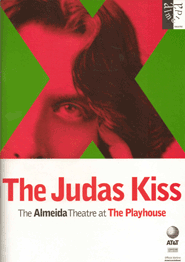
Having missed David Hare's THE JUDAS KISS at Hampstead I caught up with it finally at the Duke of Yorks, primarily to see Rupert Everett's lauded performance.


It is 15 years since I climbed the stairs to the Playhouse's peanut gallery to see the original Richard Eyre production which starred a rather out-of-place Liam Neeson as Oscar Wilde and a play-stealing turn from Tom Hollander as Lord Alfred 'Bosie' Douglas.  The play had vaguely stayed with me but I honestly didn't expect it to be revived anytime soon.  But now we had Australian director Neil Armfield's production and I was surprised how much I liked the play.

David Hare's play covers two key moments in the life of Oscar Wilde.  In April 1885, his libel case against the Marquis of Queensbury has collapsed leaving the way clear for his arrest for Gross Indecency.  His former lover Robbie Ross tips him off that the police are delaying his arrest, almost wanting him to flee to France but Wilde refuses.  Ross thinks he is staying to appease 'Bosie' his spoilt lover but Wilde stays because to flee would be to betray his life.

 
The second act takes place two years later in the run-down villa in Naples where the broken Wilde is now living with an unrepentantly petulant Lord Alfred who is shagging his way through the local Italian rough trade and looking to get away.  Again Ross appears to reprimand Wilde and remind him that his wife has threatened to refuse him any access to their sons if he sees 'Bosie' again but again Wilde refuses him.  He cannot live his life by other's demands, no matter the consequences or the obvious ruin that Bosie has led him to.  


Armfield's direction was minimal which may be fine for actors such as Everett and Cal MacAninch (superb at playing the vein-bursting frustration of Robbie Ross) but Freddie Fox as the awful 'Bosie' was left with nothing to do but stamp his foot and rant which got old very quickly.  Compared to Hollander's slyly manipulative portrayal, he was resolutely two-dimensional.


Something which cannot be levelled at Rupert Everett who gave a performance of total star power.  His Wilde, the agent of his own destruction, was played with real charisma - you simply couldn't watch anyone else when he was onstage.  It was the sudden shifts that surprised, the way his resigned and weary façade broke down at the simple generosity of the staff of the Cadogan Hotel where he was hiding.  He really came into his own in the second half as the broken ex-prisoner, shuffling around in his slippers when not huddled in his chair.  His weary, rueful manner giving way to one of total exhaustion, like a character out of Beckett.  After loving his recently published second book of memoir as well as enjoying his performance as Benedict Cumberbatch's brother in the BBC's PARADE'S END, it was great to see Everett triumph on stage too.

Further up St. Martin's Lane another actor was giving life to another revival.  Simon Russell Beale, taking a break from the National Theatre, appeared in the first production of Michael Grandage's season at the Noel Coward theatre PRIVATES ON PARADE.

 
This was a production I was looking forward to, Russell Beale is always worth seeing and I had only ever seen the film version of Peter Nichols' play which was a bit ho-hum.  Sadly the production promised more than it delivered.

At no time did it betray any need to be on that stage at that time.  Yes it's a play about the stupidity of war but it still didn't seem to chime with what's happening now in any other theatres (of war).  It felt more like Michael Grandage wanted Simon Russell Beale to open his theatre season and offered him a big camp role which is anarchic and outrageous but also provides the humanity and heart of the play.


Simon Russell Beale's audience had followed him over the river and there was plenty to drain their blue rinses: the soldiers' knobs got a good airing during the shower scene as well as a featured cameo appearance of Russell Beale's bum.  It must be odd to know that the big shocked reaction you have just heard from the audience is because you flashed your arse.  There was also more effing and jeffing than was probably heard in the whole Malayan conflict, mostly shouted by John Marquez' Corporal Bonny, who did little to dim the memory of Joe Melia's wonderful performance on screen.

It was all very well-directed and presented in the usual Donmar house-style thanks to the set by Christopher Oram and Neil Austin's excellent lighting and there were fine supporting performances from Davina Perera as Sylvia and Harry Hepple as Lance Corporal Charles Bishop but it somehow it just didn't move me.
 

There is no denying however that bestriding them all (usually in black stockings) was Simon Russell Beale as Acting Captain Terri Dennis who simply stole everything that wasn't nailed down with a performance that was outrageously funny and touchingly human.  He's some broad.

I also saw the revival of Terence Rattigan's THE WINSLOW BOY at the Old Vic.  Ever since his centenary those Rattigan productions just keep coming, everything it would seem but the Vivien Leigh screen version of THE DEEP BLUE SEA *fume*.


It was good to finally see the play as I had never seen either of the film versions and even managed to miss the 1989 BBC production which co-starred Emma Thompson as the titular boy's sister Catherine. 

Lindsay Posner directed this revival of Rattigan's 1946 hit play which he based on a real case in 1908 of a teenage boy expelled from a naval college after being accused of stealing a five shilling postal order.  Ronnie Winslow returns home in disgrace but his upstanding father Arthur is compelled to seek justice for him but as the Admiralty's ruling is considered an act of Government it can only be brought to trial by a decree from the.. um, Government.

With the family losing their place in 'good' society and Arthur becoming ill with the stress, their last hope rests with leading barrister Sir Robert Morton who is also a member of the opposition.  Winslow's suffragist daughter Catherine is strongly opposed to his involvement thinking he will only use the case to further his political career and because of his opposition to votes for women. 

In a scene which finally jolted Posner's rather tasteful production into life, Morton visits the house and ruthlessly cross-examines Ronnie in front of his appalled family, seeming to destroy the boy's story.  Morton then reveals he only did it to see how the boy might react to a courtroom and agrees to take on he case.

Through a mixture of guile and oratory Morton succeeds in getting the Government to agree to a court hearing which goes ahead with the Winslow home surrounded by newspaper reporters.  On the day of the trial Morton's ruthless cross-examinations force the Admiralty to withdraw it's charges against Ronnie and the family win the case.  But it's a hollow victory as the family is now near bankruptcy, Arthur's health is ruined as is Catherine's engagement to her Guardsman fiancée.


Any play about an individual trying to seek justice against an impossible bureaucracy will always be topical and Rattigan's play holds up well with it's expert construction.  Posner's production however felt safe and timid with several scenes seeming to tread water until the next entrance cue.  Owen asked me before it started what sort of a play it was and I assured him that at some point a scene would start with the maid turning on the study lamps and drawing the curtains.  And sure enough, there was Violet the loyal maid pulling the curtains and lighting the lamps on Peter McKintosh's rather obvious box set which looked like it belonged to a touring company.

Luckily what Posner was blessed with was a fine cast headed by Henry Goodman's benignly comfortable Arthur Winslow  who is broken by the system he has lived his life upholding.  There was good support from Deborah Findlay as Grace Winslow, ill-equipped to deal with the change wrought on her family and life, and also from Nick Hendrix as their oldest son Dickie who is happy enough learning the new dance steps rather than learn anything in Oxbridge - yes it was a silly-ass part but played with great wit.  Catherine was played by Naomi Frederick and a little more personality wouldn't have gone amiss while Charlie Rowe's Ronnie betrayed a lack of stage experience.  A special mention to Jay Villiers as the family solicitor who quietly loved Catherine.

However the stand-out performance was Peter Sullivan as Sir Robert Morton.  The production's synapses were jolted every time he appeared and his witty, self-assured, disdainful Sir Robert also gave the impression of having a heart under all that veneer.  I've seen Peter Sullivan a few times on stage and here he was finally allowed to take control of the play.  I certainly missed him when he was offstage.

There is a tragic postscript to the story of George Archer-Shee whose story was the inspiration for the play.  The case was won in 1910 but his father Martin, worn down by the two year fight for justice died in 1911.  In 1912, after completing his education, young George emigrated to New York to work on Wall Street.

Two years later in 1914 he returned to enlist in the war, and at the age of only 19, became one of the 17, 873 British soldiers reported missing in action after the first battle of Ypres.