Showing posts with label Stephen Daldrey. Show all posts

Saturday, July 15, 2017

BENT Rehearsed Reading at the Lyttelton Theatre: The Power of Words...

With it's combination of Pride and celebrations for the 50th anniversary of the partial decriminalization of homosexuality in the England and Wales, last weekend was probably the best time to revisit the thought-provoking and understated horror of Martin Sherman's BENT, staged as a rehearsed reading as part of the National Theatre's celebration of Queer Theatre.


How, I had wondered, would the play fare as a reading; it's a play that thrives on images as well as words, images that linger long in the mind.  But I had reckoned without Stephen Daldrey's insightful and nuanced handling of the text and the exemplary performances of his cast.  In the Q&A afterward he revealed that he had about seven hours in total to rehearse the reading which elicited a gasp of surprise from the audience as it was a seamless performance.

On 14th August 1979, a group of us who worked at Claude Gill Books in Piccadilly went for a night out at the Criterion, our neighbouring theatre.  I am not sure if we knew what the play was about but we emerged poleaxed.  We made for Henekey's pub next door and I remember not only being unable to speak about what I had just seen but being vaguely angry that my straight colleagues were even trying to discuss it.  I wasn't out (but felt I didn't need to be) and it was possibly the first time I had experienced seeing gay men represented as anything other than camp caricatures; this was my first exposure to BENT, seen in it's original production directed by Robert Chetwyn and starring Ian McKellen and Tom Bell.


That production haunted me, in particular the wonderful understated performance of Tom Bell as Horst, contrasting against the usual overly-showy McKellen.  I saw it again in 1990 in Sean Mathias' less-memorable production which again starred Serena opposite the milquetoast Michael Cashman.  Cashman chaired the Q&A afterward and was very eloquent about how that production not only came to be staged initially as a fundraiser to set up the charity Stonewall to fight Section 28 but also how Richard Eyre invited the production to be staged at the National Theatre.

Again talk of that initial fundraiser at the Adelphi in 1989 made me mentally beat myself up about not seeing it as it meant I missed Ian Charleson's performance of club-ower Greta, less than 6 months later he had died.  Cashman spoke fondly about Ian and it always makes me smile when I hear my favourite actor remembered with love.  Mathias' production also led to his 1997 film which is a fairly inert experience.  But that was then and this is now... 


Russell Tovey was excellent as Max, the black sheep of a wealthy family who has found Wiemar Berlin to be his playground: making black-market deals, living on his wits, selling drugs and finding plenty of men to play with despite his relationship with dancer Rudy (sweetly petulant George MacKay).  The play starts out as a comedy with Rudy tartly telling a hungover Max about what he got up to during his drunken binge but the tone darkens when the SS arrive to arrest Max's pickup Wolf who is a member of Ernst Rohm's SA, it's the morning after "The Night of the Long Knives" when Hitler had Rohm's Brownshirts organization liquidized by the SS.  Wolf is murdered and the lovers are on the run.

They turn to Greta, the self-serving owner of the gay club but Greta, although gay, has a wife and children to hide behind, and he even reveals he betrayed them to the SS to deflect attention from his club.  Giles Terera seized all the opportunities the role offers and sang Greta's haunting song "Streets of Berlin" very well, indeed it seemed to linger in the air throughout the play.  Max and Rudy's hopes of escaping to Amsterdam are dashed when Max's closeted Uncle Freddie can only supply a single ticket which Max refuses; in this one small scene, Simon Russell Beale was delicious.
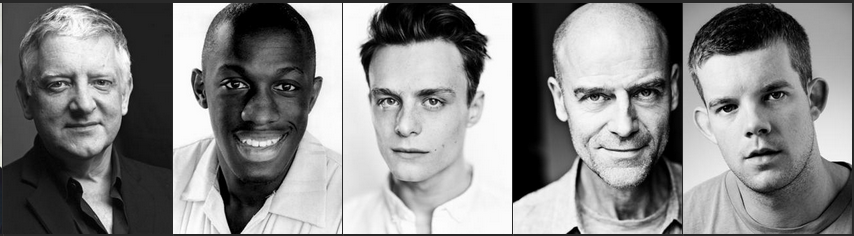

Max and Rudy are finally arrested and deported to Dachau as "Anti-social" members of society.  On the train Rudy is singled out for brutality by an officer (all the SS officers were played with understated terror by Pip Torrens) and Max is made to help beat him to death to prove he means nothing to him.  Max later reveals that he was also forced to have sex with a dead Jewish girl to prove he is not gay and once at the camp wears a yellow star to prove he is a Jew which actually wins him more concessions once in the camp.

There he meets gay political activist Horst (a powerful Paapa Essiedu) who witnessed what happened on the train and who wears a pink triangle and is disgusted that Max is denying his reality.  Max gets Horst onto his mind-numbing but relatively safe work detail of moving rocks from one pile to another next to the camp's electric fence.  Slowly the men prove that love can flourish in the stoniest of ground and Horst even verbally makes love to Max during one of their enforced rest periods standing a few feet apart.  But eventually - and in the worst circumstance - Max must admit to the world and himself that he is a homosexual...


As I said the play for me had lived in memory through it's visuals - Greta's drag act, the shadowy train, the bare stage with it's electrified fence (and constant low-level humming), two piles of rocks and a death-pit as well as the visual shock of Wolf's onstage nudity - but here, with just Sherman's text to concentrate on, it proved riveting and possibly will be the version of the play I most remember.

Martin Sherman spoke about it's history: written for Gay Sweatshop, the artistic director deliberately passed on it so it could be seen by a bigger audience but it was initially rejected by the Royal Court and Hampstead would only stage it with a gay director - none of whom took up the challenge.  Finally picked up by director Robert Chetwyn and with the star names of Ian McKellen and Tom Bell attached, it was finally staged at the Royal Court to huge popular appeal - but still with Court management disapproval and fairly hostile press reviews.  No leading West End producers would touch it until the independant producer Eddie Kulukundis brought it in to the Criterion (which is where I came in!) but only on the proviso from the Society of West End Theatre that it would be gone by December as it would be distasteful to be seen at Christmas time in the West End.  Fairly shameful eh?  Stephen Daldry also commented on the impact the production made on him as a young theatregoer. 


As was also touched on in the after-show discussion, BENT's power to shock and move is ever-timely and there was a hint that there might be a new revival next year.  I am so glad I had the opportunity to see this...

Tuesday, February 02, 2016

BILLY ELLIOT at Victoria Palace.... yes, I finally gave in!

It's only taken 11 years...
I tend not to see shows that hang around for years - to be honest none of the shows I like seem to be the hanging-around type.  I think it's also difficult to fully appreciate a show if you see it in it's nth year, shows can develop a run-of-the-mill quality with the original magic spark lost in numerous cast changes and resident director touch-ups.

I was fully expecting that with BILLY ELLIOT - I assumed it's much vaunted choreography would consist of a half-hearted leap here, an arm waved in the air there.  How wrong could I be?  Peter Darling's choreography was wonderfully kinetic and lively and a lot of that was down to our BILLY on the night, Euan Garrett who in the dance routines was a spinning, leaping and back-flipping delight.


So what took me so long?  I guess a love of the film which I have seen countless times allied to a general dislike of Elton John,  However the news that it was due to close in April and Owen asking for the dvd of the film for Xmas made me do the booking thing.

I haven't been in the Victoria Palace for years - more than 11 obviously - so I had forgotten how nice it is inside with room to roam in the theatre bars and with an impressive open auditorium - it's a shame this Frank Matcham-designed theatre doesn't have a bigger profile.  I was also surprised how busy it was!


But what of the show?  As I said I certainly enjoyed it for it's dynamic choreography and for the central performance of Euan Garrett but what really surprised me was how totally nondescript Elton John's score was.  For someone who has written the odd memorable tune in the (distant) past it was a bit odd that on leaving the theatre I couldn't remember one of the 13 songs in the score.

What I came out humming was Lee Hall's book as it lifted whole scenes out of his original film script.  Only with added swear words - make that a lot of swear words.  Now I am no prude but even I got fed up with the swearing, only there to 'shock' the audience with a kid saying "bastard" for the 100th time.  It all seemed a bit broad with certain characters becoming cyphers - Deka Walmsley's Mr. Elliot goes from being an unloving man to a bit of a lovable klutz in the course of one scene.


Ruthie Henshall played the dance teacher Mrs Wilkinson with less gritty realism than gritted teeth; I think her inherent teeth, tits & tonsils style was at odds with Mrs Wilkinson's dogged manner.  A character who has been built up is Michael, the not-so-secretly gay friend of Billy which was winningly played by Nathan Jones and who made the most of a big dance number with Billy where they are joined by giant dancing dresses.  Believe me, it ain't subtle.

Another surprise was how much it wore it's anti-Thatcher views on it's sleeve, not that I'm complaining, mind!  It was certainly more overt than the film and one of the more stirring moments of the show was towards the end when, as Billy leaves for a life of dance in London, his dad and his brother sing their way back to the pit, the auditorium and Billy illuminated in the dark by the torches from their mining helmets - defeated but unbowed.


As I said Peter Darling's choreography for Billy was quite wonderful and in particular the dream ballet between Billy and his older dancer self was quite breathtaking and Rick Fisher's lighting was also great in the dance sequences, creating areas on the stage to contain the dance.

Would I recommend it to anyone who has not yet seen it at the VP or on it's upcoming UK tour?  Yes I would, for the choreography and for Stephen Daldrey's production... just don't expect to be buying the cast recording.


Tuesday, August 12, 2014

Love and Politics in the 1990s

I was thinking the other day that we seem to be in a very good season for excellent performances onstage at the moment - Michael Xavier, Joanna Riding (Pajama Game), Julian Ovenden, Geoffrey Streatfeild, Lewis Reeves, Matt Bardock, Richard Cant (My Night With Reg), Clive Wood, Eve Best, Phil Daniels (Antony & Cleopatra),  Helen McCrory (Medea), Billie Piper, Aaron Neil, Robert Glenister (Great Britain)... and now you can add two others to that list, Bill Nighy and Carey Mulligan in the revival of David Hare's SKYLIGHT at the Wyndhams Theatre.


I never saw the original production of the play which starred Michael Gambon and Lia Williams which did the usual hop, skip and jump of National Theatre - West End - Broadway.  After it's Broadway run it reopened in London with Bill Nighy in the Gambon role and he is revisiting the role again, 18 years later.

This production also has Carey Mulligan in her West End debut and she was the reason I wanted to see it as her performances in AN EDUCATION, NEVER LET ME GO, DRIVE and SHAME have been exceptional.  Luckily she did not disappoint, with both her and Nighy giving sparky, memorable performances.


Set in that ancient, long-gone time - the early 1990s - the action takes place in a small council flat in West London which Kyra is subletting from a friend.  Kyra is a teacher in a struggling school in East Ham and has a quiet, untroubled private life.

One wintry night, Kyra is surprised to receive a visit from Edward, the 18 year-old son of her ex-lover Tom, a wealthy restaurateur.  She learns that Edward's mother died from cancer a year ago and that father and son are struggling with each other's unspoken grief, sharing a house that is no longer a home.  Edward is also still angry that Kyra walked out of all their lives three years before with no word of explanation.  Edward, bristling with the sulkiness of youth, skulks off but who should appear later also unannounced?  Tom turns up, saying he just happens to have been in the area.  Just by chance he also has an unopened bottle of Whisky.


Prowling the small flat like a lion in a cage, straightening and unstraightening her school books, dragging a chair out with his foot only to push it back again, Tom obviously has come on a mission which slowly is revealed along with what really happened three years before.  Although their story starts six years before that...

That's when Kyra had landed a waitress job in Tom and his wife's Chelsea restaurant soon after arriving in London.  She proved indispensable to the couple and their children, eventually moving in to the family home. Needless to say, Kyra and Tom were soon lovers although she said she would leave if his wife ever found out.  When she did, Kyra left with no goodbyes.  Soon after Tom's wife was diagnosed with cancer and he did all he could to make her life comfortable in their home.  Finally he admits to Kyra that he is there to try and get her back but Kyra is a different person now and refuses to give up her new life, although she cannot help her old feelings surfacing.


What soon emerges in their barbed conversations - and out-and-out arguing - is that Tom, while railing at the political correctness and woolly liberalism that he sees all around him, can no more understand Kyra's wish to travel across London every day to deliberately work in a depressing job than she can for his ever-growing need for money and his selfish world view.

In their night of long knives, we see both sides of their argument - yes, Tom cared for his dying wife turning their home into her holistic paradise but was he doing it out of genuine love or guilt over the affair and yes, Kyra cares passionately for the sink-estate children she teaches but is her hair-shirt approach to life just a reaction against her upper-middle-class upbringing - is she a working class tourist?


Bill Nighy was on excellent form as Tom the misanthrope ex-lover, railing at a changing world while attempting to repeat the past with Kyra.  His comic timing was wonderful, gaining huge laughs at his withering responses to both life and Kyra's attempts at carving out a new career, as well as the physicality of his performance too, you could feel his revulsion having to handle the lump of cheese Kyra was intending to put in her ragu!  But underneath it all was a loneliness, an emptiness and his short-lived happiness at their resumption of intimacy was touching.

Carey Mulligan had a wonderful sense of gravitas as Kyra, firmly believing that she was making a difference to people's lives and ideologically stronger than either of her male visitors.  Her sly sense of humour was delightfully played and she also suggested the quiet gnawing loneliness of a young woman deliberately cutting herself off from love.  I do hope she makes the return to stage often, she is too good an actress to be lost to film.  She also proves she can multi-task by acting and cooking onstage at the same time!  And it was real cooking too... the smell of frying onions was delicious!!!


Matthew Beard was effective as the stroppy Edward - an archetypal teenage boy that his father likens to a character from INVASION OF THE BODY SNATCHERS - who surprises both Kyra and the audience in the final scene.

Stephen Daldrey directs with his customary insight and stages the ebb-and-flow conversations with variety and pace.  Bob Crowley's set design conjured up the drab flat perfectly, it's invisible inner walls seen against a life-like block of council flats with lights going on and off in the windows showing that, while Tom and Kyra are battling each other, life goes on elsewhere.

An excellent revival of a fascinating play, as relevant now as it was in 1995.

Sunday, July 07, 2013

Remembrance Of Things Past

Ooo catchy title... I must copyright that.  Oh.

Right, Constant Reader, now that I have found my voice again, time for a bit of a catch-up on productions seen.  But I have seen so many!  I will do it in bite-size chunks.

New plays, not too many.


The latest of Peter Morgan's factional musings on the reality lived behind lives in the public eye found him returning to the ultimate person who is known to all but known to none, our Brenda.  He hit pay-dirt with her in 2006 with THE QUEEN and THE AUDIENCE reunited him with the film's leading lady Helen Mirren.  La Mirren hasn't done too badly out of HRH either and here she was given the opportunity to give a tour-de-force performance as Morgan bounced hither and yon across the six decades of the Queen's rule giving her minutes to change costumes, wigs and playing age.


Indeed it was a remarkable performance with Mirren finding a quiet through-line amidst the skilful onstage quick changes and turning on a sixpence from the young Queen finding her feet with Churchill to the slow, slightly stooped Matriarch running rings around Cameron.

The problem I had with Morgan's play was also it's purported unique selling point.  As Morgan has as much idea as we do in what takes place when the Queen meets the Prime Minister in their private weekly meetings, each section settled into a pattern of the Queen playing Devil's Advocate with whoever she was meeting so ultimately Morgan's script played it safe and certainly did nothing to shock or provoke it's - ahem - audience.  His most controversial gambit was to have the Queen haunted by her teenage self which didn't really amount to anything that would have him dragged to the tower.

 A play by Peter Morgan about the Queen starring Helen Mirren on Shaftesbury Avenue is going to attract a certain public and they were out in force when I went.  EVERYTHING got a round, the curtains, the frocks, the set, needless to say the Corgis.  The only real frisson during the show was in the enjoyable sparring match between Mirren and Haydn Gwynne's basilisk Margaret Thatcher - you could almost feel a large section of the audience having to choose between two heroines.  Seeing it a week or so after the absurd blanket canonisation of the old bitch it was good to see Morgan's jaundiced view of her.

 
Morgan obviously has a soft spot for Harold Wilson as he appeared three times: as a gauche bull-in-a-palace at their first meeting (cute but quite far from the truth I suspect), a PM-out-of-water in Balmoral and his announcement of retiring.  Richard McCabe played him very well - not so much an impression as 'an impression' if you get my drift.  His performance in the final scene was particularly touching.  Paul Ritter's turn as John Major was very entertaining and Michael Elwyn was a silky, deceptive Anthony Eden.  Edward Fox was a last minute replacement for Robert Hardy as Churchill and it showed.

Stephen Daldrey certainly kept the traffic of the stage moving briskly and Bob Crowley's design was spare and elegant.  I just wish Morgan's play - apart from the Thatcher scene - hadn't felt so damn timid.

Mirren and McCabe won this year's Olivier Awards for Best Actress and Supporting Actor which just happened to be two categories that A CURIOUS INCIDENT OF THE DOG IN THE NIGHT-TIME wasn't nominated in - lucky for them as it swept seven other categories including Best Play, Set, Lighting and Director.


Now, some history.
I have never read Mark Haddon's novel the play is based on as I spent a lifetime one evening watching his play POLAR BEARS and as that arsed me off so much I couldn't bear to set foot on him again.  I was aware of the basic premise but it was interesting to be one of the few in the packed Apollo Theatre who didn't know what was about to transpire.  By the way, we appeared to be sat in the designated American section - it was like being back on Broadway.

Luke Treadaway might have won the Best Actor Olivier award but the slacker doesn't do Monday or Tuesdays - they just don't have the range any more - so I saw Johnny Gibbon in his West End debut.  He certainly gave a relentless performance as the autistic teenager Christopher Boone who, when his neighbour's dog is killed with a pitch-fork, decides to find out not only who the killer is but the other mysteries in his life.  I am sure a long career beckons.

I must admit the plot itself didn't offer too many surprises, when the killer is revealed it was all a bit obvious - and was quickly dispensed with - the dead dog being the McGuffin to get us involved in Christopher's journey to find the missing mother he had been led to believe was dead. 

We experience his disorientating journey from Swindon to London through his eyes and this is where Marianne Elliott's production triumphs.  Elliott, set designer Bunny Christie and lighting designer Paule Constable combine to give us stage image after image which are haunting, delightful and exciting.  There were plenty of younger types in the audience and it made me wish that hopefully a good number of them will be excited by what the theatre can do in the hands of an accomplished team.


However, like a number of other productions this year, I came out thinking that I wasn't as blown away as I had been led to believe I would be.  The problem here was that the acting wasn't really all that.  Performances were either drawn larger-than-life or so muted as to be anonymous.  Even Niamh Cusack - so good recently in two productions at the Old Vic - here barely registers as Christopher's teacher.  We pride ourselves on the quality of British stage acting but more often than not, what you get are performances that have you wondering whether they bothered putting the understudy slips in the programme.  Just saying.


But as a work of theatrical possibilities?  Dazzling.


I have also had two dollops of Alan Bennett.  Earlier this year I had read his memoir A LIFE LIKE OTHER PEOPLE'S so I was curious to see the play UNTOLD STORIES which drew on part of it.

 
The play took two parts, the first half was a theatrical amuse-bouche called HYMN that was almost over before it began, a 30 minute reflection on the music Bennett remembers having an influence on him growing up.  More than anything it got us accustomed to Alex Jennings' unerring and affectionate interpretation of the author.

The main part of the evening was COCKTAIL STICKS in which Bennett turned his attention to the subject of his parents.  When I read A LIFE LIKE OTHER PEOPLE'S I had found it unbearably moving as Bennett gave us his recollections of growing up with his loving but socially embarrassed parents to whom the world seemed a party they didn't have the courage to attend.


They were played by Jeff Rawle and Gabrielle Lloyd with a gentle charm and as, in the book, Lloyd as his mother moved more centre-stage as she slipped into the twilight world of dementia.  Ultimately I think it works better on the page, especially the final section where Bennett turns his quiet anger on the institutionalised stripping away of any dignity his mother had at a pace with the dementia stripping away her identity.

After this it was natural to see Bennett' s latest play PEOPLE at the Lyttleton.  Now I had been one of the 8 people who saw THE HISTORY BOYS in the same theatre and not liked it.  Indeed I recently saw the screen version and again, found little to enjoy outside of Frances de la Tour's caustic performance.  So here was a chance to enjoy her playing the lead role for a change.  I presume it is what one could call a play of ideas, the trouble being that it is all ideas and no play.

A packed Lyttleton audience laughed itself through the play while I sat with the occasional half-smile.  Bennett has worked himself up into a right old state initially about the National Trust and on a larger scale, the idea of a culture, an identity that can similarly be shaped and packaged and sold back to you.  I have no problem with this argument and occasionally a point was made that shone through.  I just didn't buy the package.

Frances de la Tour played Dorothy Stacpoole, the heir to the crumbling stately home that has been in her family for years.  Now just she and her equally eccentric companion Iris live there so she is a sitting target for a beady-eyed consultant for the National Trust, played by Miles Jupp who was taking a break from being a panellist on innumerable quiz shows, and her Reverend younger sister (Selina Cadell).


The answer to Dorothy's problems appear to arrive in the bizarre twist of an ex-lover appearing who is now a porn director who asks for his latest film to be shot in the house.  We then had a lengthy scene of the filming which made laboured use of knob jokes, social embarrassment and the like to little purpose other than for Frances de la Tour to swish around in a 1960s style couture ensemble.


Ultimately Dorothy cannot keep the real wolves from the door and the house is taken off her hands and renovated fit for the paying proles consumption.  But she still had a trick up her sleeve...

Frances de la Tour was as watchable as ever (the cast even included her brother Andy as a vicar) and she found wells of sympathy for her improbable character and it was amusing watching Linda Bassett make bricks from straw as her bizarre cohort but otherwise it just seemed to ramble on taking a long time to get to an obvious pay-off.  The ubiquitous Bob Crowley's dark and cluttered set was obviously going to be given a make-over and it was Constant Reader, before your very eyes.

It was pointed out by director Nicholas Hytner to Bennett that the National Trust share more than just initials with the National Theatre and it was a peculiar sight to see the well-heeled audience hooting with delight as Bennett took less-than-veiled potshots at their ilk.

Ultimately it all felt rather like Bennett was having his cake and eating it too.

Still, always nice to hear Petula Clark singing DOWNTOWN.