Showing posts with label Deborah Findlay. Show all posts

Wednesday, April 26, 2017

SHAKESPEARE'S BIRTHDAY: TEN BEST FEMALE SUPPORTING PERFORMANCES

Happy birthday to William Shakespeare... born 453 years ago (and died 401 years ago).

Eight years ago I compiled four Top Ten lists of my favourite Shakespeare performances - lead & supporting male and lead & supporting female.

Eight years is a long time in theatre-going so to celebrate the greatest playwright ever, here is my updated list of favourite actresses in key supporting roles; these are the ones that all new interpretations are judged against:

BEST SUPPORTING ACTRESS (in alphabetical order):

 SINEAD CUSACK (Paulina - 2009)

JUDI DENCH (Gertrude - 1989)

JUDI DENCH (Paulina - 2015)

DEBORAH FINDLAY (Paulina - 2001)

ALEXANDRA GILBREATH (Emilia - 2011)
 
 CLARE HIGGINS (Gertrude - 2010)

HELEN McCRORY (Olivia - 2002)

VANESSA REDGRAVE (Queen Margaret - 2016)

JULIET STEVENSON (Gertrude - 2017)

SOPHIE THOMPSON (Ophelia - 1988)

Thursday, March 17, 2016

ESCAPED ALONE at Royal Court - Churchill's women...

Is it really 20 years since I sat in the famous Royal Court auditorium?  You know Constant Reader, I think it is.  Why the extraordinary space of time?  I usually find that Royal Court shows that I might want to see have no tickets available having all sold previously on the mailing list, plays that don't interest me, any number of things...


But I was intrigued about their latest production, a new play by veteran playwright Caryl Churchill, mainly because it had a cast of four cracking actresses which whetted my appetite to see them all onstage together.

Caryl Churchill doesn't do easy and after last year's disastrous National Theatre production of LIGHT SHINING IN BUCKINGHAMSHIRE it was remarkable that I wanted to expose myself to her again - as t'were.  But as I said, the opportunity to see Linda Bassett, Kika Markham, Deborah Findlay and June Watson onstage together was something I could not pass up... and oddly enough there were seats available.


A sunny afternoon, one of several.  Mrs Jarrett stands outside a garden gate and is invited in by Sally and her two friends who are chatting on their chairs, probably after a lunch.  Mrs Jarrett joins them in their aimless chatter about nephews and grandchildren, about the shops on the high street, about life in the summer, about nothing in particular as they start and finish each other's sentences.

But the odd occasional word seemingly triggers off fears or unsettled thoughts in each of the women: the seemingly-together Sally has a phobia of cats getting into her home, the thoughtful Lena reveals a crippling depression that leaves her trapped in her house sometimes, and outwardly-practical ex-hairdresser Vi reveals how life changed since being imprisoned for stabbing her husband.


But it's the seemingly benign Mrs Jarrett who seethes with an inward terrible rage which she repeats like a mantra to herself and - in startling abrupt changes of scene - seemingly steps out of the normal world of Sally's garden into a black neon-bordered hinterland where she calmly tells us of the dystopian nightmare of a man-made apocalypse which is where Churchill gives vent to so many obvious peeves: villages are crushed deliberately under rocks where survivors live on rats until drowned by rainfall, floods devastate the land, 80% of all food is given to TV companies for cookery programmes and those dying of starvation are given smart phones to look at rice.

These short, intense monologues are both funny and haunting as Churchill goes into microscopic detail about the horror the world will inflict on itself... but for now Mrs Jarrett, Sally, Vi and Lena can happily sit and sing "Da Doo Ron Ron" together.


At only 50 minutes there is no chance of Churchill's play outstaying it's welcome and although I will admit to some trepidation when the lights went down, by the end I found I had enjoyed the play and the production much more than I thought I would.  James Macdonald's production was tight as a drum although some of the actresses were better at seamlessly topping and tailing the constantly flowing chat between the characters.  Miriam Buether's set and Peter Mumford's also set the scene well enough to be shocked by the sudden wrench into limbo.

Be that as it may, what a joy to see such accomplished actresses all on the one stage in a new challenging play.  Linda Bassett, Deborah Findlay, Kika Markham and June Watson all usually play supporting roles so it was a particular pleasure to see them all having a chance to support each other.  I probably didn't understand all that Churchill was actually saying but I enjoyed what I saw and heard while certain phrases and moments have stayed with me, which is what it's all about.


Wednesday, February 12, 2014

The Popcorn Play

A week or so ago I had a totally new theatrical experience.  Constant Reader I hear your cry "But what can that be?"  Well, I have finally been to see a NT Live screening.  And what a strange experience it was.

 
NT Live has been running for nearly five years but I have put off seeing one as the previous broadcasts have either been productions I have seen previously onstage or wasn't interested.  But here we had an interesting cast - Tom Hiddleston as Coriolanus, Deborah Findlay as Volumnia and Mark Gatiss as Menenius - in a play that I had wanted to see again after having seen Ralph Fiennes' film version in 2012.  I was curious as to how to classify this: film or theatre?  But I boiled it down to the question "Would I chomp popcorn during a play?" So, film it is.
 
The Brixton Ritzy was packed with an interesting mix of older punters with glasses of wine and younger, media-types with bottles of wine.  Can you see a connection?  You could see we were the first-timers as we had bottles of Pepsi-Max.  There was an odd, jittery atmosphere in the auditorium as the screen showed us the Donmar audience taking their seats interspersed with 'trailers' for upcoming screenings (Owen shut his eyes during KING LEAR as we are seeing it actually onstage this week) and an introduction from Emma Freud.

 
To be honest I'm not sure what I should be talking about: the screen experience or the stage production. As a screen experience, the first thing that struck me was how strange it was to be seeing what the theatre audience was experiencing but with none of the inherent atmosphere you get, especially in such a small auditorium as the Donmar.  It was also odd at the end to have the actors take their bows to rapturous applause while we sat gawping.  My friends Sharon and Eamonn were seeing it in a cinema in West London and, again, it was odd to text her in the interval to chat about the theatre production we were watching but be miles apart!
 
The actual production was interesting but by the middle of the second act I had started to weary of it's sameness.  Was it because I was not actually there that I felt that?  Maybe.  Tom Hiddleston certainly gave an excellent performance, charismatic and nicely shaded.  During the play you feel Shakespeare becoming more and more fascinated with his lead character to the detriment of others and to be honest there were some very dodgy supporting performances here.  There is a real dearth of good supporting performers these days but I enjoyed Elliot Levey's duplicitous politician Brutus, happily engineering Coriolanus' downfall with his cohort Sicinia.  Oh yes, Sicinius has been given a sex change and is played by Katherine Schlesinger for no real reason but to up the actress rate and for the two nasty senators to share a snog.  Schlesinger actually was good but it reared unhappy memories of the transgender casting in the National's EDWARD II.
 
Hiddleston was better matched by Mark Gatiss' Menenius and Deborah Findlay's Volumnia.  Gatiss gave a fine performance as the peace-making senator who runs out of excuses for Coriolanus' behaviour and is ultimately let down by his friend while Findlay was in excellent form as Caius' mother Volumnia. 
 

A woman who has channelled all her ambition into her son, Volumnia is the one person Coriolanus cannot refuse and constantly pushes him: to become a senator, to suck up to the crowd and with the Senators, but who also seals his fate when she convinces him to turn back from over-running his native city of Rome.  Frustratingly, this climactic scene came across as flat and one-note, again leaving me to wonder was that the fault of Josie Rourke's direction or for the fact that the tension was dissipated by not being in the same room as the actors.  It certainly didn't have the power or the subtlety of playing that Vanessa Redgrave brought to the role of Volumnia in Fiennes' film.  The role of Virgilia, Coriolanus' wife is one of the least interesting of Shakespeare's women especially as she is over-shadowed by the character of Volumnia, but I liked the weary sadness of Birgitte Hjort Sørensen.
 
 
I'm not sure the NT Live thing is something I would do too often but it is an excellent initiative to make these theatre productions truly national events.
 

Sunday, July 21, 2013

Revivalists: Act two

Now Constant Reader, it might seem like I only see revivals at the National Theatre but I have actually gone to other theatres... like, in the actual West End.  All have featured fine performances but the actual productions themselves all felt wanting of real conviction.


Having missed David Hare's THE JUDAS KISS at Hampstead I caught up with it finally at the Duke of Yorks, primarily to see Rupert Everett's lauded performance.
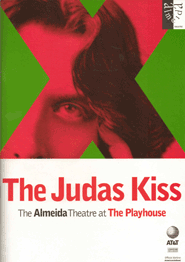

It is 15 years since I climbed the stairs to the Playhouse's peanut gallery to see the original Richard Eyre production which starred a rather out-of-place Liam Neeson as Oscar Wilde and a play-stealing turn from Tom Hollander as Lord Alfred 'Bosie' Douglas.  The play had vaguely stayed with me but I honestly didn't expect it to be revived anytime soon.  But now we had Australian director Neil Armfield's production and I was surprised how much I liked the play.

David Hare's play covers two key moments in the life of Oscar Wilde.  In April 1885, his libel case against the Marquis of Queensbury has collapsed leaving the way clear for his arrest for Gross Indecency.  His former lover Robbie Ross tips him off that the police are delaying his arrest, almost wanting him to flee to France but Wilde refuses.  Ross thinks he is staying to appease 'Bosie' his spoilt lover but Wilde stays because to flee would be to betray his life.

 
The second act takes place two years later in the run-down villa in Naples where the broken Wilde is now living with an unrepentantly petulant Lord Alfred who is shagging his way through the local Italian rough trade and looking to get away.  Again Ross appears to reprimand Wilde and remind him that his wife has threatened to refuse him any access to their sons if he sees 'Bosie' again but again Wilde refuses him.  He cannot live his life by other's demands, no matter the consequences or the obvious ruin that Bosie has led him to.  


Armfield's direction was minimal which may be fine for actors such as Everett and Cal MacAninch (superb at playing the vein-bursting frustration of Robbie Ross) but Freddie Fox as the awful 'Bosie' was left with nothing to do but stamp his foot and rant which got old very quickly.  Compared to Hollander's slyly manipulative portrayal, he was resolutely two-dimensional.


Something which cannot be levelled at Rupert Everett who gave a performance of total star power.  His Wilde, the agent of his own destruction, was played with real charisma - you simply couldn't watch anyone else when he was onstage.  It was the sudden shifts that surprised, the way his resigned and weary façade broke down at the simple generosity of the staff of the Cadogan Hotel where he was hiding.  He really came into his own in the second half as the broken ex-prisoner, shuffling around in his slippers when not huddled in his chair.  His weary, rueful manner giving way to one of total exhaustion, like a character out of Beckett.  After loving his recently published second book of memoir as well as enjoying his performance as Benedict Cumberbatch's brother in the BBC's PARADE'S END, it was great to see Everett triumph on stage too.

Further up St. Martin's Lane another actor was giving life to another revival.  Simon Russell Beale, taking a break from the National Theatre, appeared in the first production of Michael Grandage's season at the Noel Coward theatre PRIVATES ON PARADE.

 
This was a production I was looking forward to, Russell Beale is always worth seeing and I had only ever seen the film version of Peter Nichols' play which was a bit ho-hum.  Sadly the production promised more than it delivered.

At no time did it betray any need to be on that stage at that time.  Yes it's a play about the stupidity of war but it still didn't seem to chime with what's happening now in any other theatres (of war).  It felt more like Michael Grandage wanted Simon Russell Beale to open his theatre season and offered him a big camp role which is anarchic and outrageous but also provides the humanity and heart of the play.


Simon Russell Beale's audience had followed him over the river and there was plenty to drain their blue rinses: the soldiers' knobs got a good airing during the shower scene as well as a featured cameo appearance of Russell Beale's bum.  It must be odd to know that the big shocked reaction you have just heard from the audience is because you flashed your arse.  There was also more effing and jeffing than was probably heard in the whole Malayan conflict, mostly shouted by John Marquez' Corporal Bonny, who did little to dim the memory of Joe Melia's wonderful performance on screen.

It was all very well-directed and presented in the usual Donmar house-style thanks to the set by Christopher Oram and Neil Austin's excellent lighting and there were fine supporting performances from Davina Perera as Sylvia and Harry Hepple as Lance Corporal Charles Bishop but it somehow it just didn't move me.
 

There is no denying however that bestriding them all (usually in black stockings) was Simon Russell Beale as Acting Captain Terri Dennis who simply stole everything that wasn't nailed down with a performance that was outrageously funny and touchingly human.  He's some broad.

I also saw the revival of Terence Rattigan's THE WINSLOW BOY at the Old Vic.  Ever since his centenary those Rattigan productions just keep coming, everything it would seem but the Vivien Leigh screen version of THE DEEP BLUE SEA *fume*.


It was good to finally see the play as I had never seen either of the film versions and even managed to miss the 1989 BBC production which co-starred Emma Thompson as the titular boy's sister Catherine. 

Lindsay Posner directed this revival of Rattigan's 1946 hit play which he based on a real case in 1908 of a teenage boy expelled from a naval college after being accused of stealing a five shilling postal order.  Ronnie Winslow returns home in disgrace but his upstanding father Arthur is compelled to seek justice for him but as the Admiralty's ruling is considered an act of Government it can only be brought to trial by a decree from the.. um, Government.

With the family losing their place in 'good' society and Arthur becoming ill with the stress, their last hope rests with leading barrister Sir Robert Morton who is also a member of the opposition.  Winslow's suffragist daughter Catherine is strongly opposed to his involvement thinking he will only use the case to further his political career and because of his opposition to votes for women. 

In a scene which finally jolted Posner's rather tasteful production into life, Morton visits the house and ruthlessly cross-examines Ronnie in front of his appalled family, seeming to destroy the boy's story.  Morton then reveals he only did it to see how the boy might react to a courtroom and agrees to take on he case.

Through a mixture of guile and oratory Morton succeeds in getting the Government to agree to a court hearing which goes ahead with the Winslow home surrounded by newspaper reporters.  On the day of the trial Morton's ruthless cross-examinations force the Admiralty to withdraw it's charges against Ronnie and the family win the case.  But it's a hollow victory as the family is now near bankruptcy, Arthur's health is ruined as is Catherine's engagement to her Guardsman fiancée.


Any play about an individual trying to seek justice against an impossible bureaucracy will always be topical and Rattigan's play holds up well with it's expert construction.  Posner's production however felt safe and timid with several scenes seeming to tread water until the next entrance cue.  Owen asked me before it started what sort of a play it was and I assured him that at some point a scene would start with the maid turning on the study lamps and drawing the curtains.  And sure enough, there was Violet the loyal maid pulling the curtains and lighting the lamps on Peter McKintosh's rather obvious box set which looked like it belonged to a touring company.

Luckily what Posner was blessed with was a fine cast headed by Henry Goodman's benignly comfortable Arthur Winslow  who is broken by the system he has lived his life upholding.  There was good support from Deborah Findlay as Grace Winslow, ill-equipped to deal with the change wrought on her family and life, and also from Nick Hendrix as their oldest son Dickie who is happy enough learning the new dance steps rather than learn anything in Oxbridge - yes it was a silly-ass part but played with great wit.  Catherine was played by Naomi Frederick and a little more personality wouldn't have gone amiss while Charlie Rowe's Ronnie betrayed a lack of stage experience.  A special mention to Jay Villiers as the family solicitor who quietly loved Catherine.

However the stand-out performance was Peter Sullivan as Sir Robert Morton.  The production's synapses were jolted every time he appeared and his witty, self-assured, disdainful Sir Robert also gave the impression of having a heart under all that veneer.  I've seen Peter Sullivan a few times on stage and here he was finally allowed to take control of the play.  I certainly missed him when he was offstage.

There is a tragic postscript to the story of George Archer-Shee whose story was the inspiration for the play.  The case was won in 1910 but his father Martin, worn down by the two year fight for justice died in 1911.  In 1912, after completing his education, young George emigrated to New York to work on Wall Street.

Two years later in 1914 he returned to enlist in the war, and at the age of only 19, became one of the 17, 873 British soldiers reported missing in action after the first battle of Ypres.

Wednesday, December 15, 2010

A few weeks ago I was given a great dvd called BROADWAY:THE GOLDEN AGE which is one man's attempt to interview as many actors, composers and directors from the Golden Age of Broadway in the 1940s and 1950s.

He is surprised when he asks his interviewees what was the single greatest performance they saw on stage expecting it to be either Marlon Brando, Ethel Merman or Mary Martin - no, more often than not they replied "Laurette Taylor in THE GLASS MENAGERIE".All of them remember vividly the naturalness she brought to the stage, Martin Landau indeed said she gave you the impression that someone had wandered in off the street through the stage door and was making up the lines as she went along.

The same cannot be said of Deborah Findlay in the Joe Hill-Gibbins' Young Vic production as the whole enterprise is pitched at a highly theatrical level but that only adds to the power of this revelatory production.THE GLASS MENAGERIE was Tennessee Williams' breakthrough hit in 1944 when it opened first in Chicago then on Broadway the following year. The highly autobiographical play transcends it's inspiration and hits a universal chord of longing and loss which has ensured it's enduring popularity down the years.

Tennessee's narrator and theatrical incarnation is Tom Wingfield, in his early twenties in the late 1930s and sharing the genteel poverty that his family have been reduced to following the disappearance of his father some years previously. He shares the apartment with his overbearing mother Amanda, forever harking back to her Antebellum youth, and his sister Laura, made chronically shy due to her self-consciousness at school from having a brace on her crippled leg.

Tom - as did Tennessee - works in a dead-end job in a shoe factory and longs to make a career as a writer but is burdened with the guilt of being his family's only means of support with his pay-cheque. When Amanda reveals she knows he has made overtures to the US Navy she pressures him to find a man for his sister so she will be provided for in the future. For once Tom complies with his mother's demands and invites a work colleague to dinner. The Gentleman Caller is Jim O'Connor who Tom vaguely knew in High School when Jim was the hero of the sports field but what he doesn't know is that Jim was the boy that Laura had an unrequited love for. Jim's visit will have a life-changing effect on the Wingfields....Jeremy Herbert's design takes over most of the open auditorium - a right-angled stage with metal walkways surrounding it with the dining table on a riser surrounded by the bric-a-brac of the house including Laura's beloved collection of glass figurines, her glass menagerie. The acts are ushered in by a curtain that stretches around the playing area and that can be raised above or below the stage level.

The stage is also dominated by the WWI photo of the absent Mr Wingfield, castigated at by Amanda but a potent symbol of escape to Tom. Although wide and empty the space also feels claustrophobic as soon as mother and son start their eternal bickering. It actually works remarkably well aided by James Farncombe's lighting.As I said, Joe Hill-Gibbins' has directed the play in a slightly larger-than-life way but he also shows remarkably well how there are no villains in the piece - although Tom's actions can seem heartless and while Amanda can seem to be smothering her children with her vaunted dreams for them they are not villains, just people who find themselves trapped by circumstances somewhere other than where they want to be.

Leo Bill as Tom was the one I felt least able to transcend the shoutiness of his character. He certainly plays the fact that Tom is on course for a nervous breakdown - Tennessee suffered a nervous collapse while working at the shoe factory - but only occasionally let the character have three dimensions. I did like the way he changed his style in his scenes with Jim, suggesting that maybe Laura wasn't the only one under his All-American spell at High School.Being Tennessee Williams the roles for the two actresses are the most defined and the production is graced with two memorable performances from Deborah Findlay as Amanda and Sinéad Matthews as Laura.

Sinéad was quite heartbreaking as the pathologically shy Laura, one truly can imagine how she would haunt the dreams of her brother. In the magnificent duologue between Laura and Jim, with only the smallest of calibrations she charted a course from mortified terror at being confronted with the boy of her dreams to her blossoming under the warmth of his kindness to all her hopes being as broken as her favorite figurine. I saw her play a similarly devastating role as Hedwig in Ibsen's THE WILD DUCK a few years back at the Donmar and she really is an actress of rare subtlety.Deborah Findlay has an absolute field day as Amanda, not for her the fluttery relic of the South but a woman resolutely hanging on to life in reduced circumstances. She certainly didn't attempt to play the character for sympathy and one can truly understand the exasperation of Tom at her relentlessness but she certainly came into her own in the second act, first with the beautiful speech where she tells Laura of her magical summer of Jonquils and meeting her future husband and then with her flirtatiously gracious welcoming of the all-important Gentleman Caller, her crushed hopes on hearing of Jim's status was beautifully pitched. After seeing Findlay play a couple of dowdy, starchy roles recently it was a joy to see her rip it up as Amanda.

I also liked Kyle Soller as Jim O'Connor. Along with Jim's breezy good humour he also suggested the inner life of the former Boy-Most-Likely-To whose life has not turned out so rosy and for all his attendance of night classes you know his life when married will turn out to be as equally mundane.As familiar as I am with the play I still got caught up in the emotional pull of the story and was quite an emotional wreck by the end - proof positive that the production worked.

The play stands as a testament to Tennessee and to his guilt over his older sister Rose who did not have the physical affliction of Laura but was mentally unstable for most of her life. The intention behind the play is fully realised when one knows that, unknown to Tennessee, his mother consented to Rose having a lobotomy which went wrong leaving her irretrievably brain-damaged.

Tennessee's guilt was that he had grown distant from her in the years leading up to this, in part due to Rose informing their mother of his homosexuality. He couldn't save her but the following year he wrote THE GLASS MENAGERIE and the success of this and A STREETCAR NAMED DESIRE a few years later ensured he had enough money to keep Rose in private nursing care for the rest of her life. She outlived him by 13 years.

In a year that has seen some excellent revivals, THE GLASS MENAGERIE is one of the very best. It's run at the Young Vic has been extended until January 15th - rush to see it!