Friday, April 19, 2019

FIDDLER ON THE ROOF at the Playhouse - Fathers and Daughters...

I couldn't get terribly worked up over seeing Trevor Nunn's revival of FIDDLER ON THE ROOF when it originated at the Menier Chocolate Factory as, while I admire the stagecraft that went into it's creation, it's not really one of my favourite musicals.  But it's glowing reviews, it's transfer to the Playhouse Theatre - and the fact that I had seen every other show in the West End that interested me - meant that my birthday theatre event found me journeying back to the Russian shtetl of Anatevka in the early 1900s.


In it's transfer to the Playhouse, director Trevor Nunn has reconfigured the stalls to echo his Menier staging so a raised meandering path runs through the stalls to bring you into the middle of the small Jewish town, it's a bit cumbersome in finding your seat but very effective and for once, I felt engaged with the show.  Of course being a Trevor Nunn production, it's very lengthy which for me only highlighted the repetitions in Joseph Stein's book, but as I said, I was engaged.

I have only seen the show once before onstage - a jaw-dropping 14 years ago in New York in a Chekhovian production directed by David Leveaux starring Harvey Fierstein and Rosie O'Donnell - and, of course, the Norman Jewison film version starring Topol. As I said, it's not a particular favourite of mine, mostly because I find the plot device of a Jewish village milkman finding the traditions he lives by erode through his three daughters marrying against his wishes too repetitive.  I will agree that this is done by degrees: the first falls in love with a nebbish Jewish tailor, the second to a Bolshevik, the third to a gentile - but, particularly in this production, the three daughters are played exactly the same, sound exactly the same - typical west end soprano - and are so resolutely two-dimensional, that it's like you are seeing one actress on a revolve.  The three boyfriends are all given different shadings but the daughters get no personalities at all.


I also am not the biggest fan of Jerry Bock and Sheldon Harnick's score which has it's standards - "Tradition", "If I Were A Rich Man", "Sunrise Sunset", "Do You Love Me" - but otherwise I find it fairly anonymous and repetitive. But as I said, I found Nunn's production to be involving with very good musical direction from Paul Bogaev which serves the score well, apart from the endless "Tevye's Nightmare" which proves that time is not always a continuum.

Nunn has chosen Andy Nyman for his Tevye and he is excellent, making him a very human-sized character, unlike the usual Star turn from actors taking their lead from the originator of the role, the larger-than-life Zero Mostel.  Without the character being figuratively spot-lit downstage while the other actors huddle upstage, it makes for more integrated story-telling with the town of Anatevka coming fully to life.


Like the daughters, the role of Tevye's wife Golde is a fairly thankless one; for ever careworn and kvetching at her husband's foolish dreams, but Broadway actress Judy Kuhn suggested more depth to the character than is on the page.  In particular the duet "Do You Love Me?" where Tevye finally plucks up the courage to ask Golde whether their 25-year marriage is based on love or just circumstance is a touching, almost embarrassed moment between Nyman and Kuhn rather than being played for comedy.

The other stand-out in the cast is Louise Gold as Yente, the gossipy matchmaker of the village; another two-dimensional female character but imbued by the ever-reliable Gold with a vibrant personality who again had colour and depth that was not suggested by the script.  I also liked Stewart Clarke as Perchik the stern Bolshevik student who is smitten by the middle daughter Hodel.


Of course the spirit of Jerome Robbins, the show's original director/choreographer, is ever-present in the big dance routines for "To Life" and "The Wedding / Bottle Dance"; for a man who has been dead 21 years, it's not bad that he gets named three times on the poster.  Matt Cole is responsible for the rest of the enjoyable choreography.

Robert Jones' set design brings the crowded Anatevka to vibrant life both onstage and off, while Tim Lutkin's subtle, shifting lighting gives the town the warmth of summer and the dark of winter.  None more so than in the final scenes when the mood turns sombre with the forced eviction of the Jews from the town.  Despite my problems with the show, it is impossible not to be moved by the final scene where lifelong friends and families say their goodbyes knowing they will probably never see each other again as they scatter over Europe and America.


As the snow falls on Tevye's shattered community slowly trudging out of their hometown, clutching their few possessions on a long journey to who knows what fate, Nunn shows his production is sadly very relevant to today's world of displaced people and the search for home in a world of prejudice and fear.

I am not always a fan of Trevor Nunn's work but here he gives us a memorable production of FIDDLER ON THE ROOF, maybe one to see again...


Sunday, April 14, 2019

DVD/150: CARNE TRÉMULA (Live Flesh) (Pedro Almodóvar, 1997)

Almodóvar's first film adaptation sees him lose most of novelist Ruth Rendell's plot but keeps the central idea.


Madrid: Victor, 20 year-old son of a prostitute, pursues Elena, a rich addict, to her apartment a week after having sex but she rejects him. During the argument her gun misfires and two nearby policemen, David and Sancho, investigate.  Sancho is drunk after suspecting his wife Clara of infidelity and his wayward actions result in him and Victor wrestling with the gun which fires, hitting David and crippling him for life.


Released from prison, Victor discovers David is now a wheelchair paralympian married to a now-sober Elena; Victor gatecrashes a funeral attended by the couple where he meets Carla, Sancho's unhappy, abused wife and they start an affair.  David warns Victor to back off but all five are entangled in a deceitful web with Victor holding the most shocking secret...


Shelf or charity shop? A keeper for the wonderful performances of Ángela Molina and the late José Sancho as Carla and Sancho who offset the colourless leads Javier Bardem, Francesca Neri and Liberto Raval as Victor.  The film also marked the first time Penélope Cruz appeared in an Almodóvar film, in a cameo role as Victor's mother.


Saturday, April 13, 2019

MAGGIE MAY at the Finborough - Wake Up Maggie... you're onstage again.

Four years after the life-changing success of OLIVER! - which was still running in the West End - Lionel Bart's new musical MAGGIE MAY opened at the Adelphi Theatre in 1964.  Despite winning the Novello award for Best Theatre Score and a Critics Circle award for Best Musical, the show simply vanished from the repertoire.  Our Liverpudlian heroine appeared briefly in 1992 in a National Youth Theatre production but the revival at the Finborough Theatre is it's first professional appearance in 55 years.


Bart was still riding the success of OLIVER! when MAGGIE MAY became his second consecutive show to open at the Adelphi.  His 1962 musical BLITZ! - whoever said exclamation marks were a recent way to denote a musical - had opened there for a moderately successful run but was judged to be an uneven show; Sean Kenny's collapsing East End London set garnering the most attention over Bart's score or performances.  Returning again to the working-class milieu that had proved so successful for him, Bart turned away from London and focused on the thriving Liverpool scene, collaborating with writer Alun Owen who had success with his Liverpool plays PROGRESS TO THE PARK and NO TRAMS TO LIME STREET, and had just won acclaim for his script for A HARD DAY'S NIGHT.

Bart's favourite designer Sean Kenny recreated the Liverpool docks setting, while Owen was reunited with Canadian director Ted Kotcheff who had directed his plays on stage and television.  The show reunited Bart with Barry Humphries who had appeared in London and New York as OLIVER''s Mr Sowerberry - here playing the Brechtian role The Balladeer - and the show starred Rachel Roberts as Maggie May and Kenneth Haigh as Patrick Casey.  The cast also included such future tv names as Morecombe and Wise 'star' Janet Webb, Geoffrey Hughes, Billy Boyle (currently appearing as Theodore Whitman in the National Theatre's FOLLIES) and in the chorus, making her West End debut, Julia McKenzie.  MAGGIE MAY not only had a cast recording but Bart's friend Judy Garland also released four of it's songs on an EP.  In an odd twist, Bart had originally offered OLIVER! to Rachel Roberts but she declined so Georgia Brown got the role; he then offered MAGGIE MAY to Georgia but she declined so Rachel Roberts got it!  Non-singer Roberts' vocal chords just about survived to the end of her contract where she was replaced by - you guessed - Georgia Brown.


MAGGIE  MAY was Bart's last hurrah however: his 1965 musical TWANG!! was a theatrical car-crash and his 1969 Broadway musical LA STRADA not only had most of his score ditched but closed after a single night.  To finance these disasters, Bart had stupidly sold the rights to his hit shows - Max Bygraves paid £350 for OLIVER! and then re-sold them for £250,000 - so by 1972, Lionel Bart, the once and future king of British musicals, was bankrupt and suffering from alcoholism and substance abuse.  He re-awakened public interest with his Abbey National jingle 'Happy Endings' in the late 1980s, and in 1994 - the same year that MAGGIE MAY's Alun Owen died - Cameron Mackintosh revived OLIVER! with Bart making additions to the score for which he received a share of the profits.  He died in 1999 of liver cancer.

OLIVER! has had many revivals since it's 1960 opening - largely thanks to the enduring popularity of the 1968 film adaptation - but his other shows have been overshadowed.  Interestingly, his two 'contemporary' scores - FINGS AIN'T WOT THEY USED T'BE and MAGGIE MAY - are certainly influenced by his parallel career as a pop songwriter so maybe sound dated to theatre producers today; but they also carry within them an earthy, vital spark that didn't see it's like again until Willy Russell's BLOOD BROTHERS.


Maggie is a vivacious tart with a heart whose inner sadness, at losing her childhood sweetheart Patrick Casey to the life of a sailor, results in calling all her punters 'Casey'.  She lives and works near the Liverpool docks with her salty friend Maureen, and one day word reaches Maggie that Patrick Casey has arrived back, having left the navy for good.  They meet again and immediately realize they were meant to be together.  Patrick's friend Judder gets him a job on the docks but for Patrick this is a poisoned chalice; his father Joe was a famous trade unionist and rabble-rouser, loved by the workers and hated by the bosses.  His death at a demonstration has made him a legend and Patrick finds this a burden to carry with his fellow-workers who expect so much of him.

However when a worker is killed by a falling crate Patrick shows he is his father's son; not so much for the death but for the fact that the crate contained a secret shipment of guns, bound for South America which Patrick knows will be used against striking workers.  This leads him to confront his father's former crony Willie Morgan who is now the corrupt head of the docker's union.  Morgan knew the guns were being shipped as it meant jobs for his men but Patrick accuses him of class treachery.  Willie realizes Casey could easily displace him so decides to ruin him... and the key to this is through Maggie.


More guns arrive dockside and Casey's gang are assigned the job; Casey refuses and is sacked but Judder whips up the fellow dockers to walk out in support of their new hero Patrick, only Maggie realizing that this can only lead to more trouble.  She warns Patrick about going up against Morgan but he persists on addressing a large strike meeting about the need to be united with other world-wide comrades.  Morgan speaks next and manages to turn the strikers' against any further action - why think of others when your own job is on the line?  Morgan makes a move on Maggie knowing she is unhappy with Patrick but despite a trip to the fair, she rebuffs Morgan knowing that Patrick is her real love.

Patrick realizes his activism is doomed by his fellow-workers attitudes and decides his only happiness is with Maggie who has told him she will give up the game for him.  Patrick leaves her and bumps into Judder who is angry that his friend has given up so easy, especially for a tart.  They fight over Maggie, but Patrick says he has one last action to complete for the workers of the world.  Jealous of Maggie and of Patrick's secret mission, he informs Morgan that Patrick is headed for the docks.  As Casey attempts to use a crane to dump the crates of guns into the river, the police, Morgan, Judder and Maggie arrive on the dock...


MAGGIE MAY does feel uneven: Alun Owen's blue-collar book addressing trade union corruption and the in-fighting workers is a natural for his "Armchair Theatre" tv plays but sit oddly against Bart's score - both are good but play like a cut-and-shunt job.  However a little doctoring could give both a better flow; what is remarkable is to see a musical so committed to showing the working-class experience - how often does that happen?

There is a problem with the character of Maggie, a vibrant live-wire at the start of the show, she dwindles towards the end of the show to become a mere bystander to Patrick's fate.  The ending feels like a conscious steal from WEST SIDE STORY with it's sudden tragic conclusion but this too demotes Maggie to being an onlooker in what is supposed to be her story.


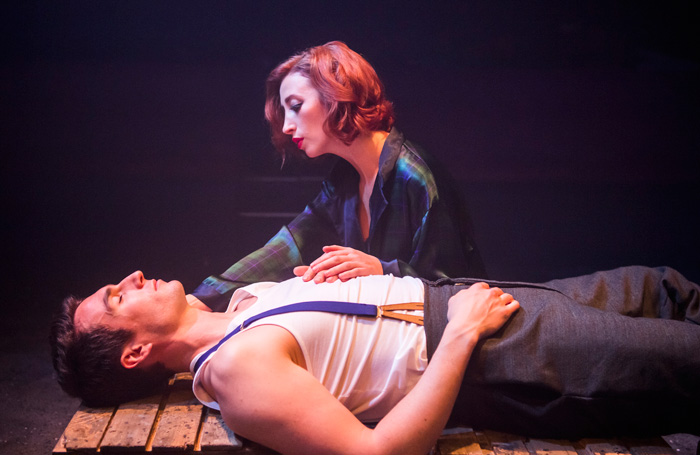
Matthew Iliffe's production is constrained by the small auditorium - the Finborough seats only 50 at a squeeze - allowing only a few small crates and a movable metal staircase as a set but the possibilities for the show do come through in his focused and fast-moving show, eliciting strong - sometimes too strong - performances from his cast.  James Darch was excellent as Patrick, a natural leading man with a strong voice and easy charm and he was well-partnered by Kara Lily Hayworth as Maggie, my only complaint being that her singing voice, while pretty in the current theatre soprano way, probably didn't give Maggie's songs their best as they were written for a rougher, more belting voice like Georgia Brown's.

A special mention to the hard-edged Maureen of Natalie Williams, the rest of the cast were all ok but Michael Nelson as Judder for some reason shouted rather than speaking his lines which seemed absurd in such a small space, however he was an excellent dancer, easily the one to focus on during the punchy and dynamic dance numbers choreographed by Sam Spencer-Lane to *just* fit the space.


Lionel Bart's score had several of his trademark numbers - the big ballads for his leading lady, a solo for his lead man reviewing his situation, ensemble numbers, a few comedy routine numbers and, kicking off the second act, an early sixties rock 'n' roll number that Cliff Richard wouldn't have turned his quiff up at - a very special mention to Henry Brennan, playing the whole score on a piano.

I honestly thought I would never see a revival of this but I am glad I did: for all it's uneven qualities, it's possibly one of the UK's most over-looked musicals.  Congratulations to Matthew Iliffe and his cast of 13 (where the original cast hit 50!), MAGGIE MAY is now sold-out for it's run at the Finborough.


Wednesday, April 10, 2019

HARRY POTTER AND THE CURSED CHILD at the Palace Theatre - Magic to do...

Back in that famous 'day' that everyone talks about, me and my mum went to the barn of a theatre that was, and is, the Palace on Shaftsbury Avenue to see Danny La Rue in his successful DANNY AT THE PALACE.  One of his guest artistes - they were 'artistes' then - was the Black Theatre of Prague, hugely popular at the time and very influential in their black-on-black illusions where objects flew and reformed themselves into different shapes.  They were much on my mind when, 45 years on, I was watching the old Black Theatre of Prague idea utilized on the same stage in HARRY POTTER AND THE CURSED CHILD.  Yep, I gave in...


Ah HARRY POTTER... Neil Simon once said of the tv series "Friends" 'It's like they made one episode and they keep showing it all the time" - that's how I felt about the Harry Potter films.  When all the blind alleys and red herrings were stripped away, they all told a fairly basic story which never really seemed to reach a denouement (apart from the final one of course).  It also suffered from the dedicated book-to-film franchise problem of having an ever-growing collection of characters who all had to appear for only minutes at a time sometimes - the last film was a veritable parade of actors all turning up to stare down the camera, contributing nothing to the actual story.  The things Maggie Smith and Emma Thompson have made me do...

But here we are, in the Dress Circle of the Palace Theatre, as I said a veritable barn of a place that could have served as an inspiration for Hogwarts with it's dark gloomy spaces and Gothic pretensions, and the good news was that, despite my fears of having restricted view seats towards the end of the third row, they gave a very good view of the large open proscenium arch stage.  Quite right too for the prices I paid.


Despite my anathema for the Harry Potter films, I must admit that I got quite excited waiting for the play to start: HARRY POTTER, along with HAMILTON, have made the mere attendance of the show an event, so sitting and waiting for the start could only be a combination of relief to finally be in the seats booked ages ago and to get the vibe from the audience that you are in the auditorium of a copper-bottomed hit.

I must also admit by the end of the first play I was fully on-board - John Tiffany's production moves along at quite a breathless pace and the sheer theatricality of the piece was what I enjoyed most: illusion, slight-of-hand, the simple Black Theatre of Prague techniques all contributed to a show - that like the best of all theatre - allows you to use your imagination while watching, the direct reverse of what the films did which allowed for no imagination as everything was CGI-d for you.


The production has the feel of a musical - the on-stage action is deftly choreographed by Steven Hoggett, which sweeps you along with the characters inter-actions with each other and the sets - I particularly liked how just some snap-to-black lighting and the ensemble's swirling capes transitioned one scene to another so effectively.  Last year we saw John Tiffany and Steven Hoggett's PINOCCHIO at the National which, compared to POTTER, seems even more clunky than it did at the time.

The programme helpfully gives you a potted Potter synopsis of all the stories up until the start of the play: 19 years after Harry's defeat of his evil nemesis Voldemort, he is grown up and employed by the Ministry of Magic.  He and his wife Ginny send Albus their youngest son off to be educated at Hogwarts and, while travelling, Albus makes friends with another new pupil, the shy yet gushing Scorpius.  Much to Albus' surprise, he discovers Scorpius is the son of Potter's former bully Draco Malfoy.  Albus and Scorpius find life at Hogwarts hard as they are forever compared to their more illustrious fathers which makes the friends bond all the more special.


Harry is approached by the father of a contemporary of his at Hogwarts who was killed by Voldemort; the old man has heard of the existence of a time-travelling device which could be used to save his son from an early death.  Harry refuses but Albus is determined to help him and his anarchic niece Delphi.  Harry is confused at the growing estrangement from Albus and is worried from auguries that something evil is approaching.  The boys steal the time device from the office of Harry's school-friend Hermione, and twice attempt their mission; however both times end with them interfering with time altering the reality of their present day.  On the second attempt, Scorpius finds himself trapped in a reality where Harry was killed by Voldemort who reigns supreme.

The first play ends on such an unexpected note of the evil world manifested to the terrified Scorpius that it really send you out desperate for Part 2 - the final coup de theatre is breath-taking, generally eerie and - as the free badge we received as we left the theatre asked us to #keepthesecrets, I will.  The second play sadly runs out of steam and is not as dramatically involving as the first. The second play seems full of repetitions and the culprit who is allowing the coming evil to happen is very obvious.  Indeed, even the final confrontation between Potter, his old friends and the spirit of Voldemort, doesn't quite work.  Both fathers and sons - Harry & Albus, Draco & Scorpius - are finally reunited however but this also threw up a quandary for me.


For a hugely successful female writer JK Rowling is oddly resistant to showing any connection between her female characters: Ginny Potter is a standard worried mother, Hermione - while in a position of power - has hardly any connection with her daughter Rose who starts out with Harry and Scorpius but who soon vanishes for large sections of the story, while Delphi remains firmly obsessed with her father.  So the only real female character who appears to have any tangible connection to Harry is his mother... who's dead.  When the relationships in the play buzz around the subject of the burdens placed on fathers and son relationships, the women in essence are not allowed any such soul-searching.  Strange.

As I said the second play cannot keep up the pace of the first and it left me with the feeling that writer Jack Thorne could have been more concise with his, Tiffany and Rowling's original story - but whoever heard of a production taking place over one full play and a second first act?  There just seemed to be a lot of padding to get to the climax of the second play.


In juggernaut productions like HARRY POTTER there really is no need to cast star names but the performances were by-and-large good: Jamie Ballard was good as the troubled Harry while Joe Idris-Roberts was very good as his equally-troubled son Albus, oddly enough we last saw him as another growing boy with father issues for John Tiffany in PINOCCHIO.

Thomas Aldridge was fine as the plain-speaking Ron Weasley but Franc Ashman as Hermione frequently sounded clanging notes, however Helen Aluko showed spirit as their daughter Rose - so much so that I wished she had more to do.  But by far the most eye-catching performance was Jonathan Case as Scorpius, in his first professional role.  Although he pushed the gurgling, bashful, tongue-tied Scorpius to almost Boris Johnsonian levels, he connected to the role perfectly and made him more of a central character than either Potter, with a more interesting character arc.


The true stars are however the production team: Tiffany's direction allied to Steven Hoggett's movement, Christine Jones' sets, Katrina Lindsay's costumes, Imogen Heap's score, Neil Austin's lighting and the illusion effects of Jamie Harrison; all combine to give a unique theatrical event and a genuine celebration of what theatre - and only theatre - can do.


Monday, March 25, 2019

DVD/150: BEYOND BIBA: A PORTRAIT OF BARBARA HULANICKI (Louis Price, 2009)

An intimate - and maddeningly short - documentary of designer Barbara Hulanicki, which sketches her life as swiftly as one of her fashion drawings.


Filmed in Miami, where Barbara has resided since 1987, she prepares for a London drawings exhibition while reminiscing: Polish-born, she moved to Jerusalem in the 1940s with her diplomat father, only for her life to change aged 12 when he was assassinated by Zionists.


Growing up in England, Barbara was working as a newspaper fashion illustrator when the Daily Mirror asked her to design a day dress - her design in pink gingham, costing 25 shillings, resulted in over 17,000 mail order requests!


Barbara and husband Stephen Fitz-Simon opened Biba in 1964 which in it's third move became Big Biba on Kensington High Street: where seven floors offered it's customers, for the first time, a whole lifestyle - clothes, furniture, food. make-up, dog food - at affordable prices.


Shelf or charity shop? Big Biba is one of my most treasured memories of growing up in Kensington in the 1970s so this is obvious to keep!  It is also interesting to follow Barbara's post-Biba career designing hotel and restaurant interiors in Miami, and to see her meeting old friends like Twiggy and Molly Parkin.


Sunday, March 24, 2019

DVD/150: DON'T LOSE YOUR HEAD (Gerald Thomas, 1967)

Anglo-Amalgamated released the first twelve CARRY ONs but when the franchise moved to Rank, DON'T LOSE YOUR HEAD was released without the prefix due to problems over who owned the CARRY ON.. title, the words still appear on the poster...


Robespierre's Reign of Terror is interrupted by the elusive Black Fingernail who, disguised, rescues aristocrats from the guillotine and under the snooty nose of police chief, Citizen Camembert.


The rescuers are two English fops, Sir Rodney Ffing and Lord Darcy Pue so Camembert journeys to England to catch them with his bumbling assistant Citizen Bidet and his mistress Desirée.


DON'T LOSE YOUR HEAD, despite the tsunami of double entendres, runs out of steam about two thirds in and never recovers.


Sid James is fine while the anarchic pairing of Kenneth Williams and Charles Hawtrey fizzes and Joan Sims is glorious as the outwardly-'refained' but common-as-muck Desirée.


Shelf or charity shop?  Despite some classic CARRY ON... gags, I think I can let this one go...

Saturday, March 23, 2019

50 Favourite Musicals: The Interval...

The interval - time for a mid-performance wee, an ice-cream or an over-priced drink in the under-staffed bar. I am halfway through my 50 favourite musicals so let's have a recap of the action so far - it's only taken nine months to get here!


How many would be in your Top 50?

The bell is ringing... the mission continues...

Wednesday, March 20, 2019

50 Favourite Musicals: 25: A CHORUS LINE (1975) (Marvin Hamlisch, Edward Kleban)

The 50 shows that have stood out down the years and, as we get up among the paint cards, the shows that have become the cast recording of my life:


 First performed: 1975, Public Theater, NY
First seen by me: 1989, Shubert Theatre, NY
Productions seen: two

Score: Marvin Hamlisch, Edward Kleban
Book: James Kirkwood Jr, Nicholas Dante
Plot: On an empty Broadway stage, director Zack selects seventeen dancers for the final round of auditions to be cast for an upcoming musical which needs a chorus line of four women and four men.  Zack puts them through a rigorous physical and emotional work-out; he wants dancers for whom it's life itself... not just a job.

Five memorable numbers: DANCE: TEN, LOOKS: THREE, WHAT I DID FOR LOVE, NOTHING, AT THE BALLET, ONE

Like a lot of musicals on my list I came to the show first through the cast recording which can be a bit of a problem when you finally see the show: the score which flows naturally from song to song in your mind actually stops every so often: "wait, there are lines *during* the song??  Who knew!"  A case in point was A CHORUS LINE which was played continuously by someone who I used to work with.  I knew practically every breath that the cast took so when I finally saw the show - on Broadway which was like drinking wine in the country where the grape was grown - it was a shock to realize that the show was actually more like a play with music, so strong are the 17 main characters and the situation they find themselves in.  I found myself totally involved, quietly rooting for my favourite dancers to get the all-important job.  The imprint of director/choreographer Michael Bennett is all over the show but of course most of all in the great dance numbers - the exhausting "God I Hope I Get It" as the successful 17 are selected out of a general chorus cattle-call; the epic montage number which incorporates "Hello Twelve, Hello Thirteen, Hello Love" as all the dancers tell director/choreographer Zack of their years growing up and what lead them to become dancers, and Cassie's big solo number "The Music and The Mirror".  Cassie is Zack's former lover and former established dance soloist who left Broadway - and Zack - to try her luck in Hollywood, but now she's back and despite Zack's goading, desperate to get a job again on Broadway, even if it means being part of an anonymous chorus line: "God, I'm a dancer, a dancer dances".  It all culminates in the shiny and brash "One", the chorus' big number in the upcoming show, which reduces the individual dancers into a glittery, uniform ensemble - all moving and looking as one - but we now know what each of them has gone through to give themselves over to that collective unit, a chorus line.  A CHORUS LINE was Broadway's longest-running musical until overtaken by by CATS in 1997, and won nine Tony Awards, the Pulitzer Prize for Drama and, for it's London production, the prize for Best Musical from both the Evening Standard Awards and the Society of West End Theatre Awards (which later became the Oliviers) - the first year the latter were awarded.  It is sad to think that from the eight people who made up the original production team only co-choreographer Bob Avian is still with us. 

Sadly most of the video available for A CHORUS LINE is from Attenborough's galumphing film version but here is the 2018 NY City Center gala production featuring some of Bennett's iconic choreography.

Sunday, March 17, 2019

DVD/150: LA PASSION DE JEANNE D'ARC (Carl Theodor Dreyer, 1928)

One of silent cinema's true masterpieces, Dreyer dispenses with the events of Joan's life to focus on her heresy trial in 1431 by the clergy, basing his script on the trial transcripts.


Dreyer distills the trial's four months to a single day, all elements of the film pared down to focus on the extraordinary performance of Maria Falconetti, previously known as a light comedy stage actress.


Dreyer's extensive use of extreme close-ups rivets the viewer to Falconetti and the actors playing the conniving judges.  Rudolph Maté's cinematography shoots them without make-up, capturing every blemish and wart.  But Falconetti's pure face allows every fleeting emotion to shine through her glassy, obsessed gaze.


Critically acclaimed but financially unsuccessful, for many years PASSION was only viewable in a truncated version which Dreyer disliked - ironically the original having burnt in a fire in 1928 - until a complete print was discovered in 1981.


Shelf or charity shop?  I can see myself wanting to re-visit the haunting intensity of Falconetti's performance so she can live in the limbo of my plastic DVD box...

Friday, March 15, 2019

GENTLY DOWN THE STREAM at the Park Theatre - ...In Gay Years...

Forty years ago this year, Martin Sherman's play BENT opened at the Royal Court Theatre.  Originally written for the Gay Sweatshop theatre group, they passed on it hoping a bigger theatre company would do it so the play could be seen by a wider audience.  It was initially rejected by the Royal Court while Hampstead would only stage it if a gay director did it, but none came forward.  The Court eventually staged it with the star power of Ian McKellen and Tom Bell but the management still disapproved.  No leading West End producers wanted it until producer Eddie Kulukundis took it to the Criterion but only on the agreement with the Society of West End Theatre that it would be gone by December as the Society felt it would be distasteful to be seen at Christmas time in the West End.

In those forty years, gay plays and musicals have found an easier journey to the stage usually through the tried and tested route of either the subsidized theatre or fringe stages.  Those forty years have also seen a whole societal change for gay men and women in the UK and Martin Sherman's latest play GENTLY DOWN THE STREAM addresses that very idea.


Directed by Sherman's frequent collaborator Sean Mathias, GENTLY DOWN THE STREAM takes place in London between the years 2001 and 2014.  Pianist Beau is an American from New Orleans who has lived mostly in Paris and London since the 1950s, ruefully observing the world around him from a distance and through the prism of his music.  Beau has taken the plunge and met a much younger man called Rufus online through Gaydar.  Beau is taken aback when Rufus reveals that he is actually a fan of his music and, in particular, his years accompanying the legendary cabaret star Mabel Mercer.

It transpires that Rufus - who works in the City of London - loves the films and music from the 1930s onwards and had been aware of Beau's presence online and made the first move.  Beau is skeptical of Rufus' effusiveness - especially when he confesses to being bi-polar - but is slowly charmed by him and his genuine interest in recording Beau's reminiscences of his life as a gay man down the years.  However he refuses to indulge in Rufus' starry-eyed nostalgia, telling him that those years were dangerous and lonely years for gay men: "Someone like Mabel confirmed our misery, and mythologized it, but misery it was - and, as a result, everyone was drunk.”


Rufus moves in and they negotiate his manic spells and Beau's unspoken disbelief that they can possibly have a life together, a combination of his only serious affairs having ended sadly, and his knowing that any new-won rights can just as easily be taken away.  Eventually Rufus confesses that he has fallen in love with Harry, a gay performance artist in his early 20s with an ego bigger than his empathy.  Beau is saddened but maintains a friendship and even acts as the couple's Best Man at their wedding.  While Rufus and Harry dwindle into a semi-bickering married life, Beau realizes that happiness can arrive just when you wouldn't suspect it...

Sherman's work can sometimes take on too many themes - I shudder to remember his clunky 1989 play A MADHOUSE IN GOA which even Vanessa Redgrave couldn't rescue - but here the bulk of 20th Century gay experience isn't as unwieldy, thanks in no small part to Beau being such a fascinating character, aloof from the world's cruelties but surprising himself at his capacity to feel.  At times it reminded me of another Sherman play called ROSE which starred Olympia Dukakis at the National Theatre which, while an admirable one-woman feat, finally wore you out as the eponymous Everywoman figure hit every major Jewish experience in the 20th Century like a crazed bagatelle.   Here, because Beau is imparting his stories to Rufus, the experiences of living through Mabel Mercer, AIDS, the shocking 1973 UpStairs lounge arson attack and gay soldiers in WWII New York, doesn't seem such information overload.  Beau got through it all... and he's still here.


This is helped by Jonathan Hyde's exquisite performance as Beau; looking at times like a slightly pissed-off parrot, Hyde's wonderfully acerbic patrician Beau showed subtle changes of thought with delicate expressions of under-played humanity.  It is remarkable to think that the 2017 premiere of GENTLY DOWN THE STREAM off-Broadway starred Harvey Fierstein as Beau, a radically different interpretation I am sure.

The roles of Rufus and Harry cannot help but pale next the the all-encompassing Beau but Ben Allen and Harry Lawtey both eased their performances into the spaces around Hyde's to give him plenty to react to, Lawtey in particular, was very good at turning the initially ghastly feckless Harry into a character with hidden depth.  Sean Mathias might have had some misfires before but here his direction was nuanced and illuminating.


GENTLY DOWN THE STREAM certainly sends you into the night musing on Sherman's arguments of the changing gay experience and I hope it will be seen by a wider audience than us lucky few who have seen it at The Park.

In thinking back on Martin Sherman's work, I am now hoping that one day we will see a revival of his remarkable play WHEN SHE DANCED based on Isadora Duncan's later years in the 1920s Riviera - but where would you find actresses now who could match the power of Vanessa Redgrave and Frances de la Tour?


Saturday, March 09, 2019

50 Favourite Musicals: 26: SOUTH PACIFIC (1949) (Richard Rodgers, Oscar Hammerstein II)

The 50 shows that have stood out down the years and, as we get up among the paint cards, the shows that have become the cast recording of my life:


First performed: 1949, Majestic, NY
First seen by me: 2010, Vivian Beaumont, NY
Productions seen: two

Score: Richard Rodgers, Oscar Hammerstein II
Book: Hammerstein II, Joshua Logan
Plot: On a South Pacific island, nurses and sailors in the US Navy find love against the background of WWII,  Nurse Nellie Forbush falls in love with French plantation owner Emile de Becque while Lt Joseph Cable falls for Liat, the young daughter of a wily Tonkinese peddler but their happiness founders on perceptions of race from within and without.

Five memorable numbers: THIS NEARLY WAS MINE, SOME ENCHANTED EVENING, YOU'VE GOT TO BE CAREFULLY TAUGHT, I'M IN LOVE WITH A WONDERFUL GUY, I'M GONNA WASH THAT MAN RIGHT OUTTA MY HAIR

Indeed - as Lt. Cable sings - you have to be carefully taught.  For many years I had an active disinterest in the musicals of Rodgers & Hammerstein. The only show of theirs I had seen on stage was the National Theatre's CAROUSEL which I found dreary, and despite seeing the films of THE SOUND OF MUSIC, THE KING AND I and OKLAHOMA!, still the team's work was never something I actively sought out.  I guess my baptism in stage musicals coinciding with discovering Stephen Sondheim kept their perceived excessive sentimentality at bay.  Indeed any liking I had for them was thanks to individual songs being recorded by Barbara Cook, Nancy LaMott or Bernadette Peters.  So it was no surprise that I had never seen SOUTH PACIFIC before despite a 1988 West End revival with Gemma Craven or the 2001 National Theatre production, but a trip to New York in 2010 made me want to see Bartlett Sher's acclaimed Lincoln Center production - the idea of seeing this quintessential Broadway musical where it should ideally be seen made me book - and I'm glad I did.  Bartlett Sher's wonderful production featured a 30+ orchestra which made the score wonderfully alive and his concentrated direction gave the piece a respect for the sub-plots of lonely people, unchallenged prejudice and the irretrievable loss of the future that war brings.  The committed performances of Laura Osnes, David Pittsinger, Andrew Samonsky, Daniel Burstein and Loretta Ables Sayre made the characters very real, and the next year Sher brought the production to the Barbican where Ables Sayre was joined by Samantha Womack, Paulo Szot (Sher's original Emile), Daniel Koek and Alex Fearns.  Remarkable how the show's score which features so many standards makes those songs seem fresh when you see the characters' lives that they were written to illustrate. The original production won 10 Tony Awards - every one it was nominated for - as well as the Pulitzer Prize; Barlett Sher's revival won 7 Tonys.  I think the show's rating will increase the next time I do one of these lists...

There are plenty of SOUTH PACIFIC video clips to choose from but I went with a scene from a 2010 live recording of Bartlett Sher's Lincoln Center production which illustrates the way he makes the songs flow naturally from the book scenes leading up to them; of course it helps to have performers like Kelli O'Hara as Nellie, Paulo Szot as Emile (who I saw at the Barbican) and Andrew Samonsky as Cable (who I saw at Lincoln Center)!