Showing posts with label Richmond. Show all posts

Saturday, April 07, 2018

THOROUGHLY MODERN MILLIE at Richmond Theatre - Tesori Times Two...

Well there you go... you wait ages for a Jeanine Tesori musical - and two turn up at the same time!

After the remarkable CAROLINE, OR CHANGE at Hampstead Theatre (which is transferring to the West End at the end of the year) we had the chance to see her earlier musical re-write of THOROUGHLY MODERN MILLIE which is currently touring.


Rewrite you say?  But why not just use the film soundtrack?  Well it turns out there wasn't a real score to the film, it was a mishpocheh of songs - THOROUGHLY MODERN MILLIE, JIMMY and THE TAPIOCA were original, while the rest were songs from pre- and contemporaneous to the 1920s.  Tesori and lyricist Dick Scanlon have only kept the first two for their score, unsurprisingly they are the ones that stay in the memory.  Tesori's score sounds good in the theatre but there are no real stand-out melodies.

The original film is an odd one for me, I had the soundtrack album when I was growing up but never actually saw the film till much later and have never really liked it.  I find it heavy-handed and forced, a straight man's idea of Camp.  Everyone appears to be acting in different films - thank God for Julie Andrews' light playing as John Gavin, James Fox and Mary Tyler Moore all have the touch of a concrete souffle.  Beatrice Lillie and Carol Channing... well, it's hard to accuse them of over-playing when that's their default style.


The stage musical opened on Broadway where it made a star of Sutton Foster and ran for two years, which is more than can be said for the original London production which lasted eight months with Amanda Holden.  Go figure.

The show is back on tour, directed and choreographed by Racky Plews - yes I know, it sounds like an illness in Polari "Ooo doctor, vada well my racky plews!"  Her choreography is great fun however and really keeps the show rolling along but the plot gets rather tired before it's de rigueuer happy end. 
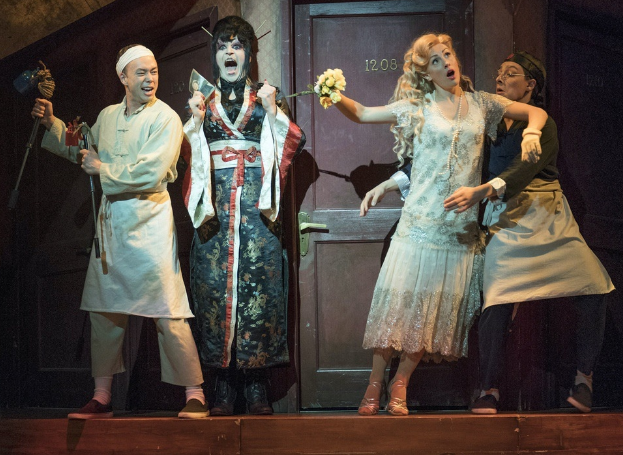

However the biggest failing of the show is the plot line of Millie's hotel being a cover for white slave trade by the it's proprietor Mrs Meers.  The playing of the Mrs Meers character just kept reminding me - as AVENUE Q famously attested - that Evly One's a Rittle Bit Lacist.  Despite Lucas Rush's game performance, line after alleged funny line died as it hit the stage and the whole concept of Mrs Meers being a failed Broadway actor in drag just distanced the character further and further away from any possible interest.  The denouement has one of the main female characters falling in love with one of Mrs Meers' Chinese henchmen but it all felt like having your dodgy comedy oriental jokes with an odd liberal gloss.

The cast certainly gave it their all and the potentially colourless male lead was given a nice spin by Michael Colbourne.  Richard Meek also managed to build up interest in the under-written role of Millie's boss Graydon but an over-played drunk scene made me wonder had he ever actually been drunk himself.  There is also a performance of clanging bad acting by the head of the typing room where Millie works which we will draw a discreet tarpaulin over.


Luckily there are two glittering performances that simply highlight some of the thin performances elsewhere. I had never seen Hayley Tamaddon on stage before but she made a totally winning Millie.  She has a nice belt of a voice and a real watchability on stage; she has had a career in television soaps but she certainly has enough charisma to hopefully become a fixture on stage.

In the role of Muzzy Van Hossmere - which gave Carol Channing her one moment of film fame - we have Nicola Blackman oozing class and bonhomie.  Nicola is one of the increasingly rare performers who, when they come on stage, you know you can just relax in the knowledge that someone on that stage knows *exactly* how to place their performance.  Muzzy's two contrasting numbers gave Nicola the chance to bring a Porter-like throb to her first act paean to New York and to swing out in her second act cabaret number.  Between Tamaddon and Blackman, the show finds it's heart.


I suspect I was the only one in Richmond who groaned loudly when the tallest chorus girl was introduced as Dorothy Parker, who in real-life was as short as her wit was large.  However, I would recommend the show if it comes your way. 


Saturday, February 25, 2017

EARLY ADVENTURES at Richmond Theatre - Matthew Bourne goes back to before...

Happy Anniversary to Matthew Bourne who has been choreographing and leading his own dance companies for 30 years - a remarkable achievement for a choreographer.  To celebrate this anniversary, we have had the new and thrilling new production THE RED SHOES and his WWII spin on Prokofiev's CINDERELLA will be revived at Christmas but in the meantime we have a tour of three early works which show the genesis of the Bourne style EARLY ADVENTURES.


It was a bit of a culture shock seeing it, coming so soon after being immersed in the stage and screen representations of the Royal Ballet's profound WOOLF WORKS, at first it seemed a bit too lightweight and throwaway, but it won over with it's abundance of cheeky irreverence and winning style.  The patrons at Richmond seemed a bit thrown by the brevity of the works - the whole triple bill was over in two hours - but they were just the right length.

It is proof that Bourne's style arrived fairly well fully-formed; there are moves in these early pieces which would not have looked out of place in 2016's THE RED SHOES.  His whole style can be traced to his Laban training: the principal tenets of body - effort - shape - space could almost describe his choreography.  But Bourne infuses his choreography with a delicious sense of fun and character; sometimes this can overtip productions - EDWARD SCISSORHANDS is all character and very little actual dance - but when the balance is right it's wonderful.


First up was the only one of the three I had not seen, WATCH WITH MOTHER from 1991, Bourne's take on a 1950s "music and movement" primary school class.  Danced to music arranged by Percy Grainger and featuring moments from Joyce Grenfell's school teacher sketch, the company of nine dancers, 3 female and 6 male, had great fun with their skipping, leaping and stretched movements.  This was one of the first pieces that Bourne worked on and it shows the youthful zest of Bourne finding his visual language.

The second (and third as it was broken up by an unnecessary interval) was TOWN AND COUNTRY, Bourne's hymn of praise to all things English.  By far the more interesting of the two sections TOWN gave a particular spotlight to the ever-dependable Danny Collins as a ukulele-playing butler and a sneering waiter in a tea-room which features in Bourne's loving tribute to BRIEF ENCOUNTER only this time there were two pairs of Alec and Laura's!  Meanwhile a posh couple get undressed and bathed by their stoic servants, a male gay couple slowly express their love and the whole company whiz around the stage on scooters - see hipsters, you didn't invent them.  The soundtrack is delicious with, among others, Noel Coward, Rachmaninoff, Eric Coates and Jack Strachey's glorious IN PARTY MOOD (aka the 'Housewives' Choice' theme).


The COUNTRY section is my least favourite, I find it outstays it's welcome but there was still nice moments including clog-dancing yokels right out of LA FILLE MAL GARDE, indeed their galumphing about cause the death of a cute hedgehog - don't panic he's a glove-puppet.

The final section was my favourite, THE INFERNAL GALOP from 1989.  Bourne's tribute to all-things Parisian includes the mer-man (dressed in silk dressing gown and socks) assisted by three matelots and the fabulous routine of two men attempting to have a rendezvous in a pissoir who are frequently interrupted by a mariachi band!  Although played for comedy, Bourne's choreography for the two men is outstanding and very sexy, the pay-off is also a surprise!


It was lovely to see these three works onstage, the company were full of character and great fun, Bourne's regular stage designer Lez Brotherston provided a simple canopied set which finally paid off in the final section and Andrew Murrell was responsible for the atmospheric lighting - although whoever was in charge of the dry-ice might think twice about swamping the stage so much for the start of THE INFERNAL GALOP.

The EARLY ADVENTURES tour continues in Oxford, Poole, Madrid, Blackpool, York, Liverpool, Sadler's Wells (the company's regular home in London), Northampton and Beverly Hills - if you are in the area do see this delightful, frothy production.


Friday, January 23, 2015

A Shaw thing: WIDOWERS' HOUSES, Orange Tree Theatre


Well last week was a novel experience - I went to a theatre I had never visited before!  Yes, Constant Reader, believe.

I have wanted to visit the Orange Tree Theatre in Richmond for a while as they have a policy of staging little-seen and neglected plays but had hitherto put it off.  The news that they were staging George Bernard Shaw's 1892 play WIDOWERS' HOUSES was the spur to finally go.


My default setting for Shaw is "Oh my lord all those WORDS" but on reflection I find that more often than not I have enjoyed what I have seen.  Of his many plays I have seen MRS WARREN'S PROFESSION, HEARTBREAK HOUSE, PYGMALION and SAINT JOAN in the theatre, as well as having seen CAESAR AND CLEOPATRA, MAJOR BARBARA, PYGMALION, SAINT JOAN and THE MILLIONAIRESS on film and television.  Yes that hectoring tone is always lurking in the background somewhere but I have enjoyed the plays seen.

WIDOWERS' HOUSES actually plays like a fast-paced drawing-room comedy but with lurking shadows among the teacups.  Shaw was 36 when it was staged at the Royalty Theatre in 1892 and it proved to be his first major success.  However it is not seen as regularly as some of his other works, I had only heard of one production before in 1970 at the Royal Court with Nicola Pagett, Frank Middlemass, Anthony Newlands, Robin Ellis and a young Penelope Wilton.  Mind you, it has only been staged on Broadway once - and that was in 1907!


Shaw sets up the play as a romantic comedy but then pulls the rug under our expectations.  Idealistic Dr. Trench is holidaying in Germany with his affected friend Cokane and has fallen for one of their fellow travellers Blanche Sartorius but although she is more than happy to reciprocate his feelings, Trench has to win over her stern widowed father, a secretive self-made man.

Back in London, Trench discovers that Sartorius has made his fortune from being a slum landlord, squeezing extortionate rates from tenants in poorly-maintained flats in deprived areas.  Sartorius even dismisses his unctuous rent-collector Mr Lickcheese for sympathising with his tenants' well-being.  Trench's shock is compounded when Sartorius reveals that the doctor's income is drawn from interest accrued from a mortgage on one of Sartorius' buildings!  Trench is further disenchanted when Blanche refuses to live without her father's 'tainted' money that has kept her in the style she has come accustomed to and they call their engagement off.


Four months later Sartorius is visited by a newly wealthy Lickcheese, grown rich by investing in a dodgy property company that renovates tenements to hopefully sell on or knock down for municipal building projects.  Sartorius' buildings - the Widowers' Houses of the title - are of interest to the company and Lickcheese hopes to persuade his former employer to join in the scheme so they can all get rich quick - including a certain doctor who has a mortgage on one of the houses.

Will Trench remain unsullied by the nefarious property deal or will he ditch his principals for a piece of the action and the chance to reconcile with Blanche?  It all leads to a surprisingly modern ending.


As I said, I was quite surprised how much I enjoyed the sharply defined characters and the swift pace.  The small in-the-round Orange Tree auditorium suited the piece well, giving the action an intimate immediacy.  

Simon Daw's design idea of having the playing area surrounded by a frieze of Charles Booth's 'poverty' map of central London helped to visualise the play's themes as these iconic maps were published around the time that Shaw wrote the play.


The Orange Tree's new Artistic Director Paul Miller's direction brought out Shaw's moments of comedy and drama in equal measure and he elicited strong performances from Patrick Drury as the commanding Sartorius, Alex Waldmann as the baffled Trench, Stefan Adegbola as the preeningly pretentious Cokane and it was a delight to see Rebecca Collingwood as the opinionated and 'modern' Blanche.  

We saw her last year in GRAND HOTEL, her final year production at the Guildhall Drama School, where she was an eye-catching and vivacious Flaemmchen so it was a thrill to see her again at the Orange Tree making her professional stage debut. Simon Gregor certainly made a splash as the oily Lickcheese - another of Shaw's working-class characters who refuse to know their place - but the Dickensian caricature he gave us was sometimes at odds with the more restrained performances around him.


As I have said, I was surprised how much I enjoyed WIDOWERS' HOUSES and hope to visit the Orange Tree again - even if the 'age specific' sold-out audience made it's small bar/foyer and narrow staircases a bit of a logistical log-jam.