Showing posts with label Franz Waxman. Show all posts

Sunday, July 04, 2021

DVD/150: BRIDE OF FRANKENSTEIN (James Whale, 1935)

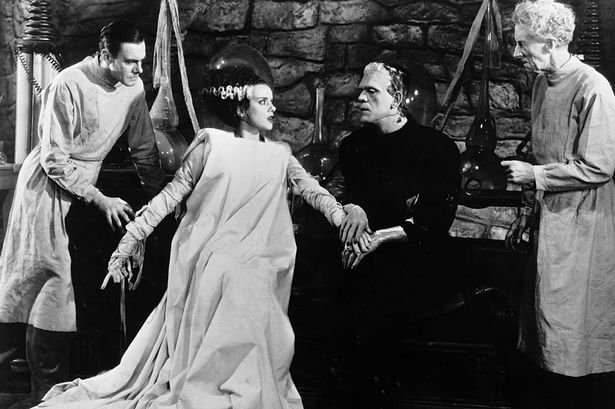
86 years on, James Whale's film re-generates with every viewing, just like his iconic Bride...

The greatest of all the Universal horror films crackles with invention, wit and a deliciously perverse subtext - all the more remarkable that James Whale wasn't interested in making the sequel.

The script went through seven writers before Whale was satisfied.

We start with Mary Godwin, Byron and Shelley discussing her novel followed by a FRANKENSTEIN montage to pick-up the storyline, swirling through to the final cataclysm - Elsa Lanchester playing both Mary and The Bride provides a wonderful symmetry.

Boris Karloff and Colin Clive return as monster and maker. Whale refused to give up on his alcoholic friend Clive who died two years afterwards from TB.

Karloff built on his performance to suggest the soul within the monster, oddly he disliked the idea of the monster learning to speak.

BRIDE OF FRANKENSTEIN lives....


Shelf or charity shop?  It's what shelves were made for... One of the rare sequels that outshines the original, Universal gave James Whale full artistic control after the success of FRANKENSTEIN and his vision was brought to vivid life by cinematographer John C Mescall, production designer Charles D Hall, costume designer Vera West, make-up artist Jack Pierce, Kenneth Strickfaden's electric laboratory props and composer Franz Waxman. Whale cast UK actors in all six lead roles: apart from Karloff, Clive and Lanchester, the film benefits from the lip-smacking eccentric campness of Ernest Thesiger's Doctor Pretorius, Henry's former professor who lures him back to the dark side. 17 year-old Valerie Hobson was cast as Elizabeth when Mae Clarke was too ill to reprise her role - Hobson is quite wonderful especially considering her age, and finally Belfast-born Una O'Connor plays the bustling, shrieking maid Minnie.  Australian actor OP Heggie is marvellous as the blind hermit who provides the monster with a few hours of understanding, while FRANKENSTEIN'S scuttling servant Dwight Frye returns to play another sniveling underling.  Elsa Lanchester's Bride is onscreen for only 3 and a half minutes but in that brief time a screen icon was born: swaying, imperious, scared and disdainful..

...and The Bride made a memorable reappearance at The Retro Bar in 2005...

Tuesday, March 30, 2021

DVD/150: SUNSET BOULEVARD (Billy Wilder, 1950)

On the date of Gloria Swanson's birth day and Billy Wilder's death, I watched his masterpiece SUNSET BOULEVARD.

As with other classic films it could have been so different - Wilder's first choice was Mae West and Marlon Brando!

Luckily they passed and Wilder cast the iconic trio of William Holden as penniless scriptwriter Joe Gillis, Gloria Swanson as the faded silent star Norma Desmond and Erich von Stroheim as her servant Max, who later reveals he was once Norma's director and first husband.

Wilder utilised both of their histories: when Joe and Norma watch one of her silent films it is 1929's QUEEN KELLY which starred - and was produced by - Swanson and directed by von Stroheim until she sacked him and stopped filming.

This scathing satire on life and death in Hollywood is ageless and Wilder's biting wit still cuts deep: by turns, it's funny, scary, perceptive, tragic and haunting.

Shelf or charity shop?  Eternal shelf life.  SUNSET BOULEVARD received 11 Academy Award nominations but only won three: screenplay (by Wilder, Charles Brackett and DM Marshman), art direction and Franz Waxman's lush score. Yes it was up against ALL ABOUT EVE but you suspect that made it easier to bypass such a bitter anti-Hollywood film. Wilder's direction wonderfully balances the operatic drama with cutting humour.  The smiles mostly come from William Holden's sardonic Joe - an opportunity he grabbed with both hands, after being type-cast in nice-guy roles,  But Wilder saw something deeper in him, his next film with Wilder, STALEG 17, won him his Best Actor Academy Award.  Gloria Swanson's screen career had dwindled in the 1930s but, unlike Norma, she had kept busy on stage and radio.  She totally inhabits Norma's deranged majesty however while shading it enough to bring moments like her delicious impersonation of Chaplin - who had directed her in 1915!  Her legendary final scene, as insane Norma descends her staircase, thinking she is playing Salome for DeMille, is still unforgettable.  Erich von Stroheim underplays rather than chewing the scenery, while Nancy Olson is delightful as Betty, the young writer who offers Joe a chance for escape.  Wilder cleverly cast former silent stars as Norma's bridge-playing friends: Buster Keaton is the only one known to viewers today, the others are Anna Q Nilsson - the first Swedish Hollywood star, before Garbo and Bergman - and HB Warner who played Jesus in KING OF KINGS, directed in 1927 by Cecil B DeMille who himself has a sizeable cameo as himself; also seen is real-life gossip columnist Hedda Hopper, phoning in her breaking news from Norma's bedroom at the film's climax.


Friday, March 26, 2021

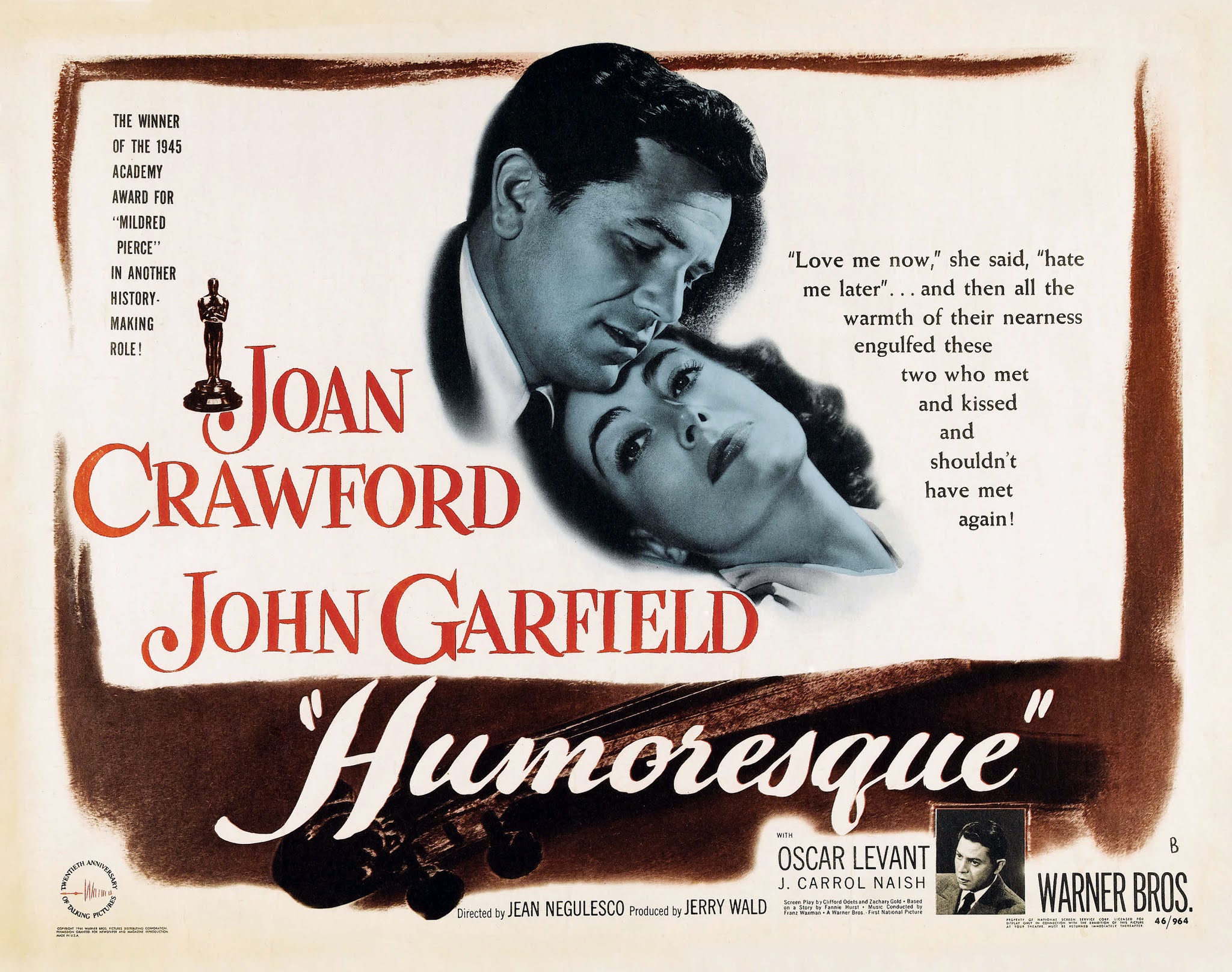
DVD/150: HUMORESQUE (Jean Negulesco, 1946)

After her Oscar-winning triumph in MILDRED PEARCE, Joan Crawford then delivered another iconic performance in HUMORESQUE, easily holding her own opposite intense John Garfield.

Previously filmed by Frank Borzage in 1920, this time screenwriter Clifford Odets borrowed from the premise of his own play GOLDEN BOY.

Paul Boray, a New York grocer's son, is a talented classical violinist, although success eludes him, but he is pushed on by his devoted mother.

Paul and his pianist friend Sid attend a swanky party; he plays his violin but is antagonistic at the patronising attitude of the hostess Helen Wright, an arts patron who is bored with her retinue of adoring men and her loveless marriage.

Helen is attracted to Paul however and secures him a manager and finally, his success.  Of course they become lovers - much to his mother's displeasure.

But love doesn't bring them happiness, just a lonely Wagnerian ending...


Shelf or charity shop?  For God's sake... it's Joan in a sequinned Adrian gown getting drunk to the Liebestod!  I have always had issues with HUMORESQUE however, Jean Negulseco's direction plods along, taking it's sudsy time to bring Crawford into the film while over-indulging the boorish performance from Oscar Levant as the pianist friend. The amount of screentime afforded Ruth Nelson's sanctimonious and provincial mother is irkesome too - the idea is problematic that the hero should not stray from hearth and home, his emotionally-dead mother and dreary childhood sweetheart; the final image of Paul walking back to the family store one presumes is meant to be heartwarming but it strikes me as singularly awful.  John Garfield gives a steely performance as Paul but needless to say the film comes alive with the arrival of Joan Crawford as the glacial Helen, and she, cinematographer Ernest Haller and composer Franz Waxman deliver two glorious scenes without dialogue - Helen drifting into an ecstatic reverie in the concert hall at Paul's violin playing, totally unaware of the cold stares from his family, and the famous scene as Crawford, alone and intoxicated, becomes one with Wagner, the wind and the sea...