I have just read an interview with James Earl Jones in which the woeful 2013 Old Vic production of MUCH ADO ABOUT NOTHING was mentioned.
Interviewer: You were doing DRIVING MISS DAISY as you were memorizing
MUCH ADO ABOUT NOTHING last year. Was that tricky to juggle both in your
brain?
JEJ: Well, I had mostly already memorized MUCH ADO. Knowing my lines didn't help, though - it was a horrible production.
Interviewer: What a shame. You and Vanessa Redgrave as a much older Beatrice and Benedick was such a unique idea.
JEJ: Yes, it was a unique idea, but it got lost. Wasted. Honestly, I should have bowed out of that production.
Yes James, you should have done.
From my blog: "I wish I could say the same for Earl Jones. He rumbled through his speech making no sense whatsoever and when he said "No, the world must be peopled" I am sure I was not the only one thinking "Love, you're 82!"
It wasn't his fault, he was saddled with a woeful concept by director Mark Rylance. He might have talent as an actor but he obviously can't even direct piss into a bucket.
Sometimes it takes a while to get used to an auditorium. You go, you see productions but nothing particularly happens around you, the walls don't bounce anything back at you. It usually takes a great production to get you to react to the space as well as to what you are seeing.
I have been to the Globe Theatre at Southwark a few times but have never liked any of the productions enough to warm to the theatre itself, however I think that might now have changed thanks to Lucy Bailey's thrilling, notorious TITUS ANDRONICUS.
It's not that often that theatre productions - classical theatre productions at that - jump from the review pages into the news sections of papers but Bailey's production has been getting column inches over the number of audience members who have been passing out during the more gory moments of Shakespeare's first revenge tragedy. Yeah, sure I thought. Good going Globe on the hype.
I had never experienced TITUS on stage before but had enjoyed Julie Taymor's stylish 1999 film adaptation starring Anthony Hopkins as the put-upon Roman general, Jessica Lange as his nemesis Tamora Queen of the Goths and Alan Cumming (channelling his performance of the MC in CABARET) as dissolute Emperor Saturninus.
Owen had booked the tickets in a rush of Shakespearean vigour after we saw Eileen Atkins' magical Ellen Terry show in the new Wanamaker Theatre next door to the Globe and as the days drew closer to last Thursday I found myself getting more excited about seeing it. Our seats were at the end of the first circle so we had the stage side-on to us but also a good view of the groundlings. This was actually a stroke of luck as Bailey has the action spill off the stage and in and around the standing punters who were - not too politely - pushed around by the actors to make way for moving metal platforms, marching soldiers etc. Those at the front were also frequently exposed to thick plumes of smoke that issued out from under the stage! That'll learn 'em.
William Dudley's design has the usual brightly coloured stage swathed in black material and black netting stretches across the open roof to echo the design of Roman Pantheon. Two large smoking braziers billowed the heavy scent of incense into the air which added to the sombre, claustrophobic atmosphere.
Titus returns to Rome victorious from a war against the Goths with his captives: Tamora, the Queen of the Goths, her three sons and her servant (and secret lover) Aaron the Moor. To avenge two of his sons who were killed in battle he orders for Tamora's eldest son to be executed. Despite Tamora's desperate pleas for mercy from one parent to another, he carries out her son's death. As in KING LEAR one misjudgement brings down tragedy. Tamora vows she will avenge this cruel act, with the chance coming sooner than she expected.
Rome is in tumult with the dead Emperor's sons, Saturninus and Bassianus, challenging for the throne. The people of Rome however declare they want Titus to be Emperor. He, always the good servant to the elite, refuses them and declares his support for Saturninus. Saturninus repays him by announcing he will marry Titus' daughter Lavinia despite the fact that she and Bassianus are betrothed. When the couple and his other sons react angrily to the Emperor, an angry Titus lashes out and kills his younger son. Bored at their in-fighting - and to punish Titus - Saturninus chooses to marry Tamora instead. Immediately grasping her chance, Tamora implores her new husband to forgive the Andronicus family and to let Lavinia and Bassianus marry.
Tamora, Aaron and her two remaining sons Chiron and Demetrius enact their revenge during the Emperor's hunting party in a forest. Trapping the young lovers alone, Tamora's sons murder Bassianus and throw his body in a camouflaged pit and, with Aaron goading them on, rape Lavinia and, to stop her from identifying them, cut out her tongue and cut her hands off. Aaron frames Titus' sons Martius and Quintus to make it look like they murdered Bassianus and Saturninus orders their execution.
Titus' brother Marcus discovers the mutilated Lavinia and brings her to Titus closely followed by Aaron who tells Titus that Saturninus will spare his sons if Titus cuts off a hand and sends it back with Aaron. Although Marcus and his last living son Lucius argue over the action Titus does what is demanded and a gloating Aaron leaves. Yes you guessed... his dismembered hand is returned to him, along with the severed heads of his sons.
Well these are the scenes that sort out the men from the boys. As Lavinia tottered onto the stage, mouth pouring blood and jerking her stumps about I noticed in my peripheral vision the first person being helped out of the pit in a wheelchair... then I saw a tall man in a suit towards the back of the standing punters go *wobble* *crash* - cue another wheelchair appearing to help him out! As Titus hacked off his hand upstage we heard a dull thud from further along from us and as Lavinia coughed up another stream of blood onto the stage I saw a girl being led out from the audience standing at the front of the stage shaking and white as a sheet.
Me? I was grinning from ear to ear! Partly because the ushers who were doing the fetching and carrying were all old grey-haired ladies who are obviously used to all this carry-on and also because I could see, in my mind's eye, Shakespeare then a successful playwright in his late 20s around 1591 cackling with delight as, quill in hand, he wrote quickly across his parchment saying "Oooh I can do this - and then I can do this - oh and I can do THIS too!" The play exhibits his excitement at attempting his first revenge drama, a genre that had been hugely popular since Thomas Kyd's THE SPANISH TRAGEDY about ten years before.
I found it fascinating to see that here that, despite all the travails that he suffers, Shakespeare cannot make Titus a sympathetic character. I likened it earlier to KING LEAR and although Lear also starts out as a vainglorious tyrant, by the end of that play Shakespeare has made him a universal figure for pity and sympathy - by the time we reach the famous climax of TITUS with the stage looking like a charnal house, Titus is exactly the same as he was at the top of the play. I think this is due to the 15 year gap between the plays during which Shakespeare honed his craft and discovered how to give his characters more internalisation.
Something else that struck me is - as in LEAR - no mention is ever made of Mrs Andronicus. Is she still living? If she is why doesn't she ever come out of the house? I can only presume that she wore out from giving birth to Titus' seven children. Indeed Lucius, the only son left alive at the end of the play, has his own son - Shakespeare could only stretch to Young Lucius as a name - with no mention again of a wife/mother.
I must admit that a couple of times John Gielgud came to mind too. He never played the role - it's remarkable how few of our acknowledged great actors have - but a critic once said of him that in tights he had "the most meaningless legs imaginable"! That quote came to mind when I saw Steffan Donnelly as Bassianus standing on two strings of spaghetti with knots tied in the middle - they were quite distracting.
Gielgud also saw Peter Brook's 1955 production at Stratford which starred Laurence Olivier as Titus and Vivien Leigh as Lavinia. In the play, Titus has Lavinia hold a stick between her stumps and write the names of the rapists in the sand and on the night Gielgud was in, Vivien dropped the stick while she was attempting to write the names. He went to see her backstage and greeted her with "Butterstumps!" In a letter afterwards he wrote that Olivier was excellent, but that "poor Vivien seems in a very bad way. She is utterly ineffective on the stage, like paper, only not so thick".
Lucy Bailey (this is a revival of a 2006 production when Douglas Hodge was Titus) has directed the play with a remarkable clear-eyed approach, the three hours runing time slip by unnoticed, and her determination to stare the atrocities of the play in the face gives it the intensity that so lays waste some members of the audience.
What was fascinating is how she has found the underlying black humour so integral to the play's strength, there were as many intentional laughs as horrific moments - but then the best horror is offset by humour. If you thought Iago was unapologetically gleeful in his actions, wait till you meet Aaron whose last lines sum up his nihilism while being led to his death:
In the best performances of the evening, Obi Abili was excellent as Aaron, seizing every opportunity to delight in his actions and to include the audience in on his intentions while Indira Varma was deliciously nasty as Tamora, turning on a Denarius from Saturninus' conciliatory bride to Aaron's ravenous lover to Titus' Furie.
But is she evil? Tamora has every right to want Titus's downfall due to his unwarrented killing of her son and is he the good character in his own story? Titus is a domineering military bully who kills his youngest son for daring to stand up to him and who has little concern for his daughter's happiness and even Lavinia displays nothing but withering contempt for Tamora and her plight. What makes Aaron and Tamora evil is the way they set about their revenge.
I also liked Matthew Needham's whining demanding Saturninus, a nasty spoilt brat playing at being a grown-up and Samuel Edward-Cook and Brian Martin were also good as Tamora's muredrous sons. Flora Spencer-Longhurst was an affecting Lavinia but the role is a difficult one with few lines at the start of the play to engage the audience and then being but a mute witness to the events that follow her rape and mutilation. I also liked Ian Gelder as a sympathetic Marcus Andronicus. I also want to credit the nerve-shredding score of Django Bates.
William Houston was certainly effective as Titus but I grew to dislike his schtick of going from a resonant chest voice up into a wheedling head voice when exasperated or feining madness. Despite these occasional flaws I loved this production for introducing me properly to Shakespeare's gory early play and for it's heightened theatricality - and yes, I think I have come to appreciate the Globe's special atmosphere.
Now if they could just sort out the Hell that is the forecourt during the interval.
This year marks the centinery of visionary theatre director Joan Littlewood's birth and Theatre Royal Stratford East are celebrating by staging revivals of two of her iconic shows, both directed by Terry Johnson. A few months ago I saw the affecting but slightly under-powered OH WHAT A LOVELY WAR but now he is on surer ground with a punchy and rollicking production of Lionel Bart and Frank Norman's FINGS AIN'T WOT THEY USED T'BE. As with OH WHAT A LOVELY WAR it was so exciting to see these on the stage where they were created by Littlewood.
In 1958 Frank
Norman submitted his first play to Littlewood's Theatre Workshop at
Stratford East. She thought his story of Soho crooks and prostitutes
- drawn from a milieu that ex-con Norman knew all too well - would be more effective with songs from a previous collaborator Lionel Bart, mainly known as a pop song writer, who had recently written the score for his first musical LOCK UP YOUR DAUGHTERS. The show was a huge success, transferring to the Garrick where it ran for 886 performances
and won the Evening Standard Award for Best Musical. By the way, the choreographer for the production was Jean Newlove, pregnant at the time with her daughter Kirsty MacColl.
The West End cast - recorded 'live' on the album - was one I would now
kill to see: Glynn Edwards as Fred Cochran, the crook who owns a
gambling club/brothel, Miriam Karlin as Lil, his long-suffering lover who runs his decrepit knocking shop, James Booth as Tosher,
Fred's second-in-command
who pimps the brasses Rosie and Betty, played by Barbara Windsor
and Toni Palmer, Wallis Eaton as the camp interior decorator Horace, Tom
Chatto as the bent local Police Inspector and, among the supporting
cast, a young Yootha Joyce. That album is so packed with larger-than-life vocal performances that it's hard for any revival to match it but Johnson has given us a production which leaps off the stage with full-on attack and neon-lit characterisations.
I had seen the show when it was revived in 2011 by the Union Theatre and while that production was compromised by bad design and a shocking supporting performance - see here for that blog review - it's nice to see two of the better performers appearing here, Ruth Alfie Adams and the unstoppable Suzie Chard. Norman's book has been revised by Bart afficianado Elliot Davis so it was a bit jolting for songs to pop up out of their usual context and sung by different characters. The score has been filled out with three of Bart's early hits - WOULD YOU MIND?, LIVING DOLL and SPARRERS CAN'T SING - which are nice to hear but do stand out from the score's particular sound but I must admit that even Davis has not managed to fix the plot's odd climax which seems to stop too soon and then take a long time about it. Davis is also the musical director of the onstage band.
A big plus is William Dudley's evocative basement spieler and costumes as well as a clever use of video footage to suggest the Soho world above. The show was enlivened by Nathan M. Wright's inventive choreography, a constant delight. But what raised the roof and rattled the rafters were the vibrant performances. Jessie Wallace, while essentially playing a variation of her "Eastenders" character Kat, gave a full-on performance as Lil, her weariness at her unfulfilled life with Fred very palpable and she belted Lil's great songs with real brio. Mark Arden played Fred with a real menace although his 'dead 'ard' accent was a bit overdone. One of the surprises was Gary Kemp who played the bent copper PC Collins with a welcome light touch and sang his big number COP A BIT OF PRIDE well.
He had the added pleasure of sharing his number with the fabulous Suzie Chard who brought big hair, big personality, big boobs and more importantly a big voice to the role of Betty the tart with a heart of pure brass. She belted over her number BIG TIME with the attack of the late and great Georgia Brown and it was lovely to see her again. Oddly enough although she played the same character at the Union Theatre, there she was named Barbara!
A real standout was Sarah Middleton as Rosie, the young runaway who Tosher recuits as the latest addition to his stable. She had a nice presence on stage and her performance of Rosie's big song WHERE DO LITTLE BIRDS GO TO? was wonderful. Christopher Ryan also made a big impression as the eternal jailbird Red Hot, always on the cadge and with knocked-off goods to sell. The supporting cast also featured fine work by Will Barton and Vivien Carter as the posh couple who arrive at the spieler.
The cast had a few mis-steps too: Ryan Molloy played the gay interior decorator Horace but, while not as atrocious as the Union Theatre actor, again this role was over-played to the nth degree and it was not surprising that his laugh lines went for nothing while Stefan Booth was oddly over-emphatic as Tosher. But these can be overlooked easily as the show was so hugely enjoyable, it would be great if it had a continued life after it's scheduled run. It deserves a West End run just like it's original incarnation to enliven the current London theatre musical scene.
Well done Startford East on the genius stroke to reprint the original 1959 programme! Who knew that the very first production featured A TASTE OF HONEY writer Shelagh Delaney playing a young "mystery" and that none other than Richard Harris played the crooked copper Collins? I wonder whatever happened to Mrs Parham who sold drinks in the long bar, Mrs. Murphy who sold teas in the snack bar and Miss Darvill who ran the box office? After seeing FINGS, again I find myself wondering when will we see a revival of Lionel Bart's Liverpool musical MAGGIE MAY which played at the Adelphi in 1964, first with Rachel Roberts then Georgia Brown in the title role and a young Julia McKenzie in the chorus.
A few weeks ago we saw GOOD PEOPLE by David Lindsay-Abaire, a recent off-Broadway play about the echoes of the past catching up with a woman and last week we saw another recent off-Broadway play about, um, the past catching up with a woman. I guess when it comes to American imports there are only seven stories.
The Old Vic has reconfigured it's auditorium for Jon Robin Baitz' OTHER DESERT CITIES so it is played in the round and it was great fun to sit in that familiar theatre but with a totally new viewing experience.
It was also a good choice for this play. I suspect if the play had been presented within it's proscenium arch it might not have been too involving.
Baitz has had a career on both stage and small screen - he was the creator of the Sally Field TV series "Brothers and Sisters" - and towards the end of the play The Big Reveal had all the elements of a end-of-season cliffhanger. For the most part I enjoyed it but, as with most plays that arrive here garlanded with awards and the praise of NY critics, the overall feeling is one of thinness.
The play takes place in the luxurious Palm Springs home of ex-actor Lyman Wyeth and his ex-scriptwriter wife Polly in 2003 against a backdrop of the first Iraqi war. The Christmas family gathering includes daughter Brooke who has just flown in from her home in New York - immediate shorthand for 'rebellious daughter' - TV executive son Trip (oh those names) and Polly's outlandish sister Silda, who co-wrote with Polly in the 1960s and now spends most of her life checking in and out of rehab.
Brooke has not visited in six years as she has been struggling with depression while attempting a follow-up to her debut novel and she soon locks ideological horns with her Republican parents while Silda snipes from the sidelines. Trip, who produces a courtroom reality tv series, is the voice for populism and just having a happy time. Brooke has not arrived empty-handed however as she has brought the proofs for her new book: a family memoir that includes her older brother Henry, now dead after killing himself in a terrorist bomb plot.
Baitz' play has distinct echoes of Edward Albee's more enigmatic A DELICATE BALANCE -
married, well-off couple are beset by the wife's alcoholic sister and
their resentful daughter - but, while being a general state-of-the-nation play, his work mostly touches on the responsibility of the artist using their family as inspiration, the spiky relationships between siblings both old and young, and of course, the eternal push-pull atmosphere between parents and children.
As I said, Baitz delivers a plot twist towards the end which I felt reduced the play to a soap-opera but I guess it did set up a nicely poetic final scene for Martha Plimpton's Brooke.
What I enjoyed most about the production, which was directed with a good sense of pace by Lindsay Posner, was the three central female performances: Clare Higgins, Sinead Cusack and Martha Plimpton.
Clare Higgins played Silda with her usual hard-edged style but Baitz does not really give her a good meaty scene to let rip, this addicted sister was an oddly muted character for all the fireworks that were expected. No such problems with Sinead Cusack who was excellent as the unapologeticly right-wing Polly, a mother who views her daughter as a total stranger - an addition to the Broadway cannon of unforgiving mothers. Martha Plimpton has morphed from being a child star of the 1980s into an accomplished stage performer and, making her London stage debut as Brooke, she was always watchable and more than held her own against two of our most charismatic actresses.
The men had less chance to shine against these fine actresses but Peter Egan was less milquetoast than usual as the urbane father who cracks at the seeming betrayal of his daughter's family memoir and is the keeper of A Big Secret while Daniel Lapaine had good fun as Trip, exasperated by his warring relatives.
An enjoyable play with an excellent cast but one that seemed to choose a distinctly Hollywood ending.
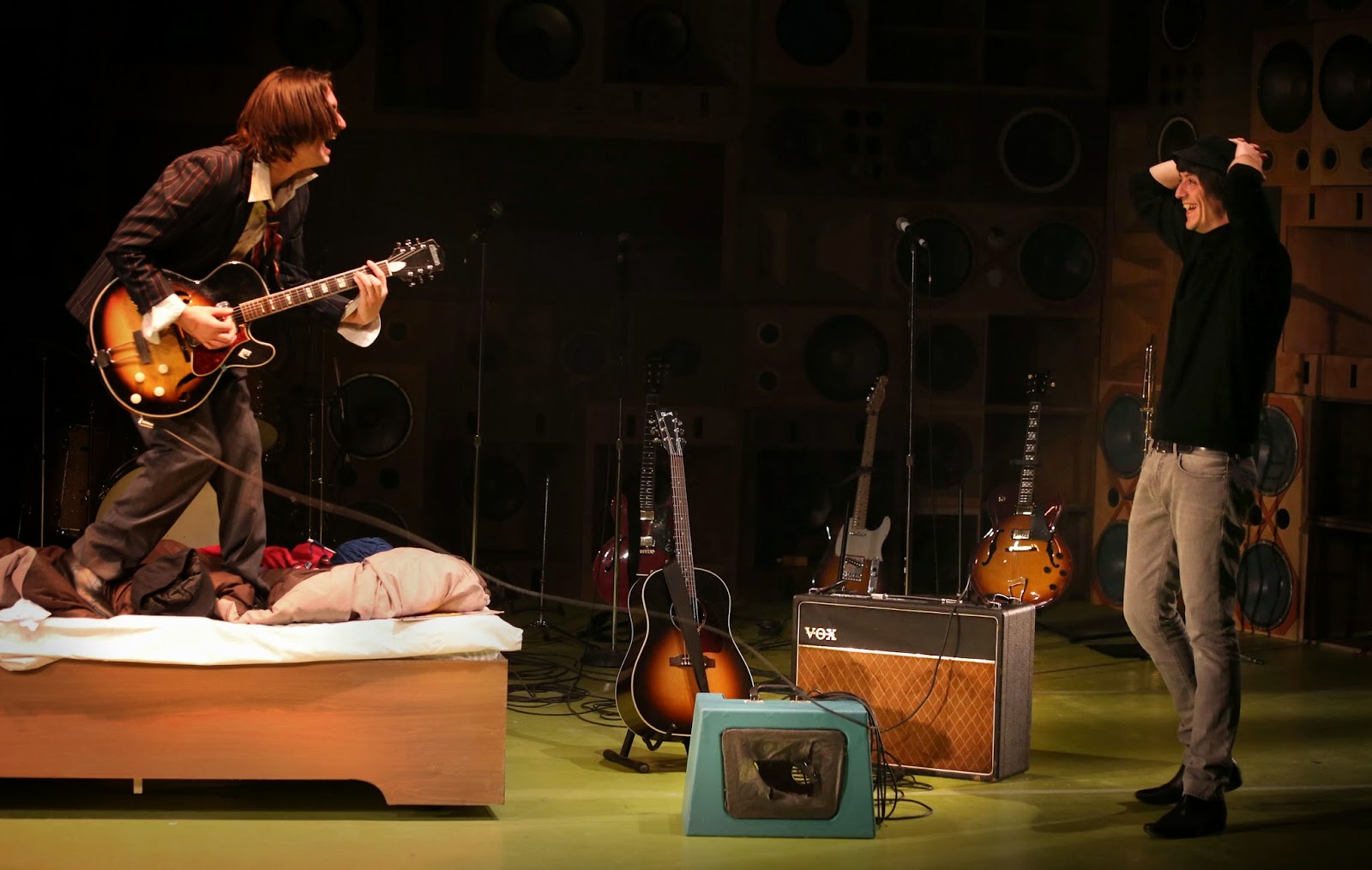
Constant Reader, you will know that I'm not the biggest fan of jukebox musicals. Along with the 'film-to-stage' show that have proliferated of late, the jukebox musical is the woeful sign of a race to the bottom mentality in theatre. However, when Hampstead Theatre announced they were staging a musical based on the rise of The Kinks using their marvelous back catalogue with the blessing of Ray Davies, well it was a no-brainer. I wasn't the only one either as the show is now sold out for it's run. Although there are some dodgy moments, the show - and the music - is ultimately triumphant.
All the usual elements are there in Joe Penhall's book: the humble beginnings, the sudden rise to fame, the inter-group rivalries that are thrown into sharp relief by the availability of drink and drugs and the inevitable nervous breakdown. Sadly - and although the real salient point of The Kinks' story is the shifting relationship of the brothers Ray and Dave Davies - Penhall's script settles for the sketchiest of details and told in clichéd lines that almost made me wonder whether he was deliberately attempting a strip-cartoon version of their story.
Luckily, the show also has Ray Davies' songs to flesh out the story. Ray Davies' songs always have been mini-chapters from an ongoing story and here they help move the story forward as well as being joyful celebrations of this most idiosyncratic of groups. Where Penhall does do well is sorting out the labyrinthine union politics that saw The Kinks being banned from playing in America for four years in the latter part of the 1960s.
Edward Hall directs the show at a galloping space which helps to cover the thinness of the book and wraps the action around the stalls auditorium, making full use of Miriam Buether's large stage and runway which stretches out into the middle of the stalls - and guess who was sat at the end of it? It was actually great fun to have the cast whizzing around past you - oh and I got pulled up out of my seat to join with the dancing to Britain's favourite song about a nightclub tranny "Lola"!
The busy cast all contribute to the show's success and the four lead players deserve all the kudos they will receive. Ned Derrington and Adam Sopp both had their moments to shine as bassist Pete Quaife and drummer Mick Avory, part of the group but always in the shadows of the fractious brothers. John Dagleish had one hell of a job taking on the role of Ray Davies and while he gave a sympathetic performance, he never totally convinced probably due to the fact that he looked more like Paul McCartney than our Ray!
Much more successful was George Maguire as the volatile Dave Davies, he was devilishly charismatic and to quote Lady Caroline Lamb's summation of Lord Byron "mad, bad and dangerous to know"! There were also nice supporting performances from Tam Williams and Dominic Tighe as the group's upper-class managers, Vince Leigh and Ben Caplan as their other managers and Philip Bird as the flashy Allan Klein. Lillie Flynn as Ray's wife Rasa wrestled with a rather thankless role.
The show concludes with the creation of Ray's masterpiece "Waterloo Sunset" - and yes, Constant Reader, that song worked it's magic on me once again. Terry and Julie crossed over the river again and I was in tearful paradise.
We flash-forward to 1970 and the magnificent "Lola", and by the time the cast had left the stage, I had a huge grin on my face and wanting this great production to transfer to the West End where it and it's wonderful score can be given a wider audience. In a perfect world, it would be in repertory with Ray Davies' haunting musical COME DANCING from 2008 which was his take on another moment from his past.
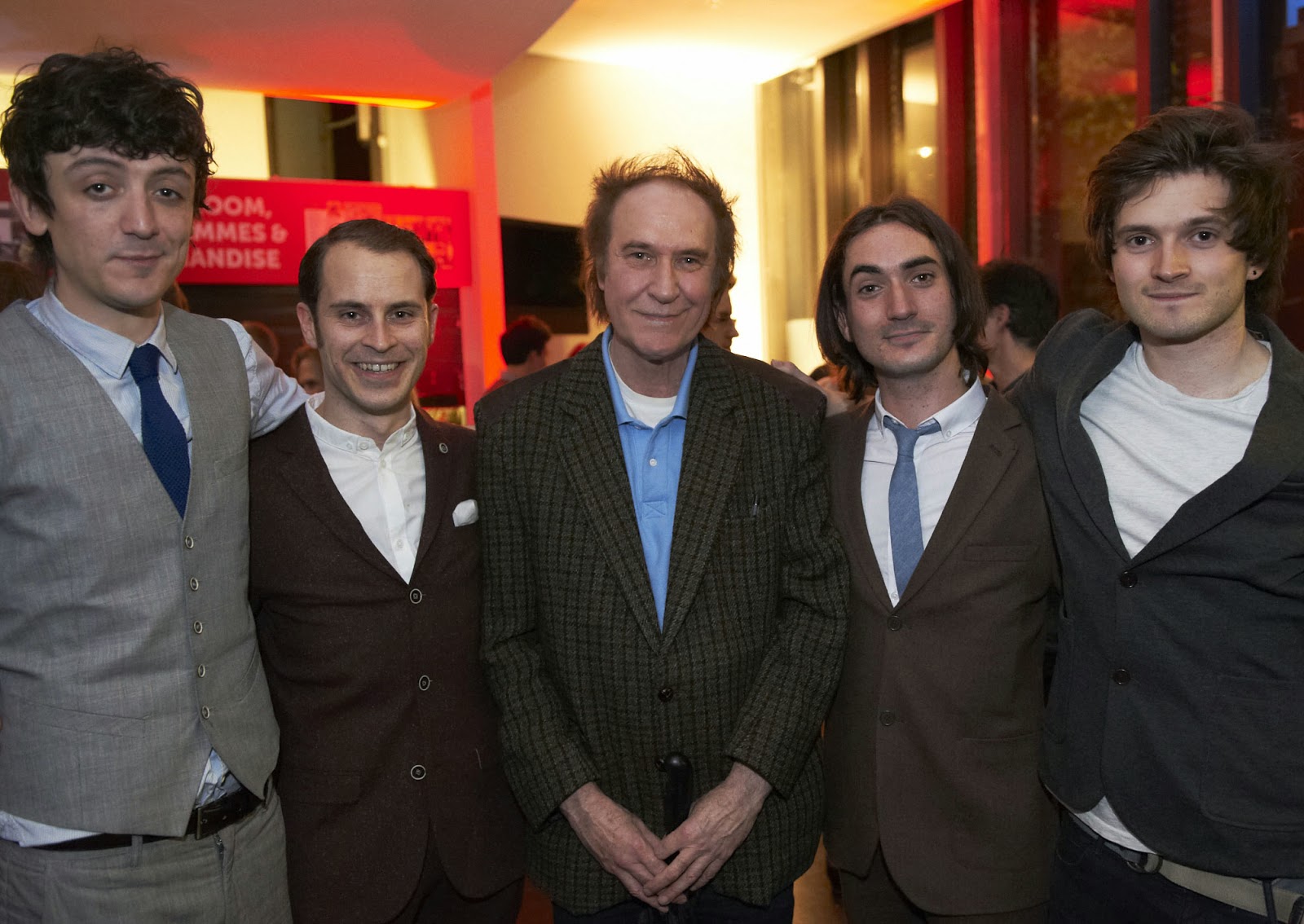
I hope he enjoyed the opening night at Hampstead...
After the hard-edged GOOD PEOPLE, it was time to relax into the chiffon-edged comedy of Noël Coward's BLITHE SPIRIT currently revived at the Gielgud Theatre with a long-overdue return to the London stage by Angela Lansbury. All very appropriate as John Gielgud had starred in and directed an ENSA touring production of the comedy during World War 2.
Michael Blakemore had previously directed Angela Lansbury in 2009 on Broadway in the play which won her a fifth Tony Award and here they are reunited with a new cast and production team. Unsurprisingly she has rooted herself into the character, making Madame Arcati her own.
Written by Coward in 1941, it was an instant hit - although Graham Greene found it "a wearisome exhibition of bad taste"! It went on to hold the record for the longest running play in the West End until "The Mousetrap" overtook it in 1957. David Lean filmed a screen adaptation in 1945 which featured the original players of Arcarti and Elvira, Margaret Rutherford and the delicious Kay Hammond, although this version had an alternate ending. The play has been revived frequently and I first saw it in 1986 at the Vaudeville Theatre with the perfect cast of Simon Cadell, Jane Asher (Ruth), Joanna Lumley (Elvira) and Marcia Warren as Arcarti.
Author Charles Condomine and his wife Ruth hold a soirée with the village doctor and his wife as well as the local eccentric Madame Arcarti with the ulterior motive of getting her to hold a seance so Charles can get material for a novel he is planning. During the seance however Arcarti "brings across" the ghost of Charles's glamorous first wife Elvira who has been dead for seven years and only Charles can see her. Elvira, as capricious in death as in life, causes mischief around the house much to Ruth's anger and Charles' bemusement.
He soon tires of her behaviour however when he realizes she has her own
agenda when she fixes the brakes on his car hoping he will join her
forever - but it's Ruth who uses the car first. Now with two ghostly wives making his life a misery he calls in Madame Arcarti to try and get them back to the other side. If only she knew how...
Michael Blakemore directs the comic business and Coward's devilishly witty dialogue to expert effect but also suggests the darker tones that lurk in the corners of the Condomine living room. Written two years into World War II where death was in everyone's consciousness, it's musings on the lingering effects of those departed must have made for a very heightened experience when first presented.
Simon Higlett's set has just the right feel of a home counties living room and also is entertaining in it's own right when the other world encroaches in on it which is also well-evoked by Mark Jonathan's lighting design.
Blakemore's cast also rise to the occasion with one clanging exception. The ever-reliable Charles Edwards is a delight as Charles, effortlessly spinning his lines with the lightest touch like the deftest of tennis players. But he also plays a man quietly delighted to be given a change from his second, rather conformist, marriage. Luckily Edwards is complemented perfectly by Janie Dee as Ruth. She showed her excellent comic timing time and again particularly in the classic exchange:
Charles: Anything interesting in The Times?
Ruth: Don't be silly, Charles.
Ruth can be a tough role - the character who wants to stop the madcap antics usually is - but Janie Dee is such an engaging stage performer that her dry delivery was a joy to behold.
I found the casting of Jemima Rooper to be a miscalculation however. Her childishly petulant pouts and squeaky voice seemed to belong to a totally different production and more than once I felt she was totally out of her depth with the quality of performance onstage. Simon Jones and Serena Evans made full use of their considerable experience to fill out the roles of Doctor and Mrs Bradman and Patsy Ferran made the most of the West End debut as Edith, the Condomine's gormless maid.
Needless to say Madame Arcarti's belated entrance on stage provoked a round of applause for Angela Lansbury, you don't get too many of those anymore but somehow within the context of Coward and BLITHE SPIRIT it didn't seem strange at all! There was the odd stumbled line but that is more than allowed when you're 88 and in the process of giving a performance of pure star quality. She played Arcarti as an intelligent and engaging authoress but one who didn't suffer fools gladly - I will treasure the exasperated daggers she shot at Mrs. Bradman's clueless questioning.
Yes, she stole scenes with her bizarre little dance in her pre-seance trance or in her delighted responses to Elvira's presence but that's what she's there to do! Although the role didn't give her the opportunity to touch us in the way her Madame Armfelt did in A LITTLE NIGHT MUSIC on Broadway in 2010, it was an utter joy to see her on a West End stage and proving that this wasn't a case of stunt star casting - just like Arcarti, she brought sheer magic to us.
All this and being made Dame Angela last week too - it's about time!
Happy Birthday to me! Just to do something out of the ordinary I went to the theatre - twice! I saw a new American play and a revival of a British play... first off the rank is the American play.
I dawdled over getting tickets for GOOD PEOPLE at the Hampstead Theatre, did I really want to see Imelda Staunton in this bearing in mind I already have tickets to see her as Rose in GYPSY later in the year? Of course it then sold out and I felt that I had miscalculated. Luckily for me, THE FULL MONTY came and went at the Noel Coward Theatre and when it was announced that GOOD PEOPLE would take it's place I jumped at the chance of a reduced price offer.
I had a vague idea of the plot from what I had gleaned when David Lindsay-Abaire's play opened on Broadway with it's Tony Award-winning turn by Frances McDormand so it was interesting to come to it clean. What I found was a play with a sticky and slightly forced first act and a riveting second act.
South Boston is not a good place to be, jobs are few and times are tough even for these locals who are used to the art of daily grind for survival. Such is the case with Margie,struggling to get by as a single mother of a mentally-handicapped daughter. As the play starts her life gets harder when she is sacked from her cashier's job at the local dollar store and her landlady intimates that unless Margie comes up with next month's rent, she will let her son have the apartment instead.
At her wit's end, Margie hears that a friend for her childhood is back in town. Mike managed to 'get out' and become a successful doctor so Margie wheedles her way into his office ostensibly to see if he can offer her any work but also to get back in with him. She knows it's a long-shot but is sure he will come through as they used to date as teenagers and his family were 'good people'.
In a testy meeting, Margie does her best to hide her desperation and when she hears that Mike is going to have a party in a few days, wangles an invitation to attend and meet his younger wife Kate.
Mike calls her the day before the party to tell her that due to his daughter's illness he is cancelling it but Margie assumes that he is lying and determines to go to his house anyway and confront him and his "lace curtain Irish" ways. Up to this point I was fighting to keep interested in the play which seemed all a bit forced with heavy reliance on the gargoyle performances of Lorraine Ashbourne's gobby friend Jean and Susan Brown's landlady Dottie.
But what a difference an interval can do. Mike and Kate's quiet night in is disrupted by Margie who Kate assumes to be a waitress hired by the caterer. Despite this Margie is welcomed by Kate to stay for a glass of wine and attempts to be the perfect host, unaware of the bristling undercurrent between the other two.
This scene, which plays almost like the perfect one-acter, drop-kicked the play finally into life. Margie's rage at being discounted from Mike's life, Mike's anger at Margie's emotional blackmail and Kate's gradual realization that she is a stranger to both the people in the room was great to watch with it's shifting emotional tectonic plates, the audience moving their allegiances with each turn.
After this a coda scene closed the show, a small act of kindness being shown to give hope but the play ended on a desolate note, there will always be another bill, another month's rent...
Jonathan Kent's direction seemed to come into it's own in the second act, as I said I found the first act to be rushed and to be heading nowhere but he rose to the challenge of the big confrontation scene by teasing out the uncomfortable suspense until the big explosion. I also liked Hildegard Bechtler's sets - down-at-heel and cluttered for Margie's world, smooth and clean for Mike's.
Apart from the over-played supporting performances mentioned above, the cast were all excellent. Matthew Barker was fine as the young manager of the dollar store called upon to sack Margie and bristling over the constant emotional blackmail over his dead mother.
I have always found Angel Coulby's TV performances to be negligible but here she sparkled as Kate, Mike's welcoming and good-natured wife, and when even she reaches her breaking point she made her a formidable opponent. Lloyd Owen is another actor who has never really impressed in anything, but here he excelled as Mike, unapologetic in his earlier wish to better himself and get out of the festering atmosphere of South Boston. Towards the end of the confrontation scene, Lindsay-Abaire does pull a rug from under his character which doesn't totally ring true but Owen had by then built up a solid and believable character.
Towering figuratively if not literally above all, Imelda Staunton was the bruised centre of the play. In a performance of contrasts, Staunton's Margie was defiantly proud of her roots but ashamed of the options it has given her, defiant yet vulnerable, good-humoured but with a bubbling anger at the actions of others, all played at a high level of commitment and energy which was breathless to watch. Both she and I have come a long way from the Hot Box Club in the National Theatre's 1982 production of GUYS AND DOLLS. I now am very excited to see her take on 'Rose' at Chichester in October.
Most new American play-writing tends to fade in the more exacting standards of UK theatre and while Lindsay-Abaire's play has it's problems, that febrile second act will stay with me for a long time.
A few weeks ago Owen and I went to see the Birmingham Royal Ballet's production of THE PRINCE OF THE PAGODAS, the only ballet that Benjamin Britten wrote the score for.
It was created in 1957 by the Royal Ballet but has had a checkered past with choreographer John Cranko's libretto coming in for most of the criticism. Here it was presented in a new version by choreographer David Bintley. Once I found out it was Britten I was doubtful if I would manage to stay the course as I have never understood the appeal but I found it the best part of the evening - apart from the ice-cream of course.
The plot still needs work: a princess is grieving for her brother who died mysteriously some years before and whose stepmother has taken control of the court while the emperor pines for his lost son. A parade of possible suitors includes a mysterious Salamander prince who the princess escapes with. They journey to his kingdom through water and fire and eventually she discovers that the prince is her assumed-dead brother and together they journey back to over-throw the wicked Empress.
The critics have a point, the plot felt like it was stitched together from many different stories and ultimately was only there to give a framework to the bouncing about. The problem was I just didn't engage with it despite Rae Smith's visually exuberant sets and Peter Teigen's lush lighting.
I have never been a classical ballet fan. While sitting in the Coliseum my mind went back to the 1980s when the late Martin Taylor took me to see Natalya Makarova in ONEGIN and saying in the interval that he hoped I was aware I was seeing a great performance. Actually I thought she had already given a great performance in the Rodgers & Hart musical ON YOUR TOES a couple of years before especially when she played the cabaret dancer in the exhilarating "Slaughter On Tenth Avenue" number.
I also think that I was a fan of Isadora Duncan from an impressionable age and agreed with her quote that it was "a school of affected grace and toe walking". So I can never be swept away by classical ballet, all I see is the court entertainment and piss-elegance of the extended curtain calls.
I am not a fan of opera either, primarily because I find it hard to engage with the distilled forms - the voice with opera, the body with ballet. One cannot doubt the expertise of the dancers but give me the excitement of Matthew Bourne's productions any day.
That's an odd title isn't it? But it ties in with the revival of OH WHAT A LOVELY WAR at Stratford East, the theatre where this groundbreaking show was born.
In case you haven't noticed, this year is the Centenary of the start of World War I but at Stratford East they are also celebrating the Centenary of the birth of the theatre's unique former artistic director Joan Littlewood. Ironically, Littlewood came close to not even doing the show in 1963.
Her partner Gerry Raffles heard Charles Chilton's radio programme "The Long, Long Road" in 1962 which interspersed soldier's reminiscences with the songs they sang among themselves. Raffles told Littlewood about it and suggested it might make a good show for her company Theatre Workshop but she turned the idea down as she was an avowed pacifist. Undeterred, Raffles invited Chilton to the theatre and while going through the songs, Littlewood began to see the potential in making a show that was a critique of the war and the warmongers but to also celebrate the lives of the ordinary people swept up in their power-games. Her idea to present the company as a Pierrot troupe gave the show a suitably Brechtian twist and featured such characterful actors as Victor Spinetti, Brian Murphy, Murray Melvin, Larry Dann and Fanny Carby. The show was a huge popular success and moved on to both the West End and Broadway. Richard Attenborough then went on to make a leaden, joyless screen version in 1969.
I have seen two revivals of the show and was looking forward to seeing this one on the stage where it was created.
There are several scenes in the show that always start the silent waterworks and again this production hit those moments with a quiet power - the Christmas Eve, 1914 scene on the western front when the English and German soldiers stop fighting and meet each other in no man's land to share makeshift Christmas presents always sets me off and the powerful scene of the French soldiers baa-ing their way towards the guns, literally 'lambs to the slaughter' is still unsettling. The production uses the original trops of slides of contemporary photographs and a moving display that rolls out the awful casualty totals for the battles but the micro-sign that is in the current production uses too large text which makes it difficult to follow what is being scrolled.
What remains the success of the show is the use of the contemporary tunes as well as the snatches of song that the soldiers would sing while marching or in the trenches which constantly reach down the years and jolt you with their jaundiced and savagely ironical lyrics. The chilling detachment of their words curdle the pretty melodies that they appropriated and are put across by the present company with both gusto and despair.
Sadly for me the show is now hampered by the too-frequent scenes where those who hold the strings - the Generals, the politicians, the businessmen - disrupt the more interesting ones with the soldiers. What makes it all the more frustrating is that these are the real legacy of the Littlewood agit-prop style but now they are too blatant, too obvious and ultimately too damn long. At the start of the second act, there is an interminable scene between American, English, German, French and Dutch businessman comparing the fortunes they have made off their munition-trading while on a Grouse shoot (geddit?). It's so heavy-handed and obvious that it outstays it's welcome very quickly. You want to shout at the stage "Yes we get it!!" A re-write of these scenes could easily be done to make these scenes more effective for a modern audience but I'm guessing the show is frozen in deference to Littlewood's wishes.
The show seemed to take an awful long time to get going - namely down to the interminable "War Game" scenes setting out how the war started but start it did with the first real appearance of Caroline Quentin as the Music Hall star singing the recruitment song "I'll Make A Man Of You". She shook the production awake by the scruff of the neck with her galvanising rendition and her two other major scenes were very effective - speed-singing "Sister Susie's Sewing Shirts" and also as Mrs. Pankhurst being hectored and pelted as she tries to deliver a pacifist speech to an angry street crowd. It's actually refreshing that Littlewood included this scene as it showed how most of the general public refused to believe there could be any other way forward apart from through killing.
Among a generally good cast, Ian Bartholomew was particularly fine as General Haig, Shaun Prendergast had a good Max Miller-like quality as the MC of the evening and I liked the contributions of Oliver J. Hembrough, who I remembered as the put-upon husband Edgar in last year's TITANIC. Terry Johnson has directed the show with a sure but possibly a too-reverential hand and I liked the Lez Brotherston's stage design which copied the theatre's proscenium arch and stage boxes in metal scaffolding and filigree.
Constant Reader, as we are on the subject of revisiting shows, I went to see Richard Eyre's pressure-cooker production of GHOSTS again which has now transferred from the Almeida to the Trafalgar Studios (my blog from the original Almeida production is here) and I am happy (?) to report that it is still holds you in a vice-like grip of increasing despair and again I found myself breathless at the power and intensity of Lesley Manville as Mrs. Alving.
It was a pleasure to see her performance again and to see how she subtly shades the reactions and actions of her character and how ultimately she descends into her own living Hell. She is magnificent and it's amazing she has kept up this remarkable performance with all that is asked of her during the course of it's 90 minutes when she is rarely offstage.
Run to see GHOSTS before it closes on March 23nd, OH WHAT A LOVELY WAR ended it's run on the 15th.
 Interviewer: You were doing DRIVING MISS DAISY as you were memorizing
MUCH ADO ABOUT NOTHING last year. Was that tricky to juggle both in your
brain?
Interviewer: You were doing DRIVING MISS DAISY as you were memorizing
MUCH ADO ABOUT NOTHING last year. Was that tricky to juggle both in your
brain?






.jpg)


