Showing posts with label Peggy Ashcroft. Show all posts

Monday, May 04, 2020

DVD/150: THE JEWEL IN THE CROWN (Christopher Morahan / Jim O'Brien, 1984, tv)

Granada's "intimate epic" THE JEWEL IN THE CROWN is a landmark in 1980s tv drama, with marvellous direction and Ken Tayor's excellent adapation of Paul Scott's novels.


1942: Indian-born Hari Kumar, raised in England and Cambridge-educated, returns to Mayapore but feels stranded between two cultures. He meets gauche Daphne Manners, living in India after her father's death, and a shy but intense relationship develops but one night, during independance riots, they are attacked while making love, and Daphne is raped.


Kumar is arrested by racist police chief Ronald Merrick who despises Hari's privileged airs and Daphne's relationship with him as she once turned down Merrick's marriage proposal.


Kumar is falsely jailed on political charges while Daphne dies in childbirth.


Merrick is seconded to an army position but cannot escape the shadows of "The Manners Case" which also reach Sarah Layton, her family and friends as India's Independance looms... 


Shelf or charity shop? SHELF!!  An extraordinary achievement considering the two directors Christopher Morahan and Jim O'Brien create a marvellous consistancy of tone despite having different working methods.  It is helped immeasurably by George Fenton's atmospheric score and how the the production moves seemlessly from location work in India to studio filming in Granada's Manchester studios. And what a cast... it launched Tim Pigott-Smith, Charles Dance, Geraldine James and Art Malik deservedly into major success but not Susan Wooldridge, so effective as Daphne Manners. The older women of the Raj are wonderfully played by Rachel Kempson, Zohra Sehgal, Janet Henfrey and Fabia Drake but Peggy Ashcroft is transcendent as missionary Barbie Batchelor, losing her mind as she loses her faith and place in society. The upper-class wives are memorably played by Carol Gillies, Rosemary Leach, Rowena Cooper and Anna Cropper but Judy Parfitt is fantastic as the cruelly snobbish, glacial Mildred Layton, while Wendy Morgan is affecting as Susan Layton, starting as a spoiled daughter and ending up a shell-shocked victim of circumstance. Excellent work too from Nicholas Farrell, Nicholas Le Prevost and Warren Clarke (hilariously playing against type as a gay nurse), but it's Eric Porter who steals every scene he is in as the enigmatic Russian Count Bronowsky.


Sunday, April 28, 2019

DVD/150: THE WAR OF THE ROSES (Robin Midgley, Michael Hayes, 1965)

Peter Hall and John Barton's conflating of Shakespeare's three HENRY VI plays with RICHARD III for the RSC in 1963 was not only a milestone in British theatre but also for television too when broadcast in 1965, filmed on the Stratford stage the year before.


Hall and Barton's trilogy - HENRY VI, EDWARD IV and RICHARD III - are a textbook adaptation, keeping the action flowing while retaining the poetry.  The BBC's decision to film it was remarkable as their version of all the History plays, AN AGE OF KINGS, had been broadcast in 1960.


With two years experience of the roles, the actors deliver definitive performances: 23 year-old David Warner as Henry VI, Peggy Ashcroft as an unforgettable Margaret of Anjou;  Donald Sinden's York, Brewster Mason's Warwick and Janet Suzman's Joan La Pucelle all shine.


John Normington is terrific as Young Clifford while Ian Holm is excellent as Richard III.


Shelf or charity shop?  These three kings will rule the shelf for some time to come...


Sunday, February 22, 2015

HAPPY DAYS at the Young Vic

A woman is buried up to her waist in a mound of earth exposed to the strength of the sun, a loud harsh bell wakes her up and announces when she should sleep, her meager, nearly depleted possessions are in a nearby bag while her uncommunicative husband remains on the other side of the mound just out of her eyesight but still she can tell herself:

"Oh this is a happy day, this will have been another happy day.  After all.  So far."


Samuel Beckett's HAPPY DAYS is truly one of the great roles for any actress: actors may have the Shakespearean kings to look forward to as they get older, women have Winnie in HAPPY DAYS.

I had never seen the play before but I read it two years ago so was disappointed that Natalie Abrahami's Young Vic production last year sold out quickly.  However it has now been revived so jumped at the chance to finally experience the play's power in person - which is how HAPPY DAYS should be experienced.


Beckett wrote the English version of HAPPY DAYS in 1961 (he would also write a French version as was his custom) and the part was first played on the London stage by Brenda Bruce.  In 1976, Peggy Ashcroft played it at the National Theatre and she reflected that Winnie "was a part that actresses will want to play in the way that actors aim at HAMLET - a summit part".  Beckett told Brenda Bruce that who could cope with all that Winnie has to and still go down singing but a woman?

1n 1979 Beckett directed a revival at the Royal Court with his favourite interpreter. Billie Whitelaw.  She later wrote that when she read it for the first time she wondered "how this man could have written the story of my life so long before he knew me?"  For Winnie, does in her extreme state, what we all do - we get through the day as best we can.  We chatter about what is around us and recollect memories to keep the darkness at bay.  


Beckett actually left the rehearsals for two weeks as their intense one-to-one method was, for the first time, beginning to stress Billie out.  She contacted Brenda Bruce and asked did she feel that after doing HAPPY DAYS she could learn anything?  No, said Bruce, after HAPPY DAYS she felt like she could never learn anything again.

Luckily, Whitelaw's performance was filmed by the BBC and can be seen on YouTube in an uncomfortable tape-to-digital transfer - come on BBC, get this remastered and available on dvd.  However even during filming Whitelaw was put through the mill as she was recovering from the flu and had to have cortisone injections on the day of filming to get through it.  Seeing this revival only two months after Billie Whitelaw's death made it all the more moving.


In Natalie Abrahami's production which wonderfully balances the humour and the tragedy, Juliet Stevenson was simply astonishing as Winnie, her bright, optimistic chatter as she goes through the pattern of her day only clouding over when her fears overtake her: that she is an object of ridicule to a couple who pass by, that Willie will one day not be there to answer her with his monosyllabic answers.

Her parasol catches fire in the heat of the sun, her medicinal tonic runs out, her toothpaste is nearly squeezed out but still Winnie chatters away, playing with both the revolver and the music box in her bag.  And she has her half-remembered quotations and memories: a ball she attended with Willie, a kiss in a garden shed when young, a little girl frightened by a mouse while undressing her doll under a table at night.  


In the second act, she is in even more dire straits as she is now buried up to her neck, kept awake by the insistent loud bell and blanched by the heat of the sun.  Although her regimented emptying of her bag's contents is lost to her, she can still see it and there is Willie.  After all.  So far.

Dwarfed by Vicki Mortimer's rockface set with it's path of trickling pebbles and deprived of bodily expression, Stevenson mesmerised with her croaking voice and facial reactions and at the play's climax, when David Beames' decrepit Willie crawls across the ground in his (wedding?) suit to collapse in front of her, she broke my heart with her whispered singing of her music box tune 'The Merry Widow Waltz':

"Every touch of fingers
Tells me what I know,
Says for you,
It's true, it's true,
You love me so"


Saturday, August 09, 2014

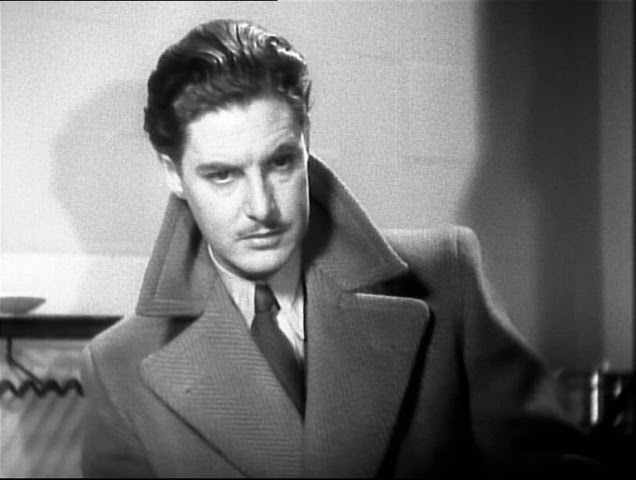
Dvd/150: THE 39 STEPS (Alfred Hitchcock, 1935)

Hitchcock's adaptation of John Buchan's novel is an unsurpassed espionage classic and all in a breathtaking 89 minutes.


A visit to a London Music Hall catapults Richard Hanney into a maelstrom of danger when a European woman who asks him to protect her for the night reveals herself as an undercover agent on the trail of a spy who's about to smuggle British military secrets abroad.


She is murdered as Hanney sleeps and he escapes from both her killers and the police to Scotland where she had traced the culprit.


He eventually gains an ally in unwilling travel companion Pamela and together they discover the secret of The 39 Steps.


An entertaining classic that glitters with wit, Hitchcock surrounds hero Robert Donat with a wonderful supporting cast of scene-stealing cameos, in particular a luminous Peggy Ashcroft as a Crofter's lonely wife and Frederick Piper as a helpful London milkman.


Shelf or charity shop?  A shelf to itself!