It's time to revisit Cranford, Elizabeth Gaskill's Victorian Cheshire village, where modernity threatens to arrive by the advancing railway.
It is 1844, two years on from the previous series, and the Cranford matrons still have much to gossip about, like the arrival of two new families: prosperous Mr Buxton, his son William and ward Erminia, and widowed Mrs Bell with son Edward and put-upon daughter Peggy.
Miss Matty, the gentle heart of Cranford, introduces the families where Peggy is an instant hit with the Buxtons, particularly William.
The railway stops five miles from Cranford as the land ahead is owned by Lady Ludlow, but when she dies her profligate son Septimus arrives and quickly signs her whole estate to the railways for cash.
Mix together thwarted lovers, an unexpected marriage, a derailed train, a runaway schoolboy, an Italian magician, and a Christmas waltz and you have a worthy sequel.
Shelf or charity shop? Joining it's predecessor on the shelf. Sue Birtwhistle and Susie
Conklin's production is slightly more sentimental as it was shown as part of the BBC's Christmas programming but the quality of the production and adaptation by Heidi Thomas from several Gaskill novellas is excellent. Once again Simon Curtis' remarkable cast blend into a seamless ensemble: Judi Dench, Julia McKenzie, Imelda
Staunton, Lisa Dillon, Francesca Annis, Tim Curry, Emma Fielding, Jim Carter, Alex Etel, Rory Kinnear, Jonathan Pryce, Tom Hiddleston and a luminous Jodie Whittaker all shine.
In 1842, the residents of the Cheshire market town of Cranford know their place in Victorian society and in God's eyes. But slowly the modern world is coming...
The formidable spinsters and widows of Cranford spend their days seizing on any gossip and the sight or two women walking quickly usually means new scandal. The arbiter of moral rectitiude is Miss Deborah Jenkyns, who lives with her younger, more gentle sister Matty but both can be relied upon to do the right thing.
The spinsters welcome in Mary Smith, the daughter of an old Manchester friend, when she is forced out by her step-mother and, together they experience new neighbours, new joys, but also new sadnesses because for all of them, death can come unexpectedly.
Heidi Thomas' adaptation of Elizabeth Gaskill's novellas is a superb mix of comedy, tragedy and class.
Shelf or charity shop? Definite shelf. Sue Birtwhistle and Susie Conklin's production would have seemed a natural for the BBC but it was hit by the corporation's budget cuts, postponed for a year and having to thin down from 6 episodes to 5 and then changing directors halfway through filming but luckily they persevered. It goes without saying that the cast give excellent performances but they also provide a seamless ensemble: Judi Dench, Eileen Atkins, Julia McKenzie, Imelda Staunton, Lisa Dillon, Francesca Annis, Barbara Flynn, Deborah Findlay, Lesley Manville, Emma Fielding, Jim Carter, Philip Glenister, Michael Gambon and Alex Etel are all memorable.
The 50 shows that have stood out down the years and,
as we get up among the paint cards, the shows that have become the cast
recording of my life. So here we are... a year and 10 months in the
making and we have reached the stage musical that is my favourite ever -
and I cannot name one out of the four shows that I have left to
consider.
I have tried every criteria, every angle and there is simply no way I
can say that one of the four is better than the other. So let's
go... my Top Four Number One's (in alphabetical order)
First performed: 1979, Uris Theatre, NY
First seen by me: 1985, Half Moon Theatre, London
Productions seen: ten
Score: Stephen Sondheim
Book: Hugh Wheeler
Plot: Sweeney Todd arrives back in Victorian London, rescued from a floating raft by young sailor Anthony, He visits the Fleet Street pie shop of the widow Nellie Lovett who recognises him as Benjamin Barker, the barber who worked above her shop fifteen years before. Barker was transported to Australia by the corrupt pair Judge Turpin and Beadle Bamford so the
Judge could rape Barker's wife Lucy. Mrs Lovett tells Sweeney his wife poisoned herself and his young daughter Johanna is now the Judge's ward who he intends to marry. Mrs Lovett presents him with his old razors and he starts to work again, plotting his revenge - and as the bodies pile up, Mrs Lovett has a solution...
Five memorable numbers: A LITTLE PRIEST, THE WORST PIES IN LONDON, THE BALLAD OF SWEENEY TODD, JOHANNA, PRETTY WOMEN
,
In 1973, while in London for the UK premiere of GYPSY, Stephen Sondheim
went to the Theatre Royal Stratford East to see Chris Bond's
version of the melodrama SWEENEY TODD. Sondheim enjoyed the Grand Guignol
atmosphere and how street songs were incorporated into the action but
what really excited him was how Bond changed the plot from a
penny-dreadful melodrama into a revenge thriller with Sweeney seeking
vengeance on Judge Turpin: an idea was
born. In 1979, SWEENEY TODD: THE DEMON BARBER OF LONDON opened on Broadway starring Len Cariou and Angela Lansbury and, the following year, in London with Denis Quilley and Sheila Hancock and although audiences couldn't warm to the American take on a London villain, London has since taken the show
to it's heart as was Sondheim's original wish - the original production
(despite it's short run) won the Olivier Award for Best Musical and it has since won two further
Oliviers for Best Musical Revival.
Over time I realised I could happily watch a good production of SWEENEY TODD every day.
I have seen it ten times with only two productions I didn't like - a
ghastly am-dram one at the Bloomsbury Theatre in 1992 and the actor/musician John Doyle production that most loved but just got on my nerves. I think eight out of ten is a very
good batting average. The show is a good example of why Sondheim always gives praise to
his book writers. Hugh Wheeler's book for SWEENEY is a classic of
musical storytelling, there are nine main characters who are all vividly
drawn and it not only stands up to repeated viewings but the book
always throws up things I had never noticed before; despite the different directorial takes on it, it just *works*. Sondheim's score acts as an aural fog that whisps, curls and evelopes the characters through the plot, not only through the songs but the relentless underscoring that happens throughout the show, which gives the audience a feeling of foreboding... that all the characters are on a moving path to a very dark place. What I particularly love about the show is, after the introductory "The Ballad of Sweeney Todd" which gives you a flavour of the ominous atmosphere of the show, you are pitched right into the action with Sweeney and Anthony arriving in London, having their first meeting with the Beggar Woman, and onto the visit to the Pie Shop and the first appearance of Mrs Lovett - all within ten minutes.
Then you are off on the wonderful runaway ghost train that is SWEENEY TODD, an unstoppable ride to it's shattering conclusion. As I have
often said, the final 20 minutes of the show - if done right - should be
one of the most relentlessly scary things you can experience, even if
you know the show It has an internal motor that if stoked properly
keeps gathering pace leaving dead bodies in it's wake and an icy, clammy grip on
the back of your neck. My first introduction to the musical was through the Broadway cast recording which, for me, is still is the definitive version of the score, capturing the remarkable performances of Len Cariou and Angela Lansbury. In 1981 the US tour was filmed in Los Angeles with Lansbury's outrageous, glorious turn as Nellie Lovett immortalised with George Hearn, partnering her perfectly as Sweeney. It's interesting that when first offered the role Lansbury hesitated - she pointed out the show was called SWEENEY TODD and was reluctant to play what she felt was a less-than-lead role. Sondheim 'auditioned' some of Mrs Lovett's songs for her and she realised that she was being given the chance to create from the ground up such a memorable character and she was onboard. My first experience seeing it live was at the long-gone Half Moon Theatre in 1985, directed by Chris Bond, the writer of the original play that Sondheim had seen 12 years before. It was wonderful to see it finally and to see the book and score working as one, and it starred Leon Greene's larger-than-life Sweeney. In 1989 I saw it again, this time on Broadway at the Circle In The Square, the first of many 'chamber' versions of the show, with Bob Gunton and Beth Fowler as the killer couple.
SWEENEY made a triumphant return to London in the National Theatre's production directed by Declan Donnellan in 1993. Staged again in a 'chamber' version, it was a wonderfully thrilling production with an excellent cast of Alun Armstrong as Sweeney, Adrian Lester as a charismatic Anthony, Barry James as Beadle Bamford and Denis Quilley, London's original Sweeney, now playing Judge Turpin. But they were overshadowed by Julia McKenzie's magnificent Mrs Lovett - a gin-soaked cockney harridan, hilarious and amoral. She deservedly won the Olivier Award for Best Actress and later, when the show transferred to the larger Lyttelton Theatre shared the stage with Quilley again, this time returning to the role of Sweeney, Sadly this was the last Sondheim role Julia played onstage. The production never had a cast recording issued but the Radio 4 full-length broadcast is available on YouTube. In 2000 the Bridewell Theatre - too close to Fleet Street for comfort - staged a prominade performance with a memorable Mrs Lovett from Jessica Martin.
In the 2010s I saw three contrasting versions: Chichester gave us Jonathan Kent's dingy between-the-wars version with Michael Ball as Sweeney and Imelda Staunton as Mrs Lovett. Imelda gave us an all-too-real Mrs Lovett, gimlet-eyed and itching to be respectable, while Michael Ball downplayed his natural exuberance to almost a monotone. I then saw the concert version at the London Coliseum directed by Lonny Price starring Bryn Terfel as Sweeney who of course sang the bejesus out of it and Emma Thompson finally onstage again as Mrs Lovett, playing up the comedy but also finding the step-up to the drama at the end. It's a key moment in the second act when, while singing "Not While I'm Around", Tobias realises that Sweeney killed his boss, and, attempting to distract him, Mrs Lovett joins him in singing that nothing's going to harm him; you have to feel the murdererous intent behind the grotesque comedy harridan at that point - it's always a chilling moment and the great actresses who have played the role such as Lansbury, McKenzie, Staunton and Thompson can manage that transformation with ease. The last production I saw was in 2016 in a final-year production by the Royal Academy of Music's Musical Theatre students, what made it special was it was at the Theatre Royal Stratford East where 43 years before, Sondheim first saw Chris Bond's original.
Again, a true wealth of video is available for SWEENEY TODD on YouTube - as I said, the full Radio 4 broadcast of Denis Quilley and Julia McKenzie in the NT's production is there - so I shall stick with that production and Julia's full-throttle "Worst Pies In London" from that year's Olivier Awards ceremony...
Then Bryn Terfel's Sweeney and Emma Thompson as Mrs Lovett delighting in her new receipe for meat pies in "A Little Priest"
and finally, the music-hall out-front performance of Lansbury, secretly laying her own plans by giving George Hearn's Sweeney only some of the truth in "Poor Thing":
I hope you have enjoyed reading about these 50 great musicals as much as I have blogging about them...
The 50 shows that have stood out down the years and,
as we get up among the paint cards, the shows that have become the cast
recording of my life. So here we are... a year and 10 months in the
making and we have reached the stage musical that is my favourite ever -
and I cannot name one out of the four shows that I have left to
consider.
I have tried every criteria, every angle and there is simply no way I
can say that one of the four is better than the other. So let's
go... my Top Four Number One's (in alphabetical order)
First performed: 1950, 46th Street Theatre, NY
First seen by me: 1982, Olivier Theatre, London
Productions seen: seven
Score: Frank Loesser
Book: Jo Swerling / Abe Burrows
Plot: Set in Damon Runyon's New York of gamblers, gangsters and showgirls. Nathan Detroit has nowhere to hold his all-night crap game, the cops have their eyes on him and he is fending off the growing impatience of his fiancee, cabaret singer Miss Adelaide, after an engagement of 14 years. Nathan finds a location but needs to raise an advance payment of $1,000. Desperate for the dough, he bets legendary gambler Sky Masterson the same amount that he cannot take strait-laced Sgt Sarah Brown from the local Save-A-Soul Mission to dinner in Havana. There's no way he can lose the bet... is there?
Five memorable numbers: SIT DOWN YOU'RE ROCKING THE BOAT, LUCK BE A LADY, I'VE NEVER BEEN IN LOVE BEFORE, ADELAIDE'S LAMENT, MORE I CANNOT WISH YOU
GUYS nearly lost out on a shared Number 1 spot simply because I have seen a few productions that I felt had
not done it justice but eventually I had to
overlook this as the first one I saw was definitive and I feel oddly protective of the show. GUYS AND DOLLS literally changed my life.
In 1950, producers Cy Feuer and Ernest Martin announced a new musical based on Damon Runyan's short stories THE IDYLL OF MISS SARAH BROWN and BLOOD PRESSURE and chose Frank Loesser to write the score, fresh from his debut Broadway success WHERE'S CHARLEY? and winning an Academy Award for writing "Baby It's Cold Outside" the previous year. The job of adapting the stories was given to Jo Swerling who was later replaced by Abe Burrows - however by that time, Loesser had nearly completed the score, so Burrows had the double chore of writing a new funnier script while also slotting in Loesser's songs. He succeeded wonderfully as GUYS AND DOLLS is judged to have one of the greatest books in Broadway history. The show was an instant hit when it opened, winning five Tony Awards and running for 1,200 performances. London first saw it in 1953 with Sam Levene and Vivian Blane repeating their Broadway roles of Nathan and Miss Adelaide. Two years later, Blane played Adelaide in the hit film version with Sinatra, Brando and Jean Simmons.
In 1971 Laurence Olivier was going to stage GUYS AND DOLLS for the National Theatre at the Old Vic with him as Nathan, Geraldine McEwan as Adelaide and Denis Quilley as Sky but his poor health at the time gave the NT Board a reason to cancel it; the thinking being should they really be staging an American musical? In 1982 when Richard Eyre was invited by Peter Hall to stage three shows at the National Theatre he still had to battle this opposition but successfully - and rightfully - argued that GUYS AND DOLLS was as much a classic of American Theatre as anything by O'Neill, Williams or Miller. He had the perfect team with David Toguri as choreographer, set designer John Gunter and lighting designer David Hersey's eye-popping sets featuring Times Square neon signs hanging over the stage and Sue Blaine's vivid costumes.
Before 1982 I went to the theatre to look at stars; Joan Collins, Elizabeth Taylor, Tom Bell, Cheryl Campbell etc. and that was exactly why I wanted to see GUYS AND DOLLS at the National - Ian Charleson was my new acting hero after CHARIOTS OF FIRE, Julie Covington was a heroine from ROCK FOLLIES and I loved Bob Hoskins from PENNIES FROM HEAVEN and THE LONG GOOD FRIDAY. Of course the show sold out from the off and I was clueless how I would get to see it. The NT then announced they would have a Bargain Night - all seats in it's three theatres at £2 each to personal callers on the day, I was up for the challenge. I arrived at 7am to join one of the longest queues I had ever seen and when they opened, I slowly shuffled to the door, sure it would be sold out - I walked away with two front-row seats! And so it came to pass that at 7:15pm on August 6th 1982, my life changed. I suddenly experienced the alchemy that can happen between an audience and a cast of extraordinary performers, they generated pure stage electricity which we returned with loud excitement. I went back countless times after that performance, even sleeping overnight outside the box office door with other front-row regulars which was a wonderful experience where I made new friends. I went back to relive that magical first time, sometimes it happened, but each experience made me realise that I was now a theatre fan.
'A good cast is worth repeating' was frequently seen at the end of old films so here they are - William Armstrong, Mark Bond, James Carter (equally memorable as Chicago gangster Big Jule and a Havana drag queen!), Ian Charleson (unforgettable as Sky, wry and laid back but singing in a glorious tenor voice), Sally Cooper, Julie Covington (a perfect steely Sgt. Sarah), Irlin Hall, David Healy (winning the SWET Award for Best Musical Supporting Performance as the jovial Nicely-Nicely Johnson), Fiona Hendley, Bob Hoskins (delicious as the exasperated Nathan Detroit), Rachel Izen (giving some serious face as a jaundiced Hot Box Girl), Julia McKenzie (winner of the SWET Award for Best Musical Actress as the definitive Miss Adelaide, hilarious but wistful, a real belter with a bawdy laugh), John Normington (touching as Sarah's protecting grandfather and always able to make me blub singing "More I Cannot Wish You"), Robert Oates, Bill Paterson (a great conniving Harry The Horse), Kevin Quarmby, Robert Ralph, Barrie Rutter (a shuffling Benny Southstreet straight off Runyon's pages), Bernard Sharpe, Belinda Sinclair, Imelda Staunton (a sour-faced Hot Box Girl and a hilariously short Cuban dancer), Harry Towb (a perfect blustering Lt. Brannigan), Larrington Walker, Richard Walsh, Norman Warwick and Kevin Williams (stealing each scene he was in). Stars all, some shining from afar now. This wonderful cast came together one last time in November 1990 to play a matinee and evening performance to honour the memory of both Ian Charleson and Norman Warwick who had both died in the past year: a very special memory.
Needless to say I have yet to see a production to match this although the subsequent revivals of Eyre's prodution gave us a sizzling Sky Masterson from Clarke Peters, Imelda's feisty Adelaide when she took over from Julia, Betsy Brantley's sweet-voiced Sarah and a memorable Nathan Detroit from Bernard Cribbins. The 2005 Donmar production that played at the Piccadilly Theatre couldn't really compete with the show ingrained in my mind but had nice performances from Jane Krakowski as a sexier Miss Adelaide and Jenna Russell as a dry-as-dust Sgt. Sarah. It ran for two years however, The recent 2014 Chichester revival and subsequent West End transfer directed by Gordon Greenberg made me happier though as did the neon-bright performance of Sophie Thompson as Miss Adelaide, Jamie Parker as Sky and David Haig as Nathan Detroit; I remember thinking as my fellow audience members in the Chichester auditorium lapped up Frank Loesser's classic score and Abe Burrows' great gags and sympathetic characters that hopefully there was a young theatregoer who would discover the magic of theatre through this glorious show.
There was only one choice for a video... THE SOUTH BANK SHOW did a profile on Richard Eyre and his company in rehearsal so here is a wonderful chance to savour the pure pleasure they gave me - Ian Charleson singing "Luck Be A Lady", the opening number "Runyonland", Julia McKenzie and the Hot Box Girls singing "Bushel and A Peck", Julie Covington singing "I'll Know" to Ian, Bob Hoskins with James Carter, Bill Paterson and Barrie Rutter in the crap-game scene, Ian singing "I've Never Been In Love Before" to Julie, and finally David Healy stopping the show as he always did with "Sit Down You're Rocking The Boat".
The 50 shows that have stood out down the years and,
as we get up among the paint cards, the shows that have become the cast
recording of my life. So here we are... a year and 10 months in the making and we have reached the stage musical that is my favourite ever - and I cannot name one out of the four shows that I have left to consider.
I have tried every criteria, every angle and there is simply no way I can say that one of the four is better than the other. One nearly lost the shared top place when I considered productions of it that I felt had not done it justice but, with that particular show, I simply had to overlook that, bearing in mind the first I saw was definitive. So let's go... my Top Four Number One's (in alphabetical order)
First performed: 1971, Winter Garden Theatre, NY
First seen by me: 1985, Forum Theatre, Wythenshawe
Productions seen: four
Score: Stephen Sondheim
Book: James Goldman
Plot: In 1971, onstage at the derelict Weismann Theatre on the eve of it's demolition, producer Dimitri Weismann holds a reunion of the stars and chorus girls of his "Follies" which ran between the World Wars. Old songs and routines are remembered, stirring up the ghosts of their younger selves. But for former best friends and chorus girls, Sally and Phyllis and their husbands, salesman Buddy and diplomat Ben, it becomes a night of bitter recriminations and the chance for lost love to be found again... what will the cruel light of day reveal?
Five memorable numbers: LOSING MY MIND, IN BUDDY'S EYES, WHO'S THAT WOMAN, I'M STILL HERE, ONE MORE KISS
In 1965, Sondheim and writer James Goldman wanted to collaborate on a project together and agreed on Goldman's idea of a murder mystery set at a
showgirls reunion. The murder plot stalled but
the showgirls reunion intrigued them especially how regrets for what
one did and more importantly didn't do, can haunt your life. Five years later, Sondheim was keen to follow up the success of his groundbreaking COMPANY with the show's producer/director Hal Prince and choreographer Michael Bennett and, when Prince heard of the reunion idea, he had an immediate visual reference: a 1960 Life magazine
photograph of a glamorous but fragile 61 year-old Gloria Swanson, standing in the
rubble of the Roxy Cinema in New York which had opened in 1927 with her film
THE LOVES OF SUNYA. Prince felt this captured the essence of the project
- the survivor, the glamour and the ruin.
Goldman and Sondheim brought in the bittersweet marital discord found in COMPANY and FOLLIES was born. Prince's 1971 production ran for 522 performances but lost over $720,000, due of huge production costs and audience
ambivalence - despite 'names' like film stars Alexis Smith and Yvonne de
Carlo, 1950s singer Dorothy Collins, Broadway star John McMartin and veteran performers Ethel Shutta and
Fifi D'Orsay, audiences found Goldman's book too downbeat. It won seven
of the ten Tony Awards it was nominated for but failed to win Best
Musical. Cult status grew through the original cast album but sadly
Capitol Records only released it on a single album meaning a lot of the score was abridged or not recorded. The show has had two further Broadway revivals in 2001 and
2011, but lost out winning the Best Musical Revival Tony Award both
times.
1985 was my FOLLIES year! To rectify the abridged 1971 recording decision, Herbert Ross staged two concert versions at Lincoln Center to be recorded
over both nights by Thomas Z Shepherd for RCA featuring the full score with a jaw-dropping cast of Barbara
Cook, Lee Remick, George Hearn, Mandy Patinkin, Elaine Stritch, Carol
Burnett, Betty Comden and Adolph Green, etc. which is the nigh-on definitive recording. But
before this, I had seen my first FOLLIES production in
Wythenshawe, Manchester, directed and choreographed by the under-valued Paul Kerryson and starring the wonderful Josephine Blake, The production swept me away, making me yearn for a London transfer.
However, when FOLLIES finally opened in London in 1987, it was with several new songs and a more upbeat ending; producer Cameron Mackintosh had asked the creators to 'revisit' the material to make it more optimistic - Goldman was happy
to, Sondheim less so. After seeing a preview, I was outside the Shaftesbury Theatre stage door
and Sondheim came out on his own. While he signed my programme, I told him I had seen the Manchester production; he
shot me a look and asked which I preferred. Cautiously I said that,
while loving Julia McKenzie, David Healy, Dolores Gray and Lynda
Baron in the new version, I felt that Manchester had the edge for being more true to the material. He replied that while shows
can always stand a revision, it was always possible to return to the
original. Point taken Steve...
In 2006, FOLLIES reappeared in the unlikely location of the Landor Theatre in Clapham which
seated a mere 48 people above a pub! But any lack of grandeur
was compensated with a cast guaranteed to make any 1980s musicals fan giddy: Sarah Payne, Claire Moore, Adele Anderson,
Rachel Izen, Carol Ball and Roni Page among others. This small production scored over the National Theatre's opulent 2017 version in one key element which was also there in 1971: then as at the Landor, the cast were chosen not only for their talents but also because to most of the audience, they would conjure up memories of seeing them in earlier shows back in the day. For FOLLIES to truly work I believe that an audience must have that nostalgic connection to the actors onstage - particularly for those who appear in the smaller but pivotal roles of the former Follies performers, then the audience can supply their own 'ghosts' for the performers; dimly remembered memories of them in previous shows.
It was with trepidation that I watched the National's FOLLIES for the first time in 2017 - I had longed for a production to be done on that stage for so many years, could it measure up? Yes it did - despite the lack of 'names' in the smaller roles, despite Tracie Bennett's mugging through "I'm Still Here" - I got the FOLLIES I have yearned for. Because when
it hit, it hit hard and with astonishing
performances wherever you looked: Imelda Staunton's despairing Sally, Janie Dee's bone-dry Phyllis. Philip Quast's crumbling Ben, but especially Josephine Barstow's tear-enducing "One More Kiss" - that the production managed to cast one of Britain's great operatic
divas for the small role was special enough, but within the short space of her
song, you could hear a pin drop as her voice soared around the
auditorium; in a score of
unstoppable great musical moments this was one to treasure.
The truly astonishing thing about FOLLIES is that Sondheim
floors you with one fantastic song after another. It was director Dominic Cooke's first musical and he gave his production a thoroughness of vision which allowed the
musical numbers to flourish while being equally as thorough at the emotional trauma the four main characters
inflict amid the nostalgia.
So... what video to pick? FOLLIES is well represented on YouTube through productions and one-off performances of songs from the score - and with a score so all-encompassing as this how do you pick a represenative song? How's about a few.. the stinging sophistication of "Could I Leave You" sung by Lee Remick at the 1985 Lincoln Center concert and then, from the same documentary, a fascinating clip of Barbara Cook rehearsing and then performing the pure emotion of "In Buddy's Eyes" and finally, from the NT Live screening of their 2017 production, Imelda Staunton's broken Sally. lost in her obsession, singing "Losing My Mind".
The 50 shows that have stood out down the years and,
as we get up among the paint cards, the shows that have become the cast
recording of my life.
First performed: 1986, Old Globe Theatre, San Diego, CA
First seen by me: 1988, Martin Beck Theatre, NY
Productions seen: six
Score: Stephen Sondheim
Book: James Lapine
Plot: Once Upon a Time, Cinderella wanted to go to the ball, Little Red Riding Hood wanted to visit Granny's cottage, a baker and his wife were desperate for a child, and Jack had to sell his aged pet cow for a new one and exchanges her for magic beans. They must all go into the woods to get their wishes, including the neighbourhood Witch to visit her daughter Rapunzel. Everyone gets their wish and live Happily Ever After... or do they?
Five memorable numbers: NO ONE IS ALONE, CHILDREN WILL LISTEN, AGONY, GIANTS IN THE SKY, A MOMENT IN THE WOODS
After the success of SUNDAY IN THE PARK WITH GEORGE, Stephen Sondheim and James Lapine wanted to work together again and decided on exploring the moral ambiguities of living Happy Ever After when the actions you have done to get there have consequences. Cinderella marries her Prince but what if he was raised to be charming but not faithful? Jack steals from and later kills The Giant but what of the grieving Giant's Wife who wants revenge on the little killer who abused their hospitality? And what do you do when parents or children are taken from you - do you blame others or yourself? Although Sondheim denies there was any deliberate intention for the work to reflect the AIDS crisis that was contemporary to it's writing, you cannot help but read it as a reflection on those times of sudden death, recrimination and the forming of community. It's continued success down the years shows the world has not changed much...
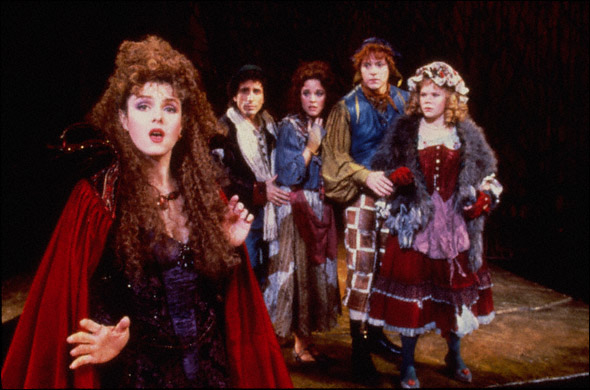
The show had a short initial run at the Old Globe Theatre in San Diego, giving Sondheim and Lapine a chance to see where the show might be enlarged and clarified before it opened at the Martin Beck Theatre in 1987 with the wonderful cast of Bernadette Peters as The Witch, Chip Zien as The Baker, Joanna Gleason as The Baker's Wife, Kim Crosby as Cinderella, Robert Westenberg as Cinderella's Prince as well as The Wolf and Danielle Ferland as Red Riding Hood. The show ran for nearly two years and won three Tony Awards - Gleason for Best Actress, Best Score and Best Book - but losing out in it's production awards to THE PHANTOM OF THE OPERA. More importantly, just after a year after it opened, INTO THE WOODS was the first musical I ever saw on Broadway.
Lapine's glorious original production was the best introduction to Broadway and luckily it was filmed with the reunited original cast just before it closed and is available on DVD. The first London production only lasted five months at the Phoenix Theatre, largely due to Robert Jones' ugly, over-intellectualised production but it did feature two memorable performances from Julia McKenzie as The Witch and Imelda Staunton as a pugnacious, determined Baker's Wife; Imelda went on to win the Best Actress Olivier Award for Best Actress. A far more cohesive and enjoyable production was John Crowley's 1998 revival at the Donmar - it's smaller stage giving the action more of a focus - with yet another Olivier Award-winning Baker's Wife, this time the wonderful Sophie Thompson, in a cast which also included Jenna Russell as Cinderella, Damien Lewis as her Prince and a break-out performance by 17 year-old Sheridan Smith as Red Riding Hood.
The last three productions I have seen illustrated how versatile directors have found the material - the Landor staged INTO THE WOODS in their 60 seat pub theatre in 2009, the Open Air theatre in Regents Park staged a spectacular production in 2011 with a multi-level set disappearing off into the surrounding trees which certainly gave the piece a vibrant setting, even if not all the directorial choices held up, but did give Hannah Waddingham as The Witch, Jenna Russell as The Baker's Wife, Beverley Rudd as Red Riding Hood and Michael Xavier as The Prince / The Wolf excellent chances to shine. In 2016, the American Fiasco Theater Company brought their INTO THE WOODS to the Menier which had a cast of 10 and a near-bare stage. The show survived of course but the relentless "look what we can do with a rope" got old very quickly. A lovely performance from Harry Hepple as The Baker helped save the day.
I still remember the excitement of buying the orginal cast recording at Tower Records and racing home to play it, reading the libretto and studying the colour foldouts of production shots - and that excitement has not diminished over 36 years, it was a worthy winner of that year's Grammy for Best Cast Recording. It's a score which moves me greatly, especially in the second act where Sondheim unleashes a succession of songs that cut through to a universal sadness: the Witch's "Lament" then her goodbye to the small-minded humans with "Last Midnight"; The Baker's burnt-out cry for a moment of rest "No More" which leads into the anthemic "No One Is Alone" where the characters realise that a family is not just blood relatives - and in between these there is one of Sondheim's most under-rated solos, The Baker's Wife's "A Moment In The Woods", it's this song that makes the role a real award magnet and makes INTO THE WOODS one of my all-time favourite musicals.
So... what video to pick? In truth I did not mind the Disney film which despite being truncated actually stayed true to the spirit of the show but it has to be the original Broadway cast, and here is the press reel of clips for broadcast purposes; they are not in chronological order but give you a real flavour of the production featuring the marvellous performances of Bernadette Peters, Joanna Gleason, Chip Zien, Danielle Ferland, Robert Westenberg, and Kim Crosby among others.
Four years after the life-changing success of OLIVER! - which was still running in the West End - Lionel Bart's new musical MAGGIE MAY opened at the Adelphi Theatre in 1964. Despite winning the Novello award for Best Theatre Score and a Critics Circle award for Best Musical, the show simply vanished from the repertoire. Our Liverpudlian heroine appeared briefly in 1992 in a National Youth Theatre production but the revival at the Finborough Theatre is it's first professional appearance in 55 years.
Bart was still riding the success of OLIVER! when MAGGIE MAY became his second consecutive show to open at the Adelphi. His 1962 musical BLITZ! - whoever said exclamation marks were a recent way to denote a musical - had opened there for a moderately successful run but was judged to be an uneven show; Sean Kenny's collapsing East End London set garnering the most attention over Bart's score or performances. Returning again to the working-class milieu that had proved so successful for him, Bart turned away from London and focused on the thriving Liverpool scene, collaborating with writer Alun Owen who had success with his Liverpool plays PROGRESS TO THE PARK and NO TRAMS TO LIME STREET, and had just won acclaim for his script for A HARD DAY'S NIGHT.
Bart's favourite designer Sean Kenny recreated the Liverpool docks setting, while Owen was reunited with Canadian director Ted Kotcheff who had directed his plays on stage and television. The show reunited Bart with Barry Humphries who had appeared in London and New York as OLIVER''s Mr Sowerberry - here playing the Brechtian role The Balladeer - and the show starred Rachel Roberts as Maggie May and Kenneth Haigh as Patrick Casey. The cast also included such future tv names as Morecombe and Wise 'star' Janet Webb, Geoffrey Hughes, Billy Boyle (currently appearing as Theodore Whitman in the National Theatre's FOLLIES) and in the chorus, making her West End debut, Julia McKenzie. MAGGIE MAY not only had a cast recording but Bart's friend Judy Garland also released four of it's songs on an EP. In an odd twist, Bart had originally offered OLIVER! to Rachel Roberts but she declined so Georgia Brown got the role; he then offered MAGGIE MAY to Georgia but she declined so Rachel Roberts got it! Non-singer Roberts' vocal chords just about survived to the end of her contract where she was replaced by - you guessed - Georgia Brown.
MAGGIE MAY was Bart's last hurrah however: his 1965 musical TWANG!! was a theatrical car-crash and his 1969 Broadway musical LA STRADA not only had most of his score ditched but closed after a single night. To finance these disasters, Bart had stupidly sold the rights to his hit shows - Max Bygraves paid £350 for OLIVER! and then re-sold them for £250,000 - so by 1972, Lionel Bart, the once and future king of British musicals, was bankrupt and suffering from alcoholism and substance abuse. He re-awakened public interest with his Abbey National jingle 'Happy Endings' in the late 1980s, and in 1994 - the same year that MAGGIE MAY's Alun Owen died - Cameron Mackintosh revived OLIVER! with Bart making additions to the score for which he received a share of the profits. He died in 1999 of liver cancer.
OLIVER! has had many revivals since it's 1960 opening - largely thanks to the enduring popularity of the 1968 film adaptation - but his other shows have been overshadowed. Interestingly, his two 'contemporary' scores - FINGS AIN'T WOT THEY USED T'BE and MAGGIE MAY - are certainly influenced by his parallel career as a pop songwriter so maybe sound dated to theatre producers today; but they also carry within them an earthy, vital spark that didn't see it's like again until Willy Russell's BLOOD BROTHERS.
Maggie is a vivacious tart with a heart whose inner sadness, at losing her childhood sweetheart Patrick Casey to the life of a sailor, results in calling all her punters 'Casey'. She lives and works near the Liverpool docks with her salty friend Maureen, and one day word reaches Maggie that Patrick Casey has arrived back, having left the navy for good. They meet again and immediately realize they were meant to be together. Patrick's friend Judder gets him a job on the docks but for Patrick this is a poisoned chalice; his father Joe was a famous trade unionist and rabble-rouser, loved by the workers and hated by the bosses. His death at a demonstration has made him a legend and Patrick finds this a burden to carry with his fellow-workers who expect so much of him.
However when a worker is killed by a falling crate Patrick shows he is his father's son; not so much for the death but for the fact that the crate contained a secret shipment of guns, bound for South America which Patrick knows will be used against striking workers. This leads him to confront his father's former crony Willie Morgan who is now the corrupt head of the docker's union. Morgan knew the guns were being shipped as it meant jobs for his men but Patrick accuses him of class treachery. Willie realizes Casey could easily displace him so decides to ruin him... and the key to this is through Maggie.
More guns arrive dockside and Casey's gang are assigned the job; Casey refuses and is sacked but Judder whips up the fellow dockers to walk out in support of their new hero Patrick, only Maggie realizing that this can only lead to more trouble. She warns Patrick about going up against Morgan but he persists on addressing a large strike meeting about the need to be united with other world-wide comrades. Morgan speaks next and manages to turn the strikers' against any further action - why think of others when your own job is on the line? Morgan makes a move on Maggie knowing she is unhappy with Patrick but despite a trip to the fair, she rebuffs Morgan knowing that Patrick is her real love.
Patrick realizes his activism is doomed by his fellow-workers attitudes and decides his only happiness is with Maggie who has told him she will give up the game for him. Patrick leaves her and bumps into Judder who is angry that his friend has given up so easy, especially for a tart. They fight over Maggie, but Patrick says he has one last action to complete for the workers of the world. Jealous of Maggie and of Patrick's secret mission, he informs Morgan that Patrick is headed for the docks. As Casey attempts to use a crane to dump the crates of guns into the river, the police, Morgan, Judder and Maggie arrive on the dock...
MAGGIE MAY does feel uneven: Alun Owen's blue-collar book addressing trade union corruption and the in-fighting workers is a natural for his "Armchair Theatre" tv plays but sit oddly against Bart's score - both are good but play like a cut-and-shunt job. However a little doctoring could give both a better flow; what is remarkable is to see a musical so committed to showing the working-class experience - how often does that happen?
There is a problem with the character of Maggie, a vibrant live-wire at the start of the show, she dwindles towards the end of the show to become a mere bystander to Patrick's fate. The ending feels like a conscious steal from WEST SIDE STORY with it's sudden tragic conclusion but this too demotes Maggie to being an onlooker in what is supposed to be her story.
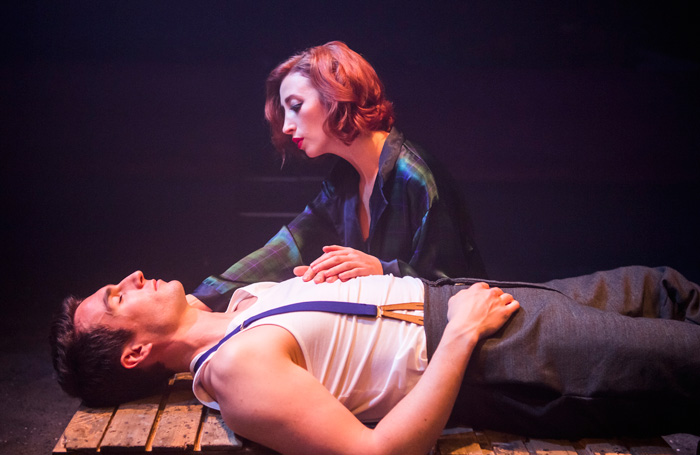
Matthew Iliffe's production is constrained by the small auditorium - the Finborough seats only 50 at a squeeze - allowing only a few small crates and a movable metal staircase as a set but the possibilities for the show do come through in his focused and fast-moving show, eliciting strong - sometimes too strong - performances from his cast. James Darch was excellent as Patrick, a natural leading man with a strong voice and easy charm and he was well-partnered by Kara Lily Hayworth as Maggie, my only complaint being that her singing voice, while pretty in the current theatre soprano way, probably didn't give Maggie's songs their best as they were written for a rougher, more belting voice like Georgia Brown's.
A special mention to the hard-edged Maureen of Natalie Williams, the rest of the cast were all ok but Michael Nelson as Judder for some reason shouted rather than speaking his lines which seemed absurd in such a small space, however he was an excellent dancer, easily the one to focus on during the punchy and dynamic dance numbers choreographed by Sam Spencer-Lane to *just* fit the space.
Lionel Bart's score had several of his trademark numbers - the big ballads for his leading lady, a solo for his lead man reviewing his situation, ensemble numbers, a few comedy routine numbers and, kicking off the second act, an early sixties rock 'n' roll number that Cliff Richard wouldn't have turned his quiff up at - a very special mention to Henry Brennan, playing the whole score on a piano.
I honestly thought I would never see a revival of this but I am glad I did: for all it's uneven qualities, it's possibly one of the UK's most over-looked musicals. Congratulations to Matthew Iliffe and his cast of 13 (where the original cast hit 50!), MAGGIE MAY is now sold-out for it's run at the Finborough.