Bart was still riding the success of OLIVER! when MAGGIE MAY became his second consecutive show to open at the Adelphi. His 1962 musical BLITZ! - whoever said exclamation marks were a recent way to denote a musical - had opened there for a moderately successful run but was judged to be an uneven show; Sean Kenny's collapsing East End London set garnering the most attention over Bart's score or performances. Returning again to the working-class milieu that had proved so successful for him, Bart turned away from London and focused on the thriving Liverpool scene, collaborating with writer Alun Owen who had success with his Liverpool plays PROGRESS TO THE PARK and NO TRAMS TO LIME STREET, and had just won acclaim for his script for A HARD DAY'S NIGHT.
Bart's favourite designer Sean Kenny recreated the Liverpool docks setting, while Owen was reunited with Canadian director Ted Kotcheff who had directed his plays on stage and television. The show reunited Bart with Barry Humphries who had appeared in London and New York as OLIVER''s Mr Sowerberry - here playing the Brechtian role The Balladeer - and the show starred Rachel Roberts as Maggie May and Kenneth Haigh as Patrick Casey. The cast also included such future tv names as Morecombe and Wise 'star' Janet Webb, Geoffrey Hughes, Billy Boyle (currently appearing as Theodore Whitman in the National Theatre's FOLLIES) and in the chorus, making her West End debut, Julia McKenzie. MAGGIE MAY not only had a cast recording but Bart's friend Judy Garland also released four of it's songs on an EP. In an odd twist, Bart had originally offered OLIVER! to Rachel Roberts but she declined so Georgia Brown got the role; he then offered MAGGIE MAY to Georgia but she declined so Rachel Roberts got it! Non-singer Roberts' vocal chords just about survived to the end of her contract where she was replaced by - you guessed - Georgia Brown.


MAGGIE MAY was Bart's last hurrah however: his 1965 musical TWANG!! was a theatrical car-crash and his 1969 Broadway musical LA STRADA not only had most of his score ditched but closed after a single night. To finance these disasters, Bart had stupidly sold the rights to his hit shows - Max Bygraves paid £350 for OLIVER! and then re-sold them for £250,000 - so by 1972, Lionel Bart, the once and future king of British musicals, was bankrupt and suffering from alcoholism and substance abuse. He re-awakened public interest with his Abbey National jingle 'Happy Endings' in the late 1980s, and in 1994 - the same year that MAGGIE MAY's Alun Owen died - Cameron Mackintosh revived OLIVER! with Bart making additions to the score for which he received a share of the profits. He died in 1999 of liver cancer.
OLIVER! has had many revivals since it's 1960 opening - largely thanks to the enduring popularity of the 1968 film adaptation - but his other shows have been overshadowed. Interestingly, his two 'contemporary' scores - FINGS AIN'T WOT THEY USED T'BE and MAGGIE MAY - are certainly influenced by his parallel career as a pop songwriter so maybe sound dated to theatre producers today; but they also carry within them an earthy, vital spark that didn't see it's like again until Willy Russell's BLOOD BROTHERS.

Maggie is a vivacious tart with a heart whose inner sadness, at losing her childhood sweetheart Patrick Casey to the life of a sailor, results in calling all her punters 'Casey'. She lives and works near the Liverpool docks with her salty friend Maureen, and one day word reaches Maggie that Patrick Casey has arrived back, having left the navy for good. They meet again and immediately realize they were meant to be together. Patrick's friend Judder gets him a job on the docks but for Patrick this is a poisoned chalice; his father Joe was a famous trade unionist and rabble-rouser, loved by the workers and hated by the bosses. His death at a demonstration has made him a legend and Patrick finds this a burden to carry with his fellow-workers who expect so much of him.
However when a worker is killed by a falling crate Patrick shows he is his father's son; not so much for the death but for the fact that the crate contained a secret shipment of guns, bound for South America which Patrick knows will be used against striking workers. This leads him to confront his father's former crony Willie Morgan who is now the corrupt head of the docker's union. Morgan knew the guns were being shipped as it meant jobs for his men but Patrick accuses him of class treachery. Willie realizes Casey could easily displace him so decides to ruin him... and the key to this is through Maggie.

More guns arrive dockside and Casey's gang are assigned the job; Casey refuses and is sacked but Judder whips up the fellow dockers to walk out in support of their new hero Patrick, only Maggie realizing that this can only lead to more trouble. She warns Patrick about going up against Morgan but he persists on addressing a large strike meeting about the need to be united with other world-wide comrades. Morgan speaks next and manages to turn the strikers' against any further action - why think of others when your own job is on the line? Morgan makes a move on Maggie knowing she is unhappy with Patrick but despite a trip to the fair, she rebuffs Morgan knowing that Patrick is her real love.
Patrick realizes his activism is doomed by his fellow-workers attitudes and decides his only happiness is with Maggie who has told him she will give up the game for him. Patrick leaves her and bumps into Judder who is angry that his friend has given up so easy, especially for a tart. They fight over Maggie, but Patrick says he has one last action to complete for the workers of the world. Jealous of Maggie and of Patrick's secret mission, he informs Morgan that Patrick is headed for the docks. As Casey attempts to use a crane to dump the crates of guns into the river, the police, Morgan, Judder and Maggie arrive on the dock...

MAGGIE MAY does feel uneven: Alun Owen's blue-collar book addressing trade union corruption and the in-fighting workers is a natural for his "Armchair Theatre" tv plays but sit oddly against Bart's score - both are good but play like a cut-and-shunt job. However a little doctoring could give both a better flow; what is remarkable is to see a musical so committed to showing the working-class experience - how often does that happen?
There is a problem with the character of Maggie, a vibrant live-wire at the start of the show, she dwindles towards the end of the show to become a mere bystander to Patrick's fate. The ending feels like a conscious steal from WEST SIDE STORY with it's sudden tragic conclusion but this too demotes Maggie to being an onlooker in what is supposed to be her story.

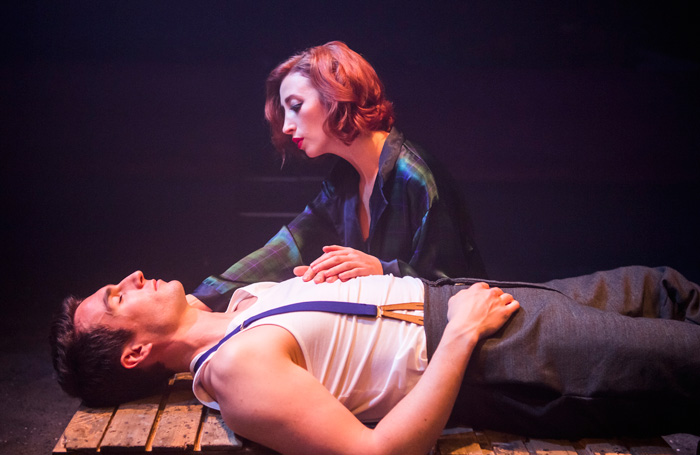
Matthew Iliffe's production is constrained by the small auditorium - the Finborough seats only 50 at a squeeze - allowing only a few small crates and a movable metal staircase as a set but the possibilities for the show do come through in his focused and fast-moving show, eliciting strong - sometimes too strong - performances from his cast. James Darch was excellent as Patrick, a natural leading man with a strong voice and easy charm and he was well-partnered by Kara Lily Hayworth as Maggie, my only complaint being that her singing voice, while pretty in the current theatre soprano way, probably didn't give Maggie's songs their best as they were written for a rougher, more belting voice like Georgia Brown's.
A special mention to the hard-edged Maureen of Natalie Williams, the rest of the cast were all ok but Michael Nelson as Judder for some reason shouted rather than speaking his lines which seemed absurd in such a small space, however he was an excellent dancer, easily the one to focus on during the punchy and dynamic dance numbers choreographed by Sam Spencer-Lane to *just* fit the space.

Lionel Bart's score had several of his trademark numbers - the big ballads for his leading lady, a solo for his lead man reviewing his situation, ensemble numbers, a few comedy routine numbers and, kicking off the second act, an early sixties rock 'n' roll number that Cliff Richard wouldn't have turned his quiff up at - a very special mention to Henry Brennan, playing the whole score on a piano.
I honestly thought I would never see a revival of this but I am glad I did: for all it's uneven qualities, it's possibly one of the UK's most over-looked musicals. Congratulations to Matthew Iliffe and his cast of 13 (where the original cast hit 50!), MAGGIE MAY is now sold-out for it's run at the Finborough.