Looking back it's remarkable that, while Anna Anderson's identity was still being disputed in European courts, it also provoked books, plays and films, most notably ANASTASIA which marked Ingrid Bergman's Hollywood 'rehabilitation' after the scandal of her extra-marital affair with Roberto Rossellini, indeed the film led to the ultimate Hollywood acceptance, an Academy Award. Anna Anderson and her persistent claim that she was the Grand Duchess Anastasia, believed killed with the rest of the Russian royal family in 1918, also inspired choreographer Kenneth McMillan to create his version of her story also called ANASTASIA which premiered in 1971.
MacMillan had originally staged ANASTASIA as a one-act ballet in 1967 while artistic director of Berlin's Deutsche Oper with his muse Lynn Seymour as Anna but he expanded the ballet to three acts in 1971 when he assumed creative control at Covent Garden, his original one-act becoming the third act. It fitted perfectly into MacMillan's volte-face idea for the production; the first two acts, showing Anastasia's pre-revolution life, is danced to symphonic music by Tchaikovsky and the third act which illustrates the fractured mental state of Anna Anderson is danced to a dissonant symphony by Bohuslav Martinu and a specially recorded electronic soundscape.
At first, Anastasia is seen to be a vivacious and precocious girl, dancing with her sisters and with the sailors on the Royal yacht, watched by her parents Nicholas and Alexandra, her brother Alexey and the silent, ominous Rasputin. The fun ends however when the hemophiliac Alexey falls and hurts himself and Tsar Nicholas receives news that WWI has been declared. MacMillan's choreography was wonderfully joyous, Anastasia being almost slid across the stage in the arms of her dancing sailors and ultimately being spun over their heads to be caught by another row of sailors behind them.
The second act takes place during a court ball in 1917; in the ballroom the lords and ladies still dance their elegant dances unaware of the revolution growing outside until it overcomes them. Meanwhile Anastasia becomes aware of strange tensions within her family as Rasputin's hold over the Tsarina grows more intense and Nicholas dances with a former lover, the ballerina Mathilde Kschessinska.
This act featured some excellent ensemble work from the corps - the female dancers' beaded frocks audibly swishing round as they moved - and there were excellent featured performances from Sarah Lamb as Mathilde and Steven McRae as her partner, as well as a bigger spotlight on Itziar Mendizabel as the haughty but emotional Tsarina and the omnipresent Rasputin of Eric Underwood.
The third act shone it's harsh light on Lauren Cuthbertson as Anna; her Anastasia had shown a sunny happiness clouded with doubts but she was put through the physical mill with MacMillan's strenuous choreography for the mentally disturbed Anna. It's quite a wrench for the audience too, confronted with the metallic score which starts the third act - overlaid with taped muttered conversations and grainy projections on the back of the set of the Romanov family which freeze-frame on the face of the real Anastasia - added to the stripped-down set and lighting.
Were the first two acts her real life or the imaginings of Anna's damaged mind? She imagines the murder of the Royal family, marauding soldiers, the groups of eager onlookers who come to gawp, the man who became her husband as well as her nemesis Rasputin. Did she really know them? MacMillan secretly wished Anderson's story to be true and it was only after his and Anderson's death that DNA evidence ruled conclusively that she was a fraud. But MacMillan ends the act with Anderson in regal parade around the stage on her moving bed, the figures from Anastasia's past looking on... Anna is certain of who she is.
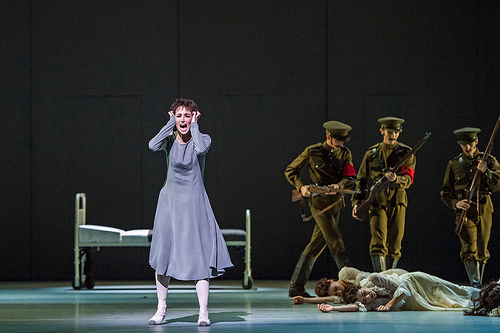
It's not the easiest ballet to take in and I suspect it is one to be admired rather than liked but it is never less than thought-provoking and Gary Harris' revival is helped immeasurably by Bob Crowley's sets and costumes, John B. Reid's lighting and the committed (no pun intended) performances of all onstage.
The real star however is the choreography and genius of Kenneth MacMillan...
Showing posts with label Itziar Mendizabel. Show all posts
Sunday, November 06, 2016
Sunday, May 22, 2016
FRANKENSTEIN at Covent Garden - Frankenstein's at it again... this time on point!
Surely ice-skating is the only area of story-telling that has not been utilized to re-tell Mary Shelley's classic horror novel FRANKENSTEIN. Since it's publication in 1818 it has been revisited, re-imagined, re-written, re-filmed... all a testament to Shelley's original idea of how man can be brought down through hubris and by his refusal to face the consequences of his actions.
However there is so much going on in her novel that any part of it can be picked on as a way to view the material. And now it's latest incarnation is in a full-length production by the Royal Ballet at Covent Garden and I saw it's 5th performance last week - always nice to be able to say that, with Royal Ballet productions it's usually the 305th!
Liam Scarlett is the Royal Ballet's artist-in-residence and this is his first full-length production for the company and it was marvellous to watch due to Scarlett's firm grasp on the narrative allied to a genuinely thrilling score by American composer Lowell Liebermann.
Scarlett stays mostly true to Shelley's story, dropping the framing device of Victor Frankenstein recounting his tale to the captain of a ship that rescues him and also the abortive creation of a mate for the creature but adds his own new spin as a finale which works within the spirit of the text.
The genesis of the story is almost as famous as the novel itself. In 1816, aged only 19, Mary Godwin, her lover Percy Shelley and Mary's half-sister Claire Claremont travelled across Europe to visit Claire's lover Lord Byron and his physician John Polidori in the rented Villa Diodati near Lake Geneva. Bad weather kept them indoors and Byron suggested they all try writing scary stories. Mary struggled with hers but a later talk about experiments in galvanization gave her the idea of a man attempting to revive a corpse - the fact that she was still grieving for her baby who had died only two months before must have influenced this idea.
The story both reflected and foreshadowed Mary's life which was shrouded with death: her mother Mary Woolstonecraft died a month after giving birth to her, three of her children with Shelley died young, her step-sister Fanny killed herself as did Shelley's abandoned wife Harriet, Shelley drowned at sea in 1822 and Mary herself died aged only 53 in 1851 from a suspected brain tumor.
Liam Scarlett's production also utilizes a moody set design from John Macfarlane and David Finn's exceptional lighting design, along with a mood-setting front cloth of a skull seen in profile which at the start of the second act turned to face the audience - wooo! As I said it was all marvellous to watch but, on reflection, the most negligible thing about the show was Scarlett's choreography.
I am no balletomane but time and again I found myself wondering how many scenes of prancing maids and servants does the story of FRANKENSTEIN need? There was also a puzzling tavern routine which sat in between the anatomy lecture-room scenes which did nothing to forward the story and seemed to be there only to give the female members of the corps a chance to whore it up.
I can appreciate that Liam Scarlett wanted to make the character of Elizabeth more than just a typical horror story heroine but again, when you realize that you are watching yet another interminable pas-de-deux for her and Victor, then you know something is off-kilter. I must say however that Sarah Lamb as Elizabeth danced the role well, full of grace and humanity.
What made me brew on this so strongly was that the final confrontation between Victor and his Creature must surely be the emotional climax of the show but here it just did not spark - was it because we had the Male Team B of Tristan Dyer as Victor and Ryoichi Hirano as the Creature? The only thing I could compare it to was the end of Matthew Bourne's SWAN LAKE which, no matter the dancers, always delivers an emotional punch.
There were fine performances from Ethan Bailey as William, Victor's young brother who plays a fatal game of blind-man's-bluff with the Creature in one of the more suspenseful scenes, James Hay was good as Frankenstein's friend Clerval, the always good Itziar Mendizabel did what she could with the minimal opportunities she had as the housekeeper Madame Moritz while her tragic daughter Justine was danced well by Francesca Hayward.
Despite my issues with the choreography I am glad we saw the show and more than enjoyed living through the story - which is more than 8 of the main 10 characters do! It's few remaining shows are sold out but hopefully it will rejoin the repertoire - maybe in 2018 to mark the novel's 200th anniversary?
In the same week, by some odd stroke of luck, we found we had booked a Horror Triple Bill at the theatre: FRANKENSTEIN, DOCTOR FAUSTUS at the Duke of Yorks and JEKYLL & HYDE at the Old Vic - who came out the winner? Constant Reader, read on...
However there is so much going on in her novel that any part of it can be picked on as a way to view the material. And now it's latest incarnation is in a full-length production by the Royal Ballet at Covent Garden and I saw it's 5th performance last week - always nice to be able to say that, with Royal Ballet productions it's usually the 305th!
Liam Scarlett is the Royal Ballet's artist-in-residence and this is his first full-length production for the company and it was marvellous to watch due to Scarlett's firm grasp on the narrative allied to a genuinely thrilling score by American composer Lowell Liebermann.
Scarlett stays mostly true to Shelley's story, dropping the framing device of Victor Frankenstein recounting his tale to the captain of a ship that rescues him and also the abortive creation of a mate for the creature but adds his own new spin as a finale which works within the spirit of the text.
The genesis of the story is almost as famous as the novel itself. In 1816, aged only 19, Mary Godwin, her lover Percy Shelley and Mary's half-sister Claire Claremont travelled across Europe to visit Claire's lover Lord Byron and his physician John Polidori in the rented Villa Diodati near Lake Geneva. Bad weather kept them indoors and Byron suggested they all try writing scary stories. Mary struggled with hers but a later talk about experiments in galvanization gave her the idea of a man attempting to revive a corpse - the fact that she was still grieving for her baby who had died only two months before must have influenced this idea.
The story both reflected and foreshadowed Mary's life which was shrouded with death: her mother Mary Woolstonecraft died a month after giving birth to her, three of her children with Shelley died young, her step-sister Fanny killed herself as did Shelley's abandoned wife Harriet, Shelley drowned at sea in 1822 and Mary herself died aged only 53 in 1851 from a suspected brain tumor.
Liam Scarlett's production also utilizes a moody set design from John Macfarlane and David Finn's exceptional lighting design, along with a mood-setting front cloth of a skull seen in profile which at the start of the second act turned to face the audience - wooo! As I said it was all marvellous to watch but, on reflection, the most negligible thing about the show was Scarlett's choreography.
I am no balletomane but time and again I found myself wondering how many scenes of prancing maids and servants does the story of FRANKENSTEIN need? There was also a puzzling tavern routine which sat in between the anatomy lecture-room scenes which did nothing to forward the story and seemed to be there only to give the female members of the corps a chance to whore it up.
I can appreciate that Liam Scarlett wanted to make the character of Elizabeth more than just a typical horror story heroine but again, when you realize that you are watching yet another interminable pas-de-deux for her and Victor, then you know something is off-kilter. I must say however that Sarah Lamb as Elizabeth danced the role well, full of grace and humanity.
What made me brew on this so strongly was that the final confrontation between Victor and his Creature must surely be the emotional climax of the show but here it just did not spark - was it because we had the Male Team B of Tristan Dyer as Victor and Ryoichi Hirano as the Creature? The only thing I could compare it to was the end of Matthew Bourne's SWAN LAKE which, no matter the dancers, always delivers an emotional punch.
There were fine performances from Ethan Bailey as William, Victor's young brother who plays a fatal game of blind-man's-bluff with the Creature in one of the more suspenseful scenes, James Hay was good as Frankenstein's friend Clerval, the always good Itziar Mendizabel did what she could with the minimal opportunities she had as the housekeeper Madame Moritz while her tragic daughter Justine was danced well by Francesca Hayward.
Despite my issues with the choreography I am glad we saw the show and more than enjoyed living through the story - which is more than 8 of the main 10 characters do! It's few remaining shows are sold out but hopefully it will rejoin the repertoire - maybe in 2018 to mark the novel's 200th anniversary?
In the same week, by some odd stroke of luck, we found we had booked a Horror Triple Bill at the theatre: FRANKENSTEIN, DOCTOR FAUSTUS at the Duke of Yorks and JEKYLL & HYDE at the Old Vic - who came out the winner? Constant Reader, read on...
Friday, April 29, 2016
The WINTER'S TALE at Covent Garden - Don't Send In The Clowns...
For the third time in four months we saw Shakespeare's THE WINTER'S TALE only this time dancers peopled the gloomy court of King Leontes in Sicillia and the sunny fields of neighbouring Bohemia as we saw Christopher Wheeldon's Royal Ballet production.
Shakespeare's tragi-comedy is one that I enjoy a lot but how can a production of it be a success with the loss of his words? Quite easily. Constant Reader, when you have a choreographer of Wheeldon's talent who, rather than doing a scene-for-scene transposing, instead conjures up the mood and the feelings behind the words.
By turn thrilling and emotional, Wheeldon is to be applauded for dropping the lengthy rude mechanicals comedy characters from the Bohemia scenes, instead the second act concentrates on a lengthy pas-de-deux between the young lovers Perdita and Florizel. As I said, what is remarkable about the production is that with no words to concentrate on, Wheeldon can instead focus on the emotions that drive Shakespeare's story and can linger on certain moments that are overlooked in the rush of words.
Christopher Wheeldon provides a prologue showing Leontes and Polixenis as young friends, separated when they become the rulers of Sicillia and Bohemia only to be reunited as adults with Leontes' wife Hermione. When Polixenes cancels his return to Bohemia because Hermione asks him to, Leontes is thrown into a jealous rage suspecting them of having an affair, which Wheeldon choreographs in a fascinating scene where Leontes clambers over the court sculptures to spy on the couple, who he imagines making love.
Polixenes flees but Leontes has Hermione arrested and put on trial. Witnessing his mother's trial, Prince Mamillius collapses and dies which causes Hermione to collapse too. Her chief supporter Paulina announces the Queen is dead and Leontes finally is confronted by the disastrous consequences of his misguided jealousy. Paulina's husband Antigonus is killed when he leaves Hermione's recently-born baby daughter to die on the shores of Bohemia and the baby is adopted by a shepherd - and all of that in the first half!
Wheeldon's choreography was remarkably involving and he was also helped enormously by the ominous design of Sicillia's court by Bob Crowley and the atmospheric lighting of Natasha Katz. Joby Talbot's score was also very fine, particularly stark and sombre as Leontes' jealous madness takes hold only to blossom into lyricism for the second act when we see the grown-up daughter Perdita falling in love with Florizel, the son of Polixenes. Again Bob Crowley's setting of a large tree was quite marvellous.
Most of the conclusion in Shakespeare's play frustratingly happens offstage but Wheeldon has the reunion between Leontes and Perdita happen onstage when he recognizes his wife's pendant that was left with her as a baby. Of course what was lost in the climax was Shakespeare's wonderful poetry when Leontes is confronted with a statue of Hermione 'coming to life' - one line that always gets me is Leontes' "O she's warm" when he touches his wife's arm - but the gentle lyricism of Wheeldon's choreography went some way to making up for this.
In fact Wheldon's final moments provided a touching coda that is not found in the original play: Crowley's design for Hermione's plinth has her standing with a figure of her son Mamillius and, as Hermione and Perdita left the stage to get to know each other after their lives apart, Leontes eagerly touched the statue of his son hoping for 'magic' to happen twice... only to be led away by Paulina as if to say "No your son *is* dead" and as the King left with his thoughts, Paulina bowed down in memory of the lost Prince. Quite lovely and enhancing Shakespeare's plot rather than ruining it.
The lead dancers all gave excellent performances while never losing the feel of a dedicated company: Bennet Gartside as Leontes, Marianela Nunez (so good previously in Wheeldon's AFTER THE RAIN and GISELLE) as a noble Hermione and, in, particular Itziar Mendizabel was wonderful as Paulina, expressing aching grief with every movement. It was good to see her again so quickly after her impressive featured role in GISELLE. Special mention too for Beatriz Stix-Brunell and Vadim Muntagirov as Perdita and Florizel in their lengthy second act pas-de-deux.
A worthy addition to any ballet fan's repertoire and a credible choice as the nearest related-production seen before the 400th anniversary of Shakespeare's death.
Shakespeare's tragi-comedy is one that I enjoy a lot but how can a production of it be a success with the loss of his words? Quite easily. Constant Reader, when you have a choreographer of Wheeldon's talent who, rather than doing a scene-for-scene transposing, instead conjures up the mood and the feelings behind the words.
By turn thrilling and emotional, Wheeldon is to be applauded for dropping the lengthy rude mechanicals comedy characters from the Bohemia scenes, instead the second act concentrates on a lengthy pas-de-deux between the young lovers Perdita and Florizel. As I said, what is remarkable about the production is that with no words to concentrate on, Wheeldon can instead focus on the emotions that drive Shakespeare's story and can linger on certain moments that are overlooked in the rush of words.
Christopher Wheeldon provides a prologue showing Leontes and Polixenis as young friends, separated when they become the rulers of Sicillia and Bohemia only to be reunited as adults with Leontes' wife Hermione. When Polixenes cancels his return to Bohemia because Hermione asks him to, Leontes is thrown into a jealous rage suspecting them of having an affair, which Wheeldon choreographs in a fascinating scene where Leontes clambers over the court sculptures to spy on the couple, who he imagines making love.
Polixenes flees but Leontes has Hermione arrested and put on trial. Witnessing his mother's trial, Prince Mamillius collapses and dies which causes Hermione to collapse too. Her chief supporter Paulina announces the Queen is dead and Leontes finally is confronted by the disastrous consequences of his misguided jealousy. Paulina's husband Antigonus is killed when he leaves Hermione's recently-born baby daughter to die on the shores of Bohemia and the baby is adopted by a shepherd - and all of that in the first half!
Wheeldon's choreography was remarkably involving and he was also helped enormously by the ominous design of Sicillia's court by Bob Crowley and the atmospheric lighting of Natasha Katz. Joby Talbot's score was also very fine, particularly stark and sombre as Leontes' jealous madness takes hold only to blossom into lyricism for the second act when we see the grown-up daughter Perdita falling in love with Florizel, the son of Polixenes. Again Bob Crowley's setting of a large tree was quite marvellous.
Most of the conclusion in Shakespeare's play frustratingly happens offstage but Wheeldon has the reunion between Leontes and Perdita happen onstage when he recognizes his wife's pendant that was left with her as a baby. Of course what was lost in the climax was Shakespeare's wonderful poetry when Leontes is confronted with a statue of Hermione 'coming to life' - one line that always gets me is Leontes' "O she's warm" when he touches his wife's arm - but the gentle lyricism of Wheeldon's choreography went some way to making up for this.
In fact Wheldon's final moments provided a touching coda that is not found in the original play: Crowley's design for Hermione's plinth has her standing with a figure of her son Mamillius and, as Hermione and Perdita left the stage to get to know each other after their lives apart, Leontes eagerly touched the statue of his son hoping for 'magic' to happen twice... only to be led away by Paulina as if to say "No your son *is* dead" and as the King left with his thoughts, Paulina bowed down in memory of the lost Prince. Quite lovely and enhancing Shakespeare's plot rather than ruining it.
The lead dancers all gave excellent performances while never losing the feel of a dedicated company: Bennet Gartside as Leontes, Marianela Nunez (so good previously in Wheeldon's AFTER THE RAIN and GISELLE) as a noble Hermione and, in, particular Itziar Mendizabel was wonderful as Paulina, expressing aching grief with every movement. It was good to see her again so quickly after her impressive featured role in GISELLE. Special mention too for Beatriz Stix-Brunell and Vadim Muntagirov as Perdita and Florizel in their lengthy second act pas-de-deux.
A worthy addition to any ballet fan's repertoire and a credible choice as the nearest related-production seen before the 400th anniversary of Shakespeare's death.
Wednesday, March 30, 2016
GISELLE at Covent Garden - dead on point...
Constant Reader, as you know I have been seeing quite a few ballets at Covent Garden since last year but I had dipped my toe-shoe into ballet before. That it didn't 'take' as it did last year is odd however I think seeing so many productions choreographed by Matthew Bourne possibly left me more open to accepting more traditional dance.
One of my rare outings before was to see Sylvie Guillem dance GISELLE at Covent Garden in 2001 so how odd to be seeing it again in the same venue, only now with more understanding of the art.
There was no star ballerina this time but as we saw the 571st performance of Peter Wright's production I guess this was the production I saw Guillem dance in.
GISELLE was an immediate success when it was first staged in 1841 and has been constantly staged ever since. First choreographed by Jean Corrali and Jules Perrot, the choreography seen today is largely based on the work of Marius Petipa - as it seems most of the classical repertoire is - who staged it for the Russian Imperial Ballet at the end of the 19th Century.
Giselle is a country girl in love with a man who is actually Count Albrecht in disguise, he ventures into the countryside to escape his life of privilege and also his fiancee Countess Bathilde. A jealous woodsman Hilarion discovers the Count's identity and when Albrecht's father, the Duke, and the Countess appear in the village during a hunting trip, he unmasks the pretense. Seeing Albrecht and the Countess together sends Giselle into a mad frenzy and she stabs herself, dying in her mother's arms. And that's just Act I!
In Act II the grieving Albrecht and Hilarion separately visit Giselle's woodland grave but her spirit has been claimed by the Wilis - stop sniggering at the back - who are the unquiet spirits of maidens who have died due to being jilted before their wedding day. The Wilis, led by their imperious Queen Myrtha, find Hilarion and drive him to suicide by drowning him in a lake but Giselle finds love transcends death and fights her ghostly sisters over Albrecht.
Peter Wright's production - here staged by Christopher Carr - has been running off and on since 1985 and one can see why as it was a visually stunning production with excellent choreography and, in particular, a fine showcase for the female corps with their appearance as the ghostly Wilis in the second act - a real endurance test that our ladies triumphed at.
All the performers gave good performances: Elizabeth McGorian as Giselle's mother Berthe, Christina Arestis as the regally cold Bathilde and Eric Underwood as the quicksilver master of the Duke's hunt were all eye-catching.
Marianela Nunez was a spirited - no pun intended - Giselle, full of youthful life alive and with a luminous stillness in death while Albrecht was well danced by Vadim Muntagirov. I also liked the icy and deadly Queen Myrtha as danced by Itziar Mendizabel whose sideways entrances and exits were all stupendous, hovering on point quickly with little discernible movement!
John Macfarlane's set design was very good especially the second act's ghostly forest which seemed to go on forever and Adolphe Adam's score sounded marvellously lush under the baton of Barry Wordsworth. The production will be screened on 6th April in cinemas and, believe me, you could do a lot worse than see this at your local fleapit.
One of my rare outings before was to see Sylvie Guillem dance GISELLE at Covent Garden in 2001 so how odd to be seeing it again in the same venue, only now with more understanding of the art.
There was no star ballerina this time but as we saw the 571st performance of Peter Wright's production I guess this was the production I saw Guillem dance in.
GISELLE was an immediate success when it was first staged in 1841 and has been constantly staged ever since. First choreographed by Jean Corrali and Jules Perrot, the choreography seen today is largely based on the work of Marius Petipa - as it seems most of the classical repertoire is - who staged it for the Russian Imperial Ballet at the end of the 19th Century.
Giselle is a country girl in love with a man who is actually Count Albrecht in disguise, he ventures into the countryside to escape his life of privilege and also his fiancee Countess Bathilde. A jealous woodsman Hilarion discovers the Count's identity and when Albrecht's father, the Duke, and the Countess appear in the village during a hunting trip, he unmasks the pretense. Seeing Albrecht and the Countess together sends Giselle into a mad frenzy and she stabs herself, dying in her mother's arms. And that's just Act I!
In Act II the grieving Albrecht and Hilarion separately visit Giselle's woodland grave but her spirit has been claimed by the Wilis - stop sniggering at the back - who are the unquiet spirits of maidens who have died due to being jilted before their wedding day. The Wilis, led by their imperious Queen Myrtha, find Hilarion and drive him to suicide by drowning him in a lake but Giselle finds love transcends death and fights her ghostly sisters over Albrecht.
Peter Wright's production - here staged by Christopher Carr - has been running off and on since 1985 and one can see why as it was a visually stunning production with excellent choreography and, in particular, a fine showcase for the female corps with their appearance as the ghostly Wilis in the second act - a real endurance test that our ladies triumphed at.
All the performers gave good performances: Elizabeth McGorian as Giselle's mother Berthe, Christina Arestis as the regally cold Bathilde and Eric Underwood as the quicksilver master of the Duke's hunt were all eye-catching.
Marianela Nunez was a spirited - no pun intended - Giselle, full of youthful life alive and with a luminous stillness in death while Albrecht was well danced by Vadim Muntagirov. I also liked the icy and deadly Queen Myrtha as danced by Itziar Mendizabel whose sideways entrances and exits were all stupendous, hovering on point quickly with little discernible movement!
John Macfarlane's set design was very good especially the second act's ghostly forest which seemed to go on forever and Adolphe Adam's score sounded marvellously lush under the baton of Barry Wordsworth. The production will be screened on 6th April in cinemas and, believe me, you could do a lot worse than see this at your local fleapit.
Subscribe to:
Posts (Atom)


