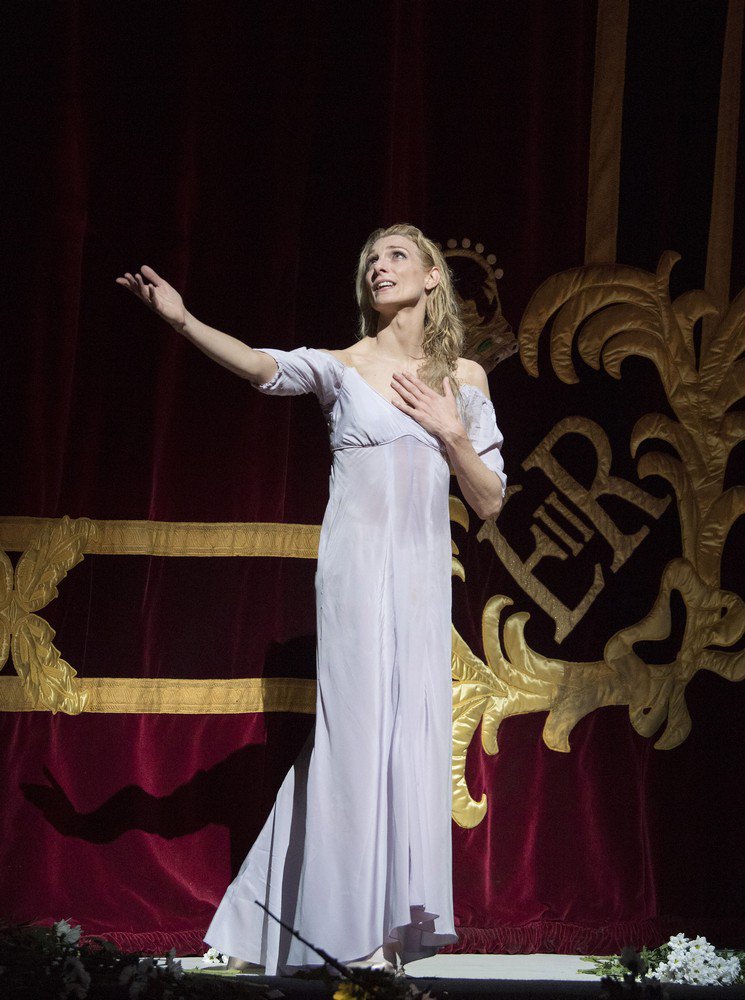
As well as the evening serving as a double tribute, it was also an evening that featured two adaptations from literature as well as featuring two ballets that were originally danced by Ashton's muse, Dame Margot Fonteyn. The Royal Ballet's triple bills usually deliver the goods - this one ranks as one of the best.
The first of the evening's ballets was THE DREAM, Ashton's 1964 version of A MIDSUMMER NIGHT'S DREAM. Rather than do a full adaptation of Shakespeare's play, Sir Fred chose to focus on the main middle section where the arguing rulers of fairyland, Oberon and Titania, find their dispute disrupted by the fleeing human lovers Helena, Demetrius, Hermia and Lysander as well as the clod-hopping Bottom. I think he might have spoiled Shakespeare's play for me now as, without the distractions of the bookending Athens sequences, his version was by far the most entertaining I have seen in years!

Ashton set his choreography to Mendelssohn's scores for two productions of the original play in the late 19th Century but John Lanchbery's arrangement of the scores is so smooth that it plays as a single piece. The late David Walker's design takes us back to full-on romantic versions of the play and I particularly liked the fairy frocks which were in varying shades of green, blue, pink and purple.
The always-remarkable Steven McRae was a fantastic Oberon, charismatic, mercurial and defying gravity, and was well partnered by Akane Takada as a spirited Titania, their final duet was simply dazzling as the couple become once more the loving king and queen of the forest. The role of Puck was played by Valentino Zucchetti who could give vivacity a bad name.

Bennet Gartside was a delight as Bottom, galumphing away when not delighting in his temporary status as Titania's donkey-headed lover. The mixed-up lovers danced by Thomas Mock, Matthew Ball, Claire Calvert and, in particular, Itziar Mendizabal as the lovelorn Helena were a delight. It must be a tough call to get laughs through just dance when you know it's a famous comedic role but Itziar got them. All in all, as I said, it was one of the most captivating DREAMs that I have seen.
In 1946 the Sadler's Wells Ballet was invited to be the permanent company at the Opera House, Covent Garden and one of their first productions was SYMPHONIC VARIATIONS, danced to music by César Franck. During WWII ballet had relied on safe, narrative productions but Ashton wanted this to be totally abstract. It was an immediate success and the original cast included Margot Fonteyn, Moira Shearer and Michael Somes. Three male and three female dancers are alone on stage with nothing to distract from their simple lines and classic moves. It is hard to judge it's originality now as it is the abstract norm but it was still beautifully danced by all the ensemble and the leads, Marianela Nunez and Vadim Muntagirov.

We had just seen Zenaida in full imperious diva mode in Liam Scarlett's SYMPHONIC DANCES but as Dumas' tragic Lady of The Camilias she was all too human but still never less than hypnotic. There was a slight sense of deja vu as we had seen the same story at Covent Garden last year in LA TRAVIATA but Ashton's MARGUERITE AND ARMAND - like his DREAM - distilled the essence of the story without making you feel much was left out.

Ashton devised the ballet in 1963 as a star vehicle for his partnership of Margot Fonteyn and Rudolf Nureyev and they created such an indelible stamp on it that the Royal Ballet felt they could not revive it until 2000, well after their deaths in the 1990s. But the piece cries out for charismatic star performers and while Yanowsky certainly is, it's a shame that Roberto Bolle was a bit stolid.
Danced to a piano sonata by Liszt the ballet starts with Marguerite on her deathbed, deserted by the hangers-on who once thronged her home and she drifts back to the love of her life Armand. We flash back to the night they met, when Marguerite was the courtesan of the Parisian rich and famous. Their initial flirtation hints at a deeper longing and they quickly become inseparable despite Marguerite's failing health.

They move to the country for Marguerite's health but her past catches up with her when Armand's disapproving father arrives and pressures Marguerite to reject Armand so he can have a blameless future. Despite her love for him, Marguerite flees their home while Armand sleeps. Well partnered by Christopher Saunders as Armand's father, Yanowsky played the scene beautifully, her final moments with Armand were achingly poignant - who needs words?
Marguerite returns to Paris and to her old rich lover but Armand appears at one of her parties and denounces her as a whore, showering her with money as payment for their love. Again Yanowsky played the scene wonderfully - and I say played rather than danced as she gave as great an acting performance as any RADA-trained thesp. Publicly humiliated, Marguerite's rich friends desert her and she succumbs to her illness alone. However Armand's father tells his son the real reason for her desertion and he rushes to her bedside to have final moments with her before she dies. This could feel mawkish but - just like Garbo in the 1936 film of CAMILLE - Yanowsky played the truth and not the sentimentality

If I thought the emotional highpoint had just taken place onstage I was wrong, as the curtain slowly descended there was a thunderous ovation which only grew and grew as Zenaida and the company took their bows. Wave after wave of flowers rained down from the stage boxes to say farewell and thank you to her from her London fans; her last-ever Royal Ballet performance will be during the company's forthcoming tour of Australia. It was like being in a Hollywood film!
Then came the real surprise,a parade of her leading men including Carlos Acosta and Steven McRae lined up to present her with a rose each then the choreographers who had worked with her ending with Sir Anthony Dowell almost hidden behind a huge bouquet. Then it was the turn of Kevin O'Hare as Director of the Royal Ballet to give a speech thanking her for 23 years of artistry with the company and hinting that he would be trying in the future to hopefully pursuade her to return as a guest artist. Then it was time for more curtain calls - and still more showers of flowers - before Zenaida left the stage for the last time.

It was a wonderful night showcasing the taste, mastery and effortless storytelling of Sir Fred but also it was an honour to be in the night when the Royal Ballet said a fond goodbye to one of their own.
Brava Zenaida!