Sunday, April 10, 2022

DVD/150: HAHA WO KOWAZUYA (aka A MOTHER SHOULD BE LOVED) (Yasujiro Ozu, 1934)

Ozu made 54 films but 17 are considered lost including his first 7 films.  Two other films barely survive while HAHA WO KOWAZUYA is missing it's first and last reels; it is still watchable but it's fairly standard melodrama.

Ozu returns to the theme of the breakdown of a family but it is fairly thin although well performed by the three lead actors.

Sadao and Kosaku's happy life shatters when their father's sudden death leaves them and their mother Chieko alone.  A few years later, Sadao discovers he is not Chieko's son but the child of his father's first marriage, he is angry at Chieko for not being told but his uncle pursuades him to forgive his mother.

A few years later, the secret flares up again when both brothers accuse Chieko of favouring the other.  Eventually Chieko reveals to Kosaku why his brother dislikes her.  Can the family survive?

Shelf or charity shop?  A keeper as it is paired with the superior LATE AUTUMN.  In later years Ozu-san said the film was only really memorable for him because his own father had died during the filming.  But despite the fairly basic melodramatic plot Ozu still builds an intensity in the scenes of family conflict and the tonal shift between the ever-reducing family homes and the shadowy local bordello with it's shuttered windows, striped awning and western film posters - boy, did I jump when Joan Crawford in RAIN appears suddenly!  Mitsuko Yoshikawa has the thankless role of the long-suffering mother, much given to collapsing to her knees. It appears to be a family trait as the brothers also crumple easily but I liked the surliness of Den Obinata as Sadao.  Ozu's favourite actor Chishu Ryu pops up as Sadao's dissolute student friend while there are nice performances from Yumeko Aizome as an icy prostitute and frequent Ozu performer Choko Iida as the bordello maid.


Monday, April 04, 2022

DVD/150: BONNIE AND CLYDE (Arthur Penn, 1967)

Like most iconic films, the origins of BONNIE AND CLYDE are surprisingly unexpected.

Writers David Newman and Robert Benton had read the same book on 1930s gangsters and were intrigued by a footnote referencing Clyde Barrow and Bonnie Parker and their nomadic 2-year crimewave across the southern and central states.

Influenced by the French New Wave, they sent their script to Godard and Truffaut, but both declined; Truffaut however met Warren Beatty later and told him about them.  Beatty contacted them and, producing for the first time, got grudging support from Warner Brothers, ironic as they thrived with their 1930s gangster films.

Leading directors refused, potential Bonnie's came and went but eventually Arthur Penn said yes and he, in turn, had been impressed by a young stage actress who had just appeared in two recent supporting film roles, Faye Dunaway.  It remains an audacious piece of mythic film-making.

Shelf or charity shop?  BONNIE AND CLYDE are hiding out on the shelf.  A film that oddly plays both inside and outside of it's genre, these contrasts make it still vital. Beatty's usual blank performance against Dunaway's relentlessly modern one creates it's own tension. The original script had Clyde bi-sexual but producer Beatty had it changed thinking it was going to be hard enough keeping mainstream audiences 'sympathetic' to the couple.  The influence of Godard and Truffaut is palpable but the locations chosen are the dusty low-rise main street buildings and wide open plains that the real couple would have been familiar with. Beatty remembered Gene Hackman's supporting role with him in 1964's LILITH and offered him the role of Buck, Clyde's jovial older brother which essentially launched his career; it's strange that in retrospect, although Beatty, Dunaway, Hackman and Michael J Pollard's getaway driver CW were all nominated, it was Estelle Parsons' shrill, whining Blanche Barrow that won the film's only acting Academy Award.  This was also Gene Wilder's screen debut in a marvellous scene where he and his girlfriend are kidnapped for an afternoon and just as they are becoming friendly, his admission of being a funeral director changes the mood immediately - indeed the scene pivots the film's tone totally to one of approaching doom. The film's release was negligible as Jack Warner disliked it, pushing the Taylor/Brando flop REFLECTIONS IN A GOLDEN EYE instead; after being challenged by Beatty it was given a different release and the audiences flocked in their droves, the film capturing the current anti-establishment mood.  Most reviewers panned it but Pauline Kael's glowing review/essay in The New Yorker made some critics revisit it and changed their minds over it, the NY Times reviewer Bosley Crowther keep panning it - and quickly lost his job!  Meanwhile Theodora Van Runkle's costume designs started a high street fashion outbreak of berets, jackets and mid-length skirts. The script of course plays fast and loose with the gangs real history but this was a prime example of filming the legend - and the ending has lost none of it's brutal impact.


Monday, March 21, 2022

DVD/150: TAXI ZUM KLO (Frank Ripploh, 1980)

The German film renaissance of the 1970s and 80s included gay directors Rosa Von Praunheim and Rainer Werner Fassbinder gaining worldwide recognition and in 1981 their friend Frank Ripploh briefly joined them when TAXI ZUM KLO became an instant cause celebre; it took 30 years for the British censore to pass it uncut.

Actor/writer/first-time director Ripploh makes sure the film revolves around him.  Echoing early John Waters films - amateurish, kitsch pop music, an over-reliance on kamikaze editing and counterpointed action - it's quite remarkable.

Ripploh plays... Frank Ripploh, a teacher whose pupils enjoy his classes. His life revolves around cruising clubs and toilets, quietly wondering if he misses out on not having a partner.

After meeting cinema usher Bernd, they move in together. Bernd wants them to leave Berlin to live in the countryside which alerts Frank that his sexual outlaw days are over.  

The relationship deteriorates...

Shelf or charity shop?  Frank can live in my plastic storage box...  despite Ripploh's clanging insistance that the film revolves around him, luckily he has charm and charisma enough to overcome this - indeed he gives the audience ample opportunities to dislike him.  Sadly the character of Bernd (played by Bernd Broaderup) is such a thinly-drawn character that it's difficult to feel anything for him - probably Ripploh's intention - so Bernd comes across as a bit of a whiny bore. This makes the second half of the film - where the relationship starts to breakdown - a bit one-sided.  Famous for the explicit gay sex scenes which caused endless censorship troubles - the British censors got themselves into a right old lather over a 'golden shower' scene - these scenes have almost an elegiac quality now.  TAXI ZUM KLO's award-winning success inflated Ripploh's ego and he dropped many old friends and, despite a small role in Fassbinder's QUERELLE, the next film he directed failed and even a later sequel to TAXI ZUM KLO tanked.  He died of cancer in 2002, aged 52.  And that title?  It translates as TAXI TO THE TOILETS, after the scene when, following an argument when Bernd visits him in hospital, Frank sneaks out and hires a taxi to take him around Berlin's public toilets.  That Frank...


Sunday, March 13, 2022

DVD/150: AKIBIYORI (LATE AUTUMN) (Yasujiro Ozu, 1960)

Ozu's classic LATE SPRING's plot was reworked for LATE AUTUMN and here Ozu intermingles humour and drama equally.

At the seventh memorial of Mr Miwa's death, his three friends meet his widow Akiko and 24 year-old daughter Ayako.  The men all courted Akiko when young and still think her attractive.  They decide to meddle in their lives and find Ayako a husband.

Akiko teaches dressmaking and Ayako works in an office with her friend Yuriko and has no wish to get married and leave Akiko alone.  But the plot continues: Mr Mamiya suggests Ayako meet his employee Goto and they start a tentative friendship.

The men decide if Akika remarries then Ayako need not worry. So widower Hirayama is chosen as her suitor but Ayako discovers the plot, misunderstanding that Akiko has agreed to re-marry.

Yuriko decides to sort the mess out but Akiko makes the ultimate decision...

 
Shelf or charity shop?  A shelfer.  Ozu-san again provides a memorable insight into the unacknowledged changes that end a family unit. The initial air of a comedy slowly gives way to the sadness of the two women at being manipulated apart.  Setsuko Hara delivers another wonderful Ozu performance as Akiko: eleven years before she had played the daughter not wanting to leave her widowed father in LATE SPRING but now she's the parent, always smiling and sad-eyed and whose final shot remains in the mind; saying volumes without saying a word.  She is well partnered by Yoko Tsukasa as her daughter Ayako, she would go on to appear in Ozu's following film. Keiji Sada delivered another fine performance as the proposed husband Goto, while three Ozu veterens Shin Saburi, Nobuo Nakamura and Ryuji Kita are great as the meddling trio of friends.  Ozu's favourite actor Chishu Ryu appears in a two scene cameo as Akiko's brother-in-law.


Monday, March 07, 2022

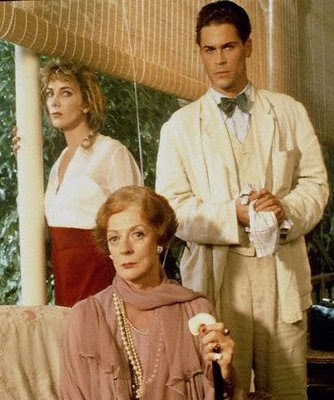
DVD/150: MAGGIE SMITH AT THE BBC - THE MERCHANT OF VENICE / THE MILLIONAIRESS / A BED AMONG THE LENTILS / SUDDENLY LAST SUMMER (various. tv)

An uneven quartet of BBC productions starring Maggie Smith.

Cedric Messina produced the PLAY OF THE MONTH series but also directed their 1972 version of THE MERCHANT OF VENICE; Portia's mix of humour and drama was perfect for Maggie but she struggles with a leaden studio-based production and a subdued Frank Finlay as Shylock.

She starred in another 1972 POTM, Shaw's THE MILLIONAIRESS where she is pure Smith: her fur stole wealded like a weapon, imperiously all wrists, cheekbones and shoulders but it's another underwhelming production.

Also included is her unforgettable Susan, the depressive vicar's wife whose secret drinking leads to the arms of an Asian shopkeeper in TALKING HEADS, written and directed by Alan Bennett.

Last is Richard Eyre's adaptation of Tennesee Williams' Southern Gothic SUDDENLY, LAST SUMMER.  Maggie was ill during the filming but her subdued Mrs Venable exudes a patrician power rather than all-out madness.

Shelf or charity shop?  Half of the productions might be underwhelming but Maggie's performances make it onto the shelf. Interestingly, the extras make it more of a keeper: there is her episode from the 1967 series ACTING IN THE 60S where she is interviewed by Clive Goodwin and they are later joined by her longtime friend Kenneth Williams to discuss playing comedy.  A 1973 apperance on PARKINSON is a great addition when, again joined by Kenneth Williams, they read John Betjemin's "Death In Leamington" to the obvious pleasure of Betjemin.


Sunday, February 13, 2022

DVD/150: THE YOUNG LIONS (Edward Dmytryk, 1958)

A box-office success, THE YOUNG LIONS hasn't aged well with the exciting pairing of Montgomery Clift and Marlon Brando nullified as they don't appear together.

Irwin Shaw's 1948 WW2 bestseller novel has three protagonists: one German, two American.  Dmytryk and screenwriter Edward Anhalt changed the plot which angered Shaw.  The main change favoured Brando by making the German more sympathetic, which pleased him but Clift was unhappy about it.

As Christian Diestl is with the German occupation of Paris, in America singer Michael Whiteacre and shop worker Noah Ackerman become friends at their draft medical.  In training camp, Noah is bullied by others - oddly Dmytryk plays down the obvious anti-semitism.

Christian's involvement with icy Captain Hardenberg starts his disillusion with Nazism while Noah and Michael eventually find themselves in Europe.

In the final days of the war, the protagonists have a fateful meeting near a liberated concentration camp.

Shelf or charity shop?  I think it's time to let these lions roam. Dmytryk's attempts at profundity now appear heavy-handed and obvious and never makes a connection between the three protagonists so the climax has no particular power.  Brando occasionally flares into life but his blonde rinse and German accent seem to drain him.  This was Monty Clift's first film after his car crash while filming RAINTREE COUNTY which permanently affected him physically and mentally. His offscreen reliance on alcohol and painkillers gives his performance a tremulous, delicate quality - the prolonged fight scenes with the barrack bullies seem overly sadistic - but his civvy scenes with Hope Lange have a welcome warmth.  Dean Martin's career was stalling after his acrimonious professional split with Jerry Lewis and, while he certainly trades on his woozy wise-cracking persona, he delivers a good performance which showed his untapped dramatic potential.  By far, the performance that delivers the best is Maximilian Schell in his first English-speaking role as the cynical Captain Hardenberg - all the more impressive as he learned his lines phonetically.