Showing posts sorted by date for query TODA FAMILY. Sort by relevance Show all posts

Thursday, February 10, 2022

DVD/150: CHICHI ARIKI (There Was A Father) (Yasujiro Ozu, 1942)

Filmed between Ozu's national service duties - in China between 1937-1939 then Singapore in 1943 - and adhering to Japan's 'national policy', CHICHI ARIKI manages to subvert dogma by alluding to the the emotional cost of 'duty done'.

Existing prints are post-war American versions which excised overt WWII references but Ryohei's army medical exams is evidence enough.
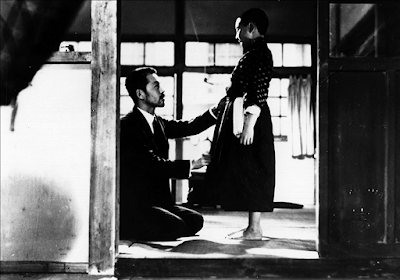
Ozu regular Chishu Ryu is memorable as widower Shuhei Horikawa, a teacher raising his son Ryohei alone.  He is a dedicated teacher but is devastated when a pupil drowns on a school trip.  Consumed with guilt, Shuhei quits teaching and moves to Tokyo to find work, leaving unhappy Ryohei to board at school.

Years pass: Shuhei is an office worker and Ryohei is teaching.  Ryohei tells his father he will leave teaching and move to Tokyo to be together again but Shuihei cannot condone Ryohei's dereliction of duty.

But can duty replace happiness...

Shelf or charity shop?  Watching the world from the shelf .  Ozu-san again provides an insight into parents and children, all the more impressive that he had to negotiate the Japanese WWII codes of Self-Sacrifice and Duty. Ozu wrote his first version of CHICHI AKIRI after THE ONLY SON was released and both have a similar theme - separated parents and children attempting to heal feelings of failed hopes - but the nuanced performances of Chishu Ryu (aged only 38 while filming) and Shuji Sano as Ryohei make it particularly memorable.  Ozu and his mother and siblings had been separated from his father during his teens so he knew the feelings involved but whereas Ryohei fulfills Shuhei's sacrifices, Ozu would avoid school to spend his days in cinemas and was later expelled for writing a love letter to a fellow school-boy.  CHICHI AKIRI was voted the 2nd best film in Kinema Junpo magazine's annual poll - number one was Ozu's THE BROTHERS AND SISTERS OF THE TODA FAMILY!


Saturday, May 15, 2021

DVD/150: TODA-KE NO KYODAI (Brothers and Sisters of The Toda Family) (Yasujiro Ozu, 1941)

Ozu's first film after two years in the Japanese army fighting on mainland China was the box-office hit TODA-KE NO KYODAI.  It shows the beginning of his more focused storyelling which was to emerge eight years later with BANSHUN (Late Spring): stories of family breakups, mixing drama and gentle humour with a sad undertow.

The Toda family gather for a group photograph outside their parent's large home to celebrate the father's 69th birthday but that night he dies from a heart attack...

The family discover their father was the guarantor for massive debts accrued by a failing business.  They sell the family home and possessions to pay half the debt, but cannot sell a dilapidated beach home.

It is decided that homeless Mrs Toda and youngest daughter Setsuko should move between the houses of the eldest three children.

But the women are treated as an embarrassing, unwanted burdon...

Shelf or charity shop?  This is on the same dvd as the glorious TOKYO STORY so of course it's a keeper but also because it is the first film where Ozu's vision of film-making started falling into place.  The film has a pace and an elegance that belies it's age and Ozu offers us his characters without judgement, just a well-observed resignation of their failings.  Ozu's favourite actor Chishu Ryu is seen in a bit part as a friend of the youngest son Shojiro who is charismatically played by Shin Saburi, the first of five roles he played for Ozu.  Ayako Katsuragi and Mieko Takamine are fine as the unwanted mother and daughter while Kuniko Miyake and Mitsuko Yoshikawa are hissable as the unwelcoming sister-in-law and sister of the Toda family.  There is also a very nice performance from Michiko Kuwano as Setsuko's friend: sadly the actress - who had played a lead role in Ozu's WHAT DID THE LADY FORGET? in 1937 - died several years later aged only 31. The film's odd, abrupt ending was the result of Ozu realizing that he didn't have two days left to film but two hours!