Showing posts with label Ronald Neame. Show all posts

Monday, January 03, 2022

DVD/150: THE POSEIDON ADVENTURE (Ronald Neame, 1972)

THE POSEIDON ADVENTURE is now fifty and holds a very special place for me - so don't expect criticizing.

What started with 1970's ANNE OF THE THOUSAND DAYS, blew up with POSEIDON - it made me a Movie Buff: any magazine that featured it was bought, any film that starred any of the actors was watched, it played a week at Kensington Odeon and I went every night.

I know POSEIDON so well but seeing it always casts a delicious spell, so easy to lose myself in.  There is always the subliminal feeling that whatever has happened in the intervening years, the ten survivors of the New Year's Day sinking of the SS Poseidon are still there, battling upwards to escape.

20th Century Fox wouldn't finance all the $4 million budget after recent losses so producer Irwin Allen secured half ot it from private investors - it went on to earn $125 million!

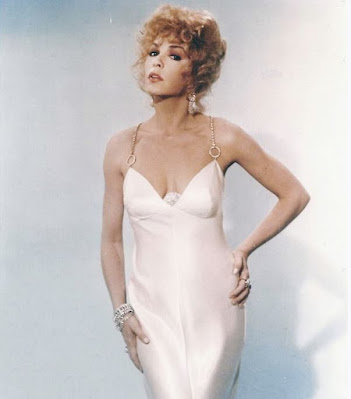
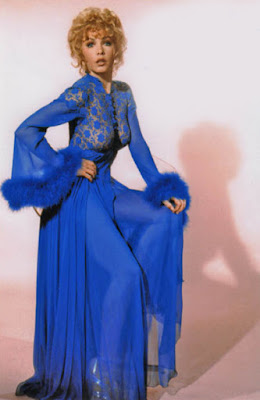
Shelf or charity shop?  Sitting happily on an upside down shelf!  THE POSEIDON ADVENTURE won two Academy Awards, a BAFTA, a Golden Globe and my unswerving devotion! I read the 1969 Paul Gallico novel at the time and disliked it's grubby, nasty characters. To this day I remain obsessed with Gene Hackman and his turtle-neck with the torn shoulder, Pamela Sue Martin's long skirt / hot pants ensemble and everything about the glorious Stella Stevens. especially in her wonderful blue negligee and white bias-cut evening dress with the plunging neckline - the height of 70s costume design!  And yes, I still blub when brave Shelley Winters takes her last dive.  I was surprised how often the actors had appeared together in other films leading up to POSEIDON but the most interesting was that director Ronald Neame, then a cinematographer, and a 10 year-old Roddy McDowall had worked together 34 years before on a George Formby film!  Ah Ronnie Neame, what a hero... the man who co-produced personal favourites like BRIEF ENCOUNTER and OLIVER TWIST and director of this, the film that lead me to Movie Buffdom. I owe him and the cast a debt of gratitude.


Thursday, April 15, 2021

DVD/150: THIS HAPPY BREED (David Lean, 1944)

In 1939, Noel Coward wrote THIS HAPPY BREED about a working-class family; he starred in the play, which played alternate performances with his more debonair comedy PRESENT LAUGHTER, but by the time the film was made, the role went to Robert Newton.

David Lean, who had co-directed the previous year's IN WHICH WE SERVE with Coward, here was sole director for the first time. he also adapted the play with his Cineguild colleagues Anthony Havelock-Allan and Ronald Neame who also was the cinematographer.

In 1919, Frank and Ethel Gibbons move into a Clapham terraced house with their three children Queenie, Reg and Vi, Frank's shrill spinster sister Sylvia and Ethel's opinionated mother Mrs Flint, and over 20 years we follow their happinesses and tragedies against the events that shaped the period.

Frank learns their neighbour is army pal Bob Mitchell whose sailor son Billy soon loves Queenie.

Shelf or charity shop?  A shelfer.  Although Coward's view of his working-class characters has a patronising tone, he knows how to make the main characters 'pop' and while David Lean had concerns about directing actors - on IN WHICH WE SERVE Coward handled the actors while Lean did the action sequences - he needn't have worried with such a talented cast, and he whips the action along at pace. Robert Newton.s performance has not dated well but Celia Johnson is wonderful as the loving but moral Mrs Gibbons, a performance which won her the US National Board of Review award for Best Actress.  While all the characters seem to take turns saying "There'll be trouble and no mistake" or "Well I'm sorry I'm sure!", there are stand-outs from Amy Veness as Celia Johnson's formidable mother, Stanley Holloway is always a delight as salt-of-the-earth neighbour Bob, John Mills gives a better-than-usual performance as sailor Billy - the only cast member from the original play - and Kay Walsh, who was married to Lean at the time, is excellent as the snobbish Queenie, a Clapham Bovary who yearns for a better life.


Saturday, April 10, 2021

DVD/150: BRIEF ENCOUNTER (David Lean, 1945)

I didn't think such violent things could happen to ordinary people.

Sometimes only the film that will leave you a sodden mess at the end will do...

The greatest British film ever made?  For me, yes...

Noel Coward's adaptation of his one-act play STILL LIFE also went through Lean's collaborators Anthony Havelock-Allen and Ronald Neame.

Lean's direction is perfection - you can keep LAWRENCE or KWAI, here he shows his genius.

Gloriously shot by Robert Krasker, his images live on in the mind in tandem with Rachmaninoff's music.

Both married with children, a chance encounter between Laura Jesson and Alec Harvey leads to them falling in love, possessed by feelings that neither knew they were capable of or that they can fully acknowledge.

Victims of time, class and circumstance they snatch brief moments of happiness but it's doomed to failure by their own decency. 

Celia Johnson and Trevor Howard (in his first starring role) give two of cinema's great performances.


Shelf or charity shop?  Are you INSANE?  Johnson and Howard have a wonderful supporting cast - Stanley Holloway as Albert Godby the ticket inspector and Joyce Carey as Myrtle Bagot the 'refained' tea-room manageress are delightful as the counterpoint couple to Laura and Alec - where as they have to hide in corners, Albert and Myrtle can be as flirtatious as they like.  There are memorable performances from Everley Gregg, as Laura's garrulous acquaintance Dolly who crashes into Alec and Laura's last moments together, denying them any resolution to their sadness, and Cyril Raymond as Laura's husband Fred who, speaking the last line of the film, destroys me every time and makes me blub uncontrollably.  Anyone who thinks Coward glib need only read Laura's internal monologue to see how wrong they are...
"This can't last. This misery can't last. I must remember that and try to control myself. Nothing lasts really. Neither happiness nor despair. Not even life lasts very long. There'll come a time in the future when I shan't mind about this anymore, when I can look back and say quite peacefully and cheerfully how silly I was. No, no, I don't want that time to come ever. I want to remember every minute, always, always to the end of my days."


Tuesday, January 12, 2021

DVD/150: IN WHICH WE SERVE (Noel Coward / David Lean, 1942)

When producer Anthony Havelock-Allen approached Noel Coward in 1941 to make a patriotic film, Coward picked the Navy, and a fictionalised account of the recent sinking of his friend Lord Mountbatten's ship HMS Kelly.  Such a blatant propaganda piece shouldn't work - but it does.

Coward's name appears seven times in the opening credits!  He produced and wrote it, starred as the patrician Captain Kinross and composed the unmemorable score.

More importantly, first-time director Coward realised that while he could handle directing actors, he would be - ahem - all at sea with the action sequences so he gave a young editor his first chance at directing, David Lean.

An uncredited Leslie Howard announces at the start "This, is the story of a ship" and we follow the life of the fictitious HMS Torrin from construction to it sinking, watched by it's survivors as they cling to a raft.  As they wait for rescue, strafed by enemy planes, Kinross, Petty Officer Hardy and Seaman 'Shorty' Blake remember their lives back home..

Shelf or charity shop?  A definite shelf.  As I said, Coward and Lean's film stands the test of time and class snobbery to be a genuinely moving look at Briton at war.  Noel Coward won a special Academy Award citation for the film and one can imagine the effect it had on it's audience at the time. Wonderfully photographed by Ronald Neame - getting in soggy training early for his later THE POSEIDON ADVENTURE! - and Lean's editing keeps the film always moving forward.  Although Coward's writing for his working-class characters always verges on the Dickensian, it does lead to some memorable performances: Coward is his ramrod, debonair self which makes for an odd Captain but what a joy to see him in his clipped prime while among the crew, there are three actors who I usually dislike but here all deliver fine performances: John Mills as cheeky chappy 'Shorty', Bernard Miles as the stoic Hardy and the film debut of Richard Attenborough, as a stoker who abandons his post.  Keeping the home fires burning are the luminous Kay Walsh as Freda, 'Shorty's shy young wife, Joyce Carey as Hardy's no-nonsense wife Kath - her last scene is particularly moving, and the sainted Celia Johnson as Kinross' wife Alix.  This was her first feature film and, despite an accent you can etch glass with, she is magnificent, especially in her one-take speech about her acceptance of the third presence in their marriage, the Torrin. 

Sunday, October 11, 2020

DVD/150: THE PASSIONATE FRIENDS (David Lean, 1949)

David Lean followed his vibrant OLIVER TWIST with the listless THE PASSIONATE FRIENDS; despite his affair with star Ann Todd, no passion transferred to the screen, she gives her usual glacial performance

Ronald Neame was to direct Eric Ambler's adaptation of HG Wells' novel but Lean disliked the script so co-wrote a new version, moved Neame to producer and became the director.

Former lovers Mary and Stephen meet again nine years after she rejected his marriage proposal to live independantly; she is now married to the banker Howard (or Haaaard as Todd says) for the security of his wealth.

They grow closer but Howard demands the relationship ends.

Nine years on, while waiting for Howard at a Swiss hotel, Mary meets Stephen by accident and they spend the afternoon together before he flies home.  Howard sees them however and starts divorce proceedings.

Desperately, Mary tries to resolve the situation...

 
Shelf or charity shop?  It's part of a David Lean box-set, if I ever break it up I suspect it will be the first to go.  Lean seems less interested in his performers than finding other ways to tell the story such as a double-flashback (which comes too early in the film) and a showy way of speeding up the action by tracking his camera along telephone poles and wires while we hear back-to-back phone calls on screen.  It's unsurprising that it failed at the box-office, Lean just cannot make you care for his characters.  Nice camera-work and a good sense of London locations however... There had been a previous silent version made in 1922.