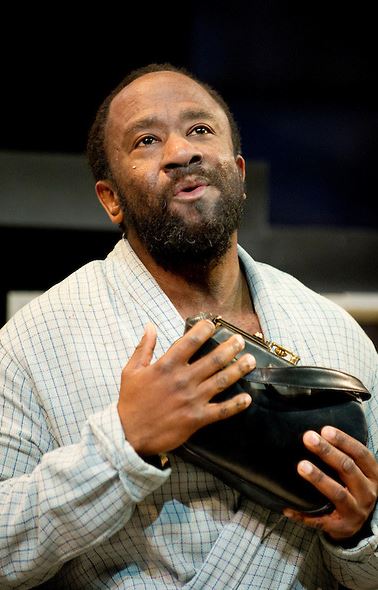
Peter Shaffer died four months before the opening of this revival of his 1979 masterpiece AMADEUS, I am sure he would have been thrilled to see it back on the National Theatre's mainstage 37 years later. Sadly that production was before I got the theatre bug in that same theatre three years later with GUYS AND DOLLS, I would loved to have seen it as my dear friend John Normington played the fussy Emperor Joseph II. As usual, I am used to seeing ghosts walk the Olivier stage....
I first saw AMADEUS on stage in 2014 in a revival at Chichester with a masterful, charismatic lead performance from Rupert Everett as Salieri, the 18th Century composer who found himself usurped in popularity by the young genius Mozart and schemes to ruin him. Shaffer has a reclusive and dying Salieri narrate the story; he has made sure that all Vienna is awash with the rumours that he murdered Mozart but takes us back to their first meeting and the start of his enmity.
What angers Salieri is that God is seemingly mocking him; from a young age he dedicated his life to the service of enriching the world and serving God through his music and while it has brought him success he has yet to fully believe that the Lord is truly in his compositions. He can sense the divine in Mozart's work but is appalled that the composer is a dissolute and obnoxious person. Salieri decides to avenge himself on his uncaring God by seeking to destroy his chosen one.
The script bristles with Peter Shaffer's distinctive literary wit and phrasing but I felt that language did not seem to be uppermost in director Michael Longhurst's three hour production. Once again we have a director who seems to follow the Emma Rice school of directing: namely distrust the words and go for the sensation - the choreographed movement, the modern anachronisms, the minimalist standing set, the gender and race-blind casting, the vague air of alienation theory. It all smacks of attempts to jazz up the form but all one is left with are tropes, no substance.
As usual what gets lost in this approach is any genuine emotion in the piece - you watch the actors going through the motions but nothing they ever do seems to connect, or even attempt to. I suspect it would be seen as old school to do that but if you are spending three hours staring at a production, something needs to have an effect surely.
Longhurst has the potentially inspiring idea of using the 21-strong Southbank Sinfonia acting as supernumeraries and also to create choreographed movement at times - all waving or pulsing to a certain strain of music. I have to admit it did make for some memorable moments but that was what they were - moments. At other times all you had were 21 people staring gormlessly about themselves and into the auditorium.
Despite the raves he has received from the critics I found Lucian Msamati ultimately wearying as Salieri; it's not entirely his fault, by the end of the play you do rather wish that Shaffer would speed up his musing on musical history and for the most part Msamati was strong enough to lead the production and give it a central focus, but his speech pattern did not really suit the writing and it became hectoring rather than insinuating. Rupert Everett gave a much more nuanced performance at Chichester and as such made the character more resonant. One applauds Msamati for the endurance but not the actual performance.
Adam Gillen as Mozart and Karla Crome as his wife Constanze also have the same affliction - both end the play as they started it; Gillen braying and whinnying and Crome like an 18th century character from Eastenders. Both Amadeus and Constanze age ten years during the play as they dwindle into poverty but you really would have no idea from their performances.
Yes Gillen was supposed to be an annoying twat but in his final scene, dying while trying to finish his own requiem, he was just as squeaky and punchable. Joshua Maguire played Amadeus in the Chichester production and at least varied the tone, finally winning some sympathy for the character.
One of the actors did however make a splash; Tom Edden - last seen gurning about in dirty underwear in the woeful DOCTOR FAUSTUS - was delightful as the petulant Emperor Joseph II. Two actors who were good in the previous Olivier production THE THREEPENNY OPERA here play Salieri's gossiping Venticelli and gave such jarringly amateur performances that they shall remain nameless.
Chloe Lamford's production design managed to be both sparse and cluttered at the same time, mainly consisting of a movable stepped dais and projected gauze's and scrims while Jon Clark's lighting design did all the heavy lifting in setting moods and place. However, there was no denying the excellent musical direction of Simon Slater who made the classical music sound wonderfully bravura.
The production is sold out until February but will continue in the repertoire further into 2017 and it will, of course, be screened in cinemas as part of the NT Live events.
Back to that original National Theatre production... AMADEUS won the Evening Standard award for Best New Play and Paul Scofield was filmed for the television coverage in the scene where Salieri hears Mozart's music for the first time; it's an acting masterclass in microcosm and is thrilling to watch and hear:
Showing posts with label Lucian Msamati. Show all posts
Sunday, November 13, 2016
Sunday, February 07, 2016
MA RAINEY'S BLACK BOTTOM at the Lyttelton - August in February!
Back in the day - actually it was 27 year's worth of days - I saw the National Theatre's production of MA RAINEY'S BLACK BOTTOM by August Wilson in the intimate Cottesloe Theatre. It stayed with me as being an exploration of the burgeoning success of black jazz and blues performers and musicians within the 'race' recording companies while also boasting impressive performances from Carol Woods, Hugh Quarshie and Clarke Peters.
August Wilson died in 2005 after writing ten plays in which he wanted to show the experience of black Americans in the 20th Century. The only other of these that the National has staged was Wilson's first play JITNEY with a visiting American company in 2001. This played in the Lyttelton Theatre which is now the home of Dominic Cooke's revival of MA RAINEY'S BLACK BOTTOM. Everything old is new again!
I am sure Rufus Norris wants to give the production the widest exposure possible but it feels too exposed on the expansive Lyttelton stage - a vast empty space surrounds Ultz's recording studio set and proves too much of a distraction even with the quality of the performances.
Ultz also has a narrow, train-corridor room raise up and down at the front of the stage to show the downstairs musicians' area which could surely have been included somewhere on the main stage as Bob Crowley did for the 1989 Cottesloe version. It reminded me too much of the set design for THE HAIRY APE at the Old Vic last year.
This was my only problem with Dominic Cooke's production which is hugely involving, after an admittedly slow-moving first hour, and he captures the undercurrents that swirl around an otherwise unexceptional recording session for Gertrude 'Ma' Rainey, "The Mother Of The Blues" and her touring band.
Cooke skillfully highlights the air of change that haunts the characters - Rainey's fame is slowly being eclipsed by Bessie Smith who has bigger record sales whereas 'Ma' Rainey's style of shouted blues are perceived as out of fashion. The band have to face the changing style in music and one in particular, the explosively egotistical Levee, is preening that the record company man has asked him to supply him with songs - surely that means Levee will be a star in his own right soon with his own band?
The play needs a barnstorming actress to play 'Ma' Rainey and Cooke has the good fortune to have Sharon D. Clarke who can act up a fearsome diva storm as well as belt out the title song to the balcony. Clarke has found a home at Rufus Norris' National Theatre with roles in THE AMEN CORNER and EVERYMAN and here she is in suitably imperious form.
After her manager (a suitably harassed Finbar Lynch) assures the record boss that she will be on her best behaviour, she sweeps in an hour late, says she will not sing her song with the new jazzy arrangement, she won't sing if she doesn't get her bottle of Coca-Cola and she definitely won't sing unless her stuttering nephew is allowed to perform the spoken intro to the song! Clarke is excellent in the role and shades the divaness when 'Ma' is allowed a reflective moment in the studio.
There are excellent performances too from Lucian Msamati as Toledo, the seen-it-all pianist, Giles Terera as Slow Drag the bass-player, Clint Dyer as trombone-playing Cutler and O-T Fagbenle (a name I marvel at) as the dangerously ambitious Levee. When his dreams of being a future jazz star are dashed by "the man" his violent response brings to the play to it's shocking conclusion and Fagbenle gave a kinetic, jangly performance.
There is also fine work from Lynch as Rainey's weary manager, Tunji Lucas as her stuttering nephew Sylvester and a nicely sly performance from Tamara Lawrance as Dussie Mae, Ma's latest young lover who one suspects will move from bed to bed as long as it keeps her in new dresses and spending money.
I would recommend MA RAINEY'S BLACK BOTTOM very much... and look forward to new plays such as MADONNA'S CAUSING A COMMOTION and DUSTY SPRINGFIELD'S GOIN' BACK!
And to finish off, how about the actual recording the play is based on - although the first photo on the video is actually Bessie Smith (oh and it fades out before the end) 'Ma' would NOT be happy!
August Wilson died in 2005 after writing ten plays in which he wanted to show the experience of black Americans in the 20th Century. The only other of these that the National has staged was Wilson's first play JITNEY with a visiting American company in 2001. This played in the Lyttelton Theatre which is now the home of Dominic Cooke's revival of MA RAINEY'S BLACK BOTTOM. Everything old is new again!
I am sure Rufus Norris wants to give the production the widest exposure possible but it feels too exposed on the expansive Lyttelton stage - a vast empty space surrounds Ultz's recording studio set and proves too much of a distraction even with the quality of the performances.
Ultz also has a narrow, train-corridor room raise up and down at the front of the stage to show the downstairs musicians' area which could surely have been included somewhere on the main stage as Bob Crowley did for the 1989 Cottesloe version. It reminded me too much of the set design for THE HAIRY APE at the Old Vic last year.
This was my only problem with Dominic Cooke's production which is hugely involving, after an admittedly slow-moving first hour, and he captures the undercurrents that swirl around an otherwise unexceptional recording session for Gertrude 'Ma' Rainey, "The Mother Of The Blues" and her touring band.
Cooke skillfully highlights the air of change that haunts the characters - Rainey's fame is slowly being eclipsed by Bessie Smith who has bigger record sales whereas 'Ma' Rainey's style of shouted blues are perceived as out of fashion. The band have to face the changing style in music and one in particular, the explosively egotistical Levee, is preening that the record company man has asked him to supply him with songs - surely that means Levee will be a star in his own right soon with his own band?
The play needs a barnstorming actress to play 'Ma' Rainey and Cooke has the good fortune to have Sharon D. Clarke who can act up a fearsome diva storm as well as belt out the title song to the balcony. Clarke has found a home at Rufus Norris' National Theatre with roles in THE AMEN CORNER and EVERYMAN and here she is in suitably imperious form.
After her manager (a suitably harassed Finbar Lynch) assures the record boss that she will be on her best behaviour, she sweeps in an hour late, says she will not sing her song with the new jazzy arrangement, she won't sing if she doesn't get her bottle of Coca-Cola and she definitely won't sing unless her stuttering nephew is allowed to perform the spoken intro to the song! Clarke is excellent in the role and shades the divaness when 'Ma' is allowed a reflective moment in the studio.
There are excellent performances too from Lucian Msamati as Toledo, the seen-it-all pianist, Giles Terera as Slow Drag the bass-player, Clint Dyer as trombone-playing Cutler and O-T Fagbenle (a name I marvel at) as the dangerously ambitious Levee. When his dreams of being a future jazz star are dashed by "the man" his violent response brings to the play to it's shocking conclusion and Fagbenle gave a kinetic, jangly performance.
There is also fine work from Lynch as Rainey's weary manager, Tunji Lucas as her stuttering nephew Sylvester and a nicely sly performance from Tamara Lawrance as Dussie Mae, Ma's latest young lover who one suspects will move from bed to bed as long as it keeps her in new dresses and spending money.
I would recommend MA RAINEY'S BLACK BOTTOM very much... and look forward to new plays such as MADONNA'S CAUSING A COMMOTION and DUSTY SPRINGFIELD'S GOIN' BACK!
And to finish off, how about the actual recording the play is based on - although the first photo on the video is actually Bessie Smith (oh and it fades out before the end) 'Ma' would NOT be happy!
Thursday, August 22, 2013
Say Amen Somebody!
A few weeks ago Owen and I went to Church. Oh, and we went to New York. The difficult part was that we also went back 60 years to 1953. But the Olivier Theatre has always served me well as a time machine. It was all so we could witness the goings on at a storefront church which is where James Baldwin's THE AMEN CORNER takes place. Baldwin had grown up in the abusive home of his preacher stepfather. He became a preacher himself at the age of 14 until three years later when he became disenchanted with religious life, around the time he also discovered his gay sexuality. At the age of 29, after living in Paris, he wrote GO TELL IT ON THE MOUNTAIN, a semi-autobiographical first novel set in the Pentecostal community but, still not exorcised, the following year he wrote his first play THE AMEN CORNER.
The play is a rarity in that it features four excellent larger-than-life female characters who power the play alongside three lesser male roles. Rather shockingly, the play has only had one Broadway production, a two month run in 1965. In London it had a notable premiere in 1987 at the Tricycle Theatre which transferred to the West End and now it is being presented in the largest auditorium at the National Theatre.
Margaret Alexander is a self-made woman, a woman who has raised her son David single-handed and become the preacher at a small storefront church while she, her son and her devoted sister Odessa all live in the small apartment on the premises. Although she is deeply loved by her congregation they are also cowed by her God-fearing teaching and way of life which means that she is immovable in her fierce belief that God's is the only way.
For example, Brother Boxer comes to Margaret and says that he has been offered a job driving a beer truck which will earn him more money. But no, Margaret rules from on high that to take the job would be Godless as it's propagating the sale of the demon drink. The best the aggrieved parishioners can hope for is that the more easy-going Odessa will try to convince her hard-line sister.
But in true Greek Drama style, just as Margaret is achieving great things in hooking up with a bigger church in a different state, her life is rocked when her dissolute husband Luke appears from out of her past. Luke is in a very bad physical state and cannot be moved so it allows David to finally get to know his musician father, just as he is feeling the pull away from the church to jazz clubs.
While this is taking place downstairs, Margaret is facing growing dissent in the church as questions are being asked, such as where the new fridge came from in her kitchen just after the parishioners had financed her trip to the affiliated church. This Crimplene & big hat rebellion is led by sweet-talking, steel-eyed Sister Moore who is given extra fuel when Luke tells everyone that the truth is that Margaret left him, he never left her.
Baldwin certainly created interesting characters who hold your attention and are bold, decisive figures. Sadly his dialogue doesn't match up to these characters and his scenes can sometimes go over the same ground too many times which can be a little wearying especially if it is between just two characters. The pay-off is also rather obvious and the denouement, after all the plotting that has gone before, seems oddly rushed.
Rufus Norris has directed the play well with the action motoring along despite the treading-water quality to some of Baldwin's two-hander scenes. I was surprised when it was announced that the production was going into the Olivier as the play would fit perfectly into the 'normality' of the Lyttleton but actually I applaud that choice as I suspect within the proscenium arch the whole enterprise would have felt stifled. Ian MacNeil's set design angles the action so it is close to the audience and it certainly helps open the play out from what could be quite a claustrophobic piece.
What Norris has also done is elicited excellent performances from his cast of fine performers. As I said earlier, Baldwin has written four stonking roles for women and here they are grabbed with huge gusto by four formidable performers.
Marianne Jean-Baptiste has lived and worked in Los Angeles since 2002 after finding little progression in the roles offered to her here after being the first black Briton nominated for an Academy Award in SECRETS AND LIES. Her performance as the righteous Margaret shows us all how much we have been missing.
It's a very hard role: although loving to her family, Margaret is a brick wall who will not be breached. It is hard to feel sympathy for the character but at the end - when Margaret realises that love is the way to true spirituality - it is important that the actress can touch you and this is exactly what Jean-Baptiste achieved. Throughout the second act you could almost see her carapace being chipped away piece by piece until, confronted by the collapse of all her dreams, she is left alone but more at peace. It's a rare actress that can hold an audience's sympathy off until she needs to let it be released but Marianne Jean-Baptiste managed it with a consummate ease. It's a crime that she was not given the opportunities before.
As Margaret's more forgiving but equally loyal sister Odessa, Sharon D. Clarke was a revelation too. I am used to seeing her in musical roles but here she gave us a portrait of a woman who has put her on life on hold to support her more ambitious sister and her nephew. Another actress who I have also only usually seen in featured musical roles is Jacqui Boatswain who here gave a delightfully slippery performance as Sister Boxer, smarting from Margaret's refusing her husband to take a well-paid job and biding her time until she could help bring her down.
But despite these excellent performances, there was yet one more performer who not only stole every scene she was in but also went through all of our pockets and took the bulbs out of the lights too. Cecilia Noble was just astonishing as Sister Moore, a baby-voiced Judas and an outsized Brutus, dissembling sweetly while she orchestrated Margaret's downfall only to let the mask fall at the end with a hollered "Victory!" as she moves to centre-stage. It was an audaciously funny but truthful performance that lingered long in the memory.
I would also like to mention Naana Agyei-Ampadu as Ida, a nervous young woman who comes to Margaret for help over her sick child in the first act only to appear again in the second act - just as Margaret is starting to doubt her own rigid beliefs - in a state of suicidal distress now her child is dead. It was a performance that had to go from 0 to 100 in as many minutes and she handled it with a raw power.
The three men's roles really are just supporting parts but I enjoyed Donovan F. Blackwood as the boisterous Brother Boxer, Eric Kofi Abrefa as the conflicted son David and Lucian Msamati was a shaky livewire as the dying ex-husband Luke. Among the supporting cast, augmented with members of London Community Gospel Choir, who raised the Olivier roof with their Church singing were Delroy Atkinson (from Ray Davies' musical COME DANCING) and Miquel Brown (Hi-NRG Queen and Sinitta's mum!)
Saturday, March 19, 2011
When a production has won every Best Play award going for the year - and you come late to it - you run the risk of leaving the theatre thinking "Well it wasn't all THAT". Remarkably Bruce Norris' CLYBOURNE PARK can not be included in that sentiment.
It's a play that is as savage as it's funny, as insightful as it is provocative, as tender as it is angry.
An explosive argument erupts over letting a black family into the neighbourhood which is witnessed by Francine's unassuming husband Albert and Karl's deaf wife Betsy. It was a powerful first act - the fury of Russ and Karl's standoff made all the uncomfortable by the discomfort of Francine and Albert, the blissfully unaware Betsy and Bev's hysterical breakdown - and is so compulsive that at the interval I was relieved to finally be able to breathe!
The second act hurtles forward 50 years in time and the same house in 2009 is now in a sad state of disrepair. On a swelteringly hot day, young couple, Steve and Lindsey, are having a professional meeting with Kathy their lawyer, Tom the estate agent, and Lena and Kevin, another couple from the neighbourhood Improvement Committee over their plans to buy the property, knock the house down and rebuild a bigger one. Only this time the buyers are white, seeking to move to Clybourne Park which is now an all-black area.
The social niceties are wonderfully played out: the mundane chitchat while one person takes a call on their mobile, the effusiveness of the couple wanting to move to the area, one person's dogged attempt to say something to the group while others butt in or wander off topic.
In discussing the area it soon emerges that Kathy is the daughter of Karl and Betsy while Lena is the niece of the family who bought the house in 1959 and is mindful of the historical significance of the house to the black neighbourhood. Lena's ice-cool intransigence leads to Steve's frustration exploding into anger and once again the gloves are off - an argument erupts where Steve rails against the curse of political correctness after being forced to retell a black joke he had been told - by a black workmate. It ends with everyone arguing with each other.
The scene is as brutal as it is hilarious - the audience's screams of laughter interspersed with sharp intakes of breath as again you found yourself begging a character "Please don't say what I think you are going to!!"
Dominic Cooke's direction is powerfully nuanced and his committed cast who play two roles each rise to the occasion wonderfully. After the play there was a Q&A with Cooke and the company which was insightful for once as to their
approaching the play's many challenges.
Lorna Brown is excellent in the roles of Francine / Lena - the maid's deference turned on a dime to clear-eyed annoyance when with her husband, and then the steely calm amusement of the academic who refuses to give an inch of ground - her landing of her joke about white women was the highlight of the evening! Sam Spruell and Lucian Msamati were both fine in the less showy roles as Jim / Tom and Albert / Kevin.
I liked Sarah Goldberg's performance in SIX DEGREES OF SEPARATION at the Old Vic last year and here she is excellent as the amiably deaf Betsy and as the buzzsaw-voiced Lindsey whose ambition for a dream home vanish along with her respect for her husband during the second act. Another SIX DEGREES cast member Michael Goldsmith has a small but telling role iin the play's coda.
Stephen Campbell Moore stepped into the main roles of Karl / Steve at the last minute - taking over from Jason Watkins who was himself replacing Martin Freeman who played the role at the Royal Court - but you would never know as he gave both roles a tenacious anger. He was matched in the first scene by Stuart McQuarrie as Russ, a man worn down by the double standards of his community and who finally boils over. He had the more placid role of Dan the builder in the second act which counter-balanced his performance well.

Needless to say I couldn't wait to see the play as Sophie Thompson has had such acclaim for her performance as Bev / Kathy and she didn't disappoint.
Her performance of Bev was a masterclass of controlled hysteria, a housewife burying her grief in packing up her household things while blindly patronising both her maid and deaf friend. Sophie can play this out-front comedy with the best but her breakdown during the fight was chilling and in a tiny moment at the end of the act, when Russ assures her that all will be better when they move closer to his job, she asks "And what will I do while you're gone?" and she captured perfectly the desert of loneliness her character was in. In the second half, she found every laugh going with Kathy's nightmare trip to Europe. She was sublime.
If you have not seen it and want a challenging night in the
theatre I urge you to go, if you have seen it before.. go again!
A final thought... at the Q&A afterwards, Matt Wolff asked the question as to why this production has had such a roaring success when the off-Broadway premiere production came and went after it's month-long run at Playwright's Horizons in early 2010.
Lucian Msamati answered the question with a question: would an English play that dealt with our racial fault lines have found a West End theatre so readily?
Indeed.
Norris has written it as a companion piece to Lorraine Hansberry's groundbreaking A RAISIN IN THE SUN which in 1959 was the first play performed on Broadway by a black female playwright. If like me you have never seen it then panic ye not, it will not spoil your enjoyment of CLYBOURNE PARK.
The subject of Hansberry's play is a black working-class family being given the opportunity to move to a house in the totally white neighbourhood of Clybourne Park. They are visited by Karl Lindner (the play's only white character) from the area's housing Improvement Committee who attempts to buy them off but they refuse. Norris' launchpad for his play is what was the reason for the house coming on the market so cheaply in the first place and what neighbourly disapproval did the seller face for accepting the offer and how the subject of race has echoed down the generations since then.
The play opens in 1959, Russ and Bev are preparing for a move to a new house further out in the suburbs. Bev is a housewife who is kept afloat by her duties and her hyper-active packing is shared with Francine, the family maid. The whirlwind of preparing for the move is disrupted by two friends, Jim the local priest and Karl the head of the neighbourhood committee. Soon the real reason for the couple's decision to sell their house cheaply is revealed - their son returned from fighting in Korea charged with a village massacre and after being ostracised by the community, hung himself in his bedroom.
The subject of Hansberry's play is a black working-class family being given the opportunity to move to a house in the totally white neighbourhood of Clybourne Park. They are visited by Karl Lindner (the play's only white character) from the area's housing Improvement Committee who attempts to buy them off but they refuse. Norris' launchpad for his play is what was the reason for the house coming on the market so cheaply in the first place and what neighbourly disapproval did the seller face for accepting the offer and how the subject of race has echoed down the generations since then.
The play opens in 1959, Russ and Bev are preparing for a move to a new house further out in the suburbs. Bev is a housewife who is kept afloat by her duties and her hyper-active packing is shared with Francine, the family maid. The whirlwind of preparing for the move is disrupted by two friends, Jim the local priest and Karl the head of the neighbourhood committee. Soon the real reason for the couple's decision to sell their house cheaply is revealed - their son returned from fighting in Korea charged with a village massacre and after being ostracised by the community, hung himself in his bedroom.An explosive argument erupts over letting a black family into the neighbourhood which is witnessed by Francine's unassuming husband Albert and Karl's deaf wife Betsy. It was a powerful first act - the fury of Russ and Karl's standoff made all the uncomfortable by the discomfort of Francine and Albert, the blissfully unaware Betsy and Bev's hysterical breakdown - and is so compulsive that at the interval I was relieved to finally be able to breathe!
The second act hurtles forward 50 years in time and the same house in 2009 is now in a sad state of disrepair. On a swelteringly hot day, young couple, Steve and Lindsey, are having a professional meeting with Kathy their lawyer, Tom the estate agent, and Lena and Kevin, another couple from the neighbourhood Improvement Committee over their plans to buy the property, knock the house down and rebuild a bigger one. Only this time the buyers are white, seeking to move to Clybourne Park which is now an all-black area.The social niceties are wonderfully played out: the mundane chitchat while one person takes a call on their mobile, the effusiveness of the couple wanting to move to the area, one person's dogged attempt to say something to the group while others butt in or wander off topic.
In discussing the area it soon emerges that Kathy is the daughter of Karl and Betsy while Lena is the niece of the family who bought the house in 1959 and is mindful of the historical significance of the house to the black neighbourhood. Lena's ice-cool intransigence leads to Steve's frustration exploding into anger and once again the gloves are off - an argument erupts where Steve rails against the curse of political correctness after being forced to retell a black joke he had been told - by a black workmate. It ends with everyone arguing with each other.The scene is as brutal as it is hilarious - the audience's screams of laughter interspersed with sharp intakes of breath as again you found yourself begging a character "Please don't say what I think you are going to!!"
Dominic Cooke's direction is powerfully nuanced and his committed cast who play two roles each rise to the occasion wonderfully. After the play there was a Q&A with Cooke and the company which was insightful for once as to their
approaching the play's many challenges.Lorna Brown is excellent in the roles of Francine / Lena - the maid's deference turned on a dime to clear-eyed annoyance when with her husband, and then the steely calm amusement of the academic who refuses to give an inch of ground - her landing of her joke about white women was the highlight of the evening! Sam Spruell and Lucian Msamati were both fine in the less showy roles as Jim / Tom and Albert / Kevin.
I liked Sarah Goldberg's performance in SIX DEGREES OF SEPARATION at the Old Vic last year and here she is excellent as the amiably deaf Betsy and as the buzzsaw-voiced Lindsey whose ambition for a dream home vanish along with her respect for her husband during the second act. Another SIX DEGREES cast member Michael Goldsmith has a small but telling role iin the play's coda.
Stephen Campbell Moore stepped into the main roles of Karl / Steve at the last minute - taking over from Jason Watkins who was himself replacing Martin Freeman who played the role at the Royal Court - but you would never know as he gave both roles a tenacious anger. He was matched in the first scene by Stuart McQuarrie as Russ, a man worn down by the double standards of his community and who finally boils over. He had the more placid role of Dan the builder in the second act which counter-balanced his performance well.
Needless to say I couldn't wait to see the play as Sophie Thompson has had such acclaim for her performance as Bev / Kathy and she didn't disappoint.
Her performance of Bev was a masterclass of controlled hysteria, a housewife burying her grief in packing up her household things while blindly patronising both her maid and deaf friend. Sophie can play this out-front comedy with the best but her breakdown during the fight was chilling and in a tiny moment at the end of the act, when Russ assures her that all will be better when they move closer to his job, she asks "And what will I do while you're gone?" and she captured perfectly the desert of loneliness her character was in. In the second half, she found every laugh going with Kathy's nightmare trip to Europe. She was sublime.
If you have not seen it and want a challenging night in the
theatre I urge you to go, if you have seen it before.. go again!A final thought... at the Q&A afterwards, Matt Wolff asked the question as to why this production has had such a roaring success when the off-Broadway premiere production came and went after it's month-long run at Playwright's Horizons in early 2010.
Lucian Msamati answered the question with a question: would an English play that dealt with our racial fault lines have found a West End theatre so readily?
Indeed.
Subscribe to:
Posts (Atom)