Showing posts with label Alessandra Ferri. Show all posts

Thursday, November 04, 2021

L'HEURE EXQUISE at The Linbury & ROMEO AND JULIET at Covent Garden

As you know Constant Reader, my final pre-lockdown theatre trip was to see the late Liam Scarlett's SWAN LAKE at Covent Garden so how odd it was to visit it again twice in as many days; a bit wary but we did it.  The main reason was to see two favourite dancers who illuminate The Royal Ballet company.

The first was a ballet amuse-bouche, only 70 minutes, but what a remarkable 70 minutes!  It was Maurice Béjart's L'HEURE EXQUISE from 1998, a dance adaptation of Samuel Beckett's HAPPY DAYS.  Becket without the words?  It sounds a stretch but the ballerina playing 'She' does speak occasionally, enough at least to put the piece into some context.

Actually I like HAPPY DAYS so I found it enjoyable but missed the profound quality that the play has: Winnie finds her life shrinking: buried up to her waist in earth but still able to apply her make-up, play with her parasol, sort through her capacious handbag - sure in the knowledge that the gun she has could be used in the last resort = and all the time chatting away to her husband Willie, just out of sight to her.  But all changes in the second half as she is now buried up to her neck, all she can access are her memories, but Willie is still there and she remembers the words to their love song "The Merry Widow waltz".
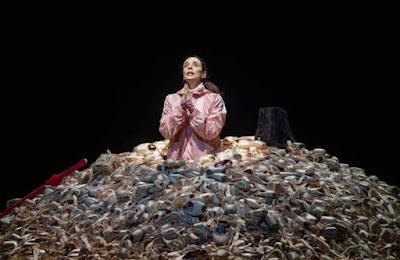
In L'HEURE EXQUISE, Winnie is now named She, an aging ballerina buried up to her waist in her old ballet shoes and as she chatters away to her partner He, she remembers her career.  Luckily for the audience, the mound of shoes parts and we watch She as she recalls dancing as a child to reaching success, dancing many roles and seemingly ending up in a vaudeville routine - all the time helped and hindered by He as her father / dance partner / manager.  Only three dancers have danced the role professionally: the late Carla Fracci who originated it, Maina Gielgud and now Ferri (under Gielgud's staging).

Ferri chose this to celebrate her 40th anniversary with The Royal Ballet which is no small achievement in the life of a ballet dancer - even one who is a prima ballerina assoluta.  In the 120+ years since the first assoluta was named there have only been thirteen dancers granted that title: there are three still living but only Ferri remains dancing.  She is simply glorious; when she dances you believe every gesture, every movement - she is an actress without needing words but here she handled both with ease.  She was partnered by Carsten Jung, ex-principal with the Hamburg Ballet.

Our second visit was to see the return to the Covent Garden stage of our favourite male dancer Steven McRae, it was a performance that we needed to see...  On 16th October 2019, we were overjoyed to see him on stage at Covent Garden again, after nearly two years injured.  We were nearly at the end of the 2nd Act of Kenneth MacMillan's MANON and McRae was dancing alone on the stage: two leaps, two pirouhettes - then he froze for a few seconds, and hopped into the wings as the curtains closed but not before hearing chilling, unforgettable howls of pain.  Kevin O'Hare, Director of the Royal Ballet, appeared onstage to confirm Steven was injured and would be replaced for the rest of the performance.

It later transpired that he had endured a full rupture of his Achilles tendon and we followed his slow, determined rehabilitation back to full dancing strength and here we were, two years after that ghastly night, to see him dance again.  Could he?  Would he?  

A massive cheer greeted his first appearance and as wonderful as it was to see him again, we were on the edge of our seats right up to the last chords of Prokofiev's score, but he absolutely triumphed.  Giving us a Romeo of passion and verve, Steven was greeted with an enormous ovation at the end. 

It must have been very special for him to share his return with his frequent stage partner Sarah Lamb who emotionally pushed him forward to take a solo bow and joined in the rapturous applause for him. Sarah Lamb was an exquisite Juliet, her grace and elegance turned by her secret love into determination and ultimately devastation.  What a marvellous partnership they have on stage!

MacMillan premiered ROMEO AND JULIET in 1965 with the iconic pairing of Margot Fonteyn and Rudolph Nureyev but it wasn't meant to be them.  He had created the roles for the younger Christopher Gable and Lynn Seymour but they were demoted to the second cast when demands for box-office names for the subsequent US tour won out - Gable and Seymour even had to help teach the more famous pair their roles due to time constraints in rehearsals.

The unhappy situation resulted in MacMillan leaving The Royal Ballet the following year but returned to be it's artistic director from 1970 to 1977 when he became it's principal choreographer until his death backstage during a revival of his MAYERLING in 1992.  Along with his other great works, ROMEO AND JULIET has remained in the repertoire and is still a glorious creation, it grips from the start with a thrilling choreographed sword fight in the city square which results in five bodies piled up centre-stage; in McMillan's Verona, danger is only a hair's breath away.

John B Read's lighting and the original evocative set design by the late Nicholas Georgiadis are still wonderful while McMillan's truly thrilling choreography is staged this time by Christopher Saunders and Laura Morera. Sergei Prokofiev's score sounded excellent played by the Opera House orchestra under the baton of Koen Kessels.

There was good support from James Hay and Bennet Gartside as Mercutio and Tybalt, Christopher Saunders was also a controlling Lord Capulet partnered by Elizabeth McGorin as Lady Capulet and Kristen McNally's bustling Nurse.  The night we saw it marked the 514th performance of MacMillan's masterpiece: here's to many more - and welcome back Steven!


Friday, February 01, 2019

TRIO CONCERTDANCE at the Linbury Theatre, Royal Opera House - music and movement

It took 22 days into the new year but I finally went to the theatre.  I am amazed I knew how to sit in the seat properly.  It was a first visit to the newly-designed Linbury Theatre which sits in the basement of the Covent Garden Opera House as it's studio space.  We had been a few years ago to see The Unthanks - when they were called the unwieldy Rachel Unthank and The Winterset - but it was a rather cold auditorium which has now been transformed into a shining wooden nest of a space which rather oddly has it's upper circle level on the ground floor, the oval staircase proving to be a bit slow-moving both going in and coming out.


Our visit was to see the wonderful Alessandra Ferri in a programme that she devised with American Ballet Theater principal Herman Cornejo and concert pianist Bruce Levingston.  Four pas de deux and a solo each were interspersed with piano pieces by Satie, Chopin, Glass and Bach among others.  The six dances all have different choreographers and amongst them were Russell Maliphant, Wayne McGregor and Cornejo himself.

The real thrill was being only five rows from the stage so it was very easy to be overtaken by the limpid mood of the music and the dance, it was great to be so close too to see the total immersion in the music and movement by Cornejo and especially the magnificent Alessandra; she was hypnotic enough on the Covent Garden main stage in McGregor's WOOLF WORKS but here she was extraordinary.


Cornejo was an excellent partner for her, as they seemingly mirrored each other throughout the pieces - one moment him supporting her then she supporting him.  They were partnered by the excellent playing of Levinstone, his piano's notes floating across the open stage for them to simply hang upon and be spun around by them.

They were joined in the final number by the strings of the Halcyon Quartet and the added volume helped make this a remarkable finale, with Mozart's music brought to life by French choreographer Angelin Preljocaj; especially the breathtaking moment of Ferri's armed locked around Cornejo's neck as he spun around as they kissed.  A special mention too to the nuanced, subtle lighting of Clifton Taylor.

A lovely night of gentle surprises and revelations...


Saturday, February 18, 2017

WOOLF WORKS Works On Stage, Screen And CD... Living the past again

Nearly two years ago, we took the plunge - in the year of trying new things artistically - and went to Covent Garden to see WOOLF WORKS, a new Royal Ballet production choreographed by Wayne McGregor.  I remember feeling some trepidation... Virginia Woolf is one of my favourite authors for whom language is the key so how can you silence that but still make it relevant?  Two words... Wayne McGregor.

As you can see from my blog it had a profound effect on us both and it did indeed start a continuing exploration of ballet which has been very rewarding.  But how would the first revival of WOOLF WORKS compare - and would it have the same impact?


I am happy to be able to say that it led to a deeper, richer understanding of the work but also there was the added bonus this year of seeing it on the big screen at the Curzon Mayfair and also being able to appreciate the depth of Max Richter's music with it's release on cd.

Onstage we were blessed with practically the same cast as in 2015, the only major replacement being Calvin Richardson and his breathtaking pirouettes dancing the role of 'Evans' for the unwell Tristan Dyer in the MRS. DALLOWAY-inspired 'I Now, I Then'.  The impact of seeing the company onstage was made even more exciting by seeing the same dancers a few days later on the live cinema screening, giving an opportunity to experience their talent closer than possible at the Opera House although there was some loss too, in particular the glorious digital stage image of the garden of Clarissa's imagined youth flooding the set.


McGregor has choreographed three ballets in distinct styles: 'I Now, I Then' is the most narrative; based on MRS DALLOWAY - and introduced with the only known recording of Virginia Woolf musing on the difficulty of using old English words in new ways - we see Clarissa Dalloway (sublime Alessandra Ferri) meeting old flame Peter Walsh (Gary Aves) and relives the glorious summer she spent as a teenager with Peter and her best friend, the free spirited Sally Seton, and how life seemed full of possibility and choice.  The younger selves were danced wonderfully by Francesca Hayward, Federico Bonelli and Beatriz Stix-Brunell.

As Clarissa is lost in memories of what could have been we also see Septimus Smith (the astonishing Edward Watson) who is tortured with the lasting trauma of shell-shock from his experience in the WWI trenches.  His wife Rezia (Akana Takada) tries to keep him engaged in life but he is lost in memories of his friend Evans (Richardson) who was killed before him.  It is a perfect fusion of performance, choreography, design by Cigué, lighting by Lucy Carter - the moment the stage was suffused with glowing red when Septimus danced with Evans was glorious - and, almost a character of it's own, Max Richter's heartbreaking, longing music.


The second act 'Becomings' takes ORLANDO as it's inspiration and is the most abstract of the pieces although during one of the intervals for the screened event Wayne McGregor was interviewed by hosts Darcey Bussell and Clemency Burton-Hill and said he believed that no dance can be truly abstract as the human element will always lend a dance a narrative sense.  Again Lucy Carter's lighting is thrilling: an overhead beam roams the dark stage picking out 12 dancers in varying degrees of glittering gold Elizabethan costumes before a cold laser beam illuminates two of them and we launch into McGregor's take on Woolf's exploration of gender fluidity.

As Richter's music roams from bone-crunching electro beats to minimal keyboard runs so McGregor's choreography changes from solos to duets to triple routines for his remarkable dancers - pushing their limbs into even more challenging shapes and attitudes; the exhilaration is in seeing male and female dancers fusing into just pure dance.  With each segment, they slowly lose their Elizabethan costumes until they are in shades of grey, all dancing in and out of four overhead spotlights, all individual but all unified, until the lights cut out and the auditorium is criss-crossed with shafts of laserlight.  Again the live screening was wonderful to showcase in detail the astonishing work of, among others, Sarah Lamb, Natalia Osipova, Steven McRae and Watson.


The final act is TUESDAY and takes it inspiration from THE WAVES but also references Woolf's suicide note written on Tuesday 25th March 1941, three days before she actually drowned in the River Ouse.  McGregor has the inspired choice of Gillian Anderson reading the wrenching suicide note while a slow-motion film of crashing waves shows on a stage-wide screen all but dwarfing the stationary figure of Ferri beneath.  Anderson's measured, hypnotic delivery leads you in to McGregor's slow meditation on love and loss, beautifully danced by Ferri and Federico Bonelli who are later joined by Sarah Lamb and an ensemble which also includes young students from the Royal Ballet School.

Ferri is astonishing in her poetry and control as she becomes the embodiment of Richter's dreamlike, ethereal music, solitary notes slowly coming together with Anush Hovhannisyan's soprano to wash over you with waves of strings and brass.  There was one moment that haunts me: Alessandra Ferri starts a solo movement against the ensemble's choreography who slowly, three or four at a time, echo her until they are all bending and stretching as one, it's breathtakingly beautiful.  Slowly the ensemble ebb away into the darkness at the back of the stage, as Bonelli lowers a prone Ferri onto the stage as the music slowly vanishes note by note...


As I have said, the live screening was a wonderful opportunity to see the dancers closer than possible in the theatre and there were the added extras of interviews with Wayne McGregor and Max Richter as well as Maggie Smith reading passages from THE WAVES as well as Virginia's memoir MOMENTS OF BEING.

As I have written this I have been able to relive the experience by playing the cd THREE WORLDS of Richter's score; I wondered if it would work separately from the experience of seeing it with the dancers but it works beautifully.  It has been great to be able to explore this work in depth for the past two weeks - I would love the opportunity to see it again.


Saturday, May 30, 2015

WOOLF WORKS: Moments of Being...

I was lost for words when Owen told me he had booked tickets for the Royal Ballet's WOOLF WORKS at Covent Garden.  I just couldn't grasp it... three short ballets based on MRS DALLOWAY, ORLANDO and THE WAVES?  How could this be?  What can there be of Woolf without her writing, it's rhythms and the power to connect moments of her life with ours.  How could this succeed robbed of her words?  It was with this air of quiet bafflement that I took my very good seat in that most sumptuously decadent of London auditoriums and the light lowered as the curtain raised...


Within seconds my central question was resolutely answered.  Virginia's voice sounded out, steady and strong in her only recorded piece for the BBC in 1937, talking about the difficulty with trying to find new forms of writing when English words are so over-familiar through being used again and again.  As we listened, her writing appeared on a screen, meshing and re-forming into a likeness of Virginia then coming apart again.  It was as if choreographer Wayne McGregor was saying that if words have lost their imaginative use then their must be other ways.


The first in the triptych was I NOW, I THEN based on the main characters in MRS DALLOWAY and the atmosphere and mood of the story.  Again after a few minutes not only did the penny drop but I found myself deeply involved.  This was helped by Lucy Carter's sombre lighting, the hazy video projections of London as seen through a dream and the striking set design of Cigué, 3 wooden oblongs that rotated slowly to open up new vistas and configurations, occasionally revealing a new dancer as if from nowhere. 


The hypnotic Alessandra Ferri, returned from retirement, danced the role of Clarissa Dalloway and as the title suggests, she was joined onstage by Francesca Hayward as the younger Clarissa who danced with Beatriz Stix-Brunell as the quicksilver Sally Seton and Gary Avis as the younger Peter Walsh, the older Peter was danced by Federico Bonelli.  Max Richter's intriguing score kept returning to the chiming of Big Ben, ticking clocks and watches, all suggesting Woolf's subject of time, the past and memory.


Edward Watson enthralled as he interpreted McGregor's disjointed choreography as the shell-shocked Septimus Smith partnered by Akane Takada as his despairing wife Rezia.  In a marvellous visual cue, the stage was bathed in a warm reddish light when he danced with Tristan Dyer as Evans, his dead friend from the trenches.


What was good about WOOLF WORKS was that each of the three sections felt totally different, the only connection being the source novelist.  Totally different in tone was BECOMINGS, the second of the three and based on ORLANDO.  Twelve dancers appeared on a darkened stage as an overhead spotlight searched them, their golden costumes gleaming as it swept around them as if trying to find a single person.  It finally alighted on one and the dancers soon started dancing in pairs, male and female, again suggesting Woolf's theme of gender confusion.


This was the longest of the three and it's abstract form did rather outstay it's welcome but what made it all the more thrilling was Richter's crunching music which at one point got so loud I actually thought the circle might give way!  The lighting was all very 80s with laser beams illuminating the dancers, suggesting the other-world space of Orlando's changing gender. The lasers swept into the auditorium too, lighting up each of the circles with beads of light and in a dramatic, sudden finale end with countless lasers firing all over the auditorium, just like the last Pet Shop Boys concert!  It was all very thrilling - and again not what I had expected.


After a second interval - each about the same length as the actual dance pieces themselves - oh and after a second wild strawberry champagne cocktail (I LIKE Covent Garden), it was time for the last of the three, TUESDAY (based on THE WAVES) as the curtain rose on a bare stage apart from a long screen on which a slow film of crashing waves played.  


Gillian Anderson was then heard reading Virginia's heartbreaking suicide letter to Leonard and, as usual when confronted with it, I soon had tears running down my face.  Beautifully read by Anderson and with nothing on stage to distract from the words it was incredibly powerful.  It affects for many reasons: the private nature of a suicide letter to a husband by a writer who always strove to find new ways of describing life, the sheer beauty of the writing even though the content is so tragic, that in describing all she knew she shared with Leonard was not enough to stop Virginia from doing what she did to end her losing battle with her insanity.


Alessandra Ferri was magnificent as the spirit of Woolf, painfully moving through her duet with Federico Bonelli, his attempts to hold her and keep her aloft ending with her escaping away, her sheer force of personality filling the auditorium.  They were joined on stage by children dancing with Sarah Lamb, again Ferri interacting with a dancer playing her younger self, for the children to vanish into an ensemble of dancers who filled the stage with slow, sinuous movement which culminated in Ferri joining them, at first moving on her own but slowly becoming one with their repeated moves, as if subsumed by the rhythm of the waves.


Slowly the ensemble pulled away, moving forward and back, forward and back as Richter's moving composition for strings reached it's climax as Bonelli carried Ferri for the last time to slowly lower her on to the stage to retreat away with the others.  It was powerful, emotional, impossibly moving.  She deserved every minute of her extended ovation, as indeed did her fellow dancers.


At the start of this year, Owen suggested that this should be a year of discovering new cultural things to see and on the back of this visit, Owen has indeed booked to see two more non-Matthew Bourne ballets.  I suspect however that nothing will come close to the emotional tour-de-force of Wayne McGregor's WOOLF WORKS.