Monday, August 01, 2022

DVD/150: SANMA NO AJI (AN AUTUMN AFTERNOON) (Yasujiro Ozu, 1962)

After a career spanning 53 films over 35 years, Yasujiro Uzo died in 1963 from throat cancer.  His final film was released the previous year, SANMA NO AJI.

Ozu again focusses on a middle-class family as Japan embraces modernity.

Widower Hirayama lives with daughter Michiko and younger son Kazuo.  His older son Koichi is married to nagging Akiko who wants all the latest gadgets.

Hirayama is nagged by old friends Kawai and Horie to get Michiko married - although she doesn't want to - and Hirayama reflects on this after meeting the sad daughter of his school professor who is stuck looking after him.

Koichi's friend - who Machiko quietly likes - admits he has a girlfriend, so Kawai suggests a man he knows.

Michiko relents and marries. but after the wedding Hirayama is alone: dressed in his best suit someone asks did he attend a funeral and he replies "Something like that". 

Shelf or charity shop?  A shelf on it's own.  A perfect distillation of Ozu's themes and pure, spare storytelling.  While preparing the script with regular co-writer Kogo Noda, Ozu's beloved mother died which cast a pall over the process and there is a sadness lurking in the corners of the film which comes into it's own at the end when Hirayama returns home to the house he now only shares with his youngest son who obviously will soon leave too. Ozu's film pops with Ozu regular Yuharu Atsuta's Fujicolour cinematography and the score by Ozu's collaborator Kojun Saito.  As always Ozu drew great performances from some favourite actors: Ryuji Kita and Nobuo Nakamura are delightful as Harayama's interfering friends, Kyoko Kishida is eye-catching as a friendly bar owner, while Haruko Sugimura, in her 9th Ozu film, has only one scene but is sensational as the old teacher's sad daughter.  Keiji Sada and Mariko Okada are good as Hirayama's bickering son and daughter-in-law while Shima Iwashita has a rare gravity as Machiko. But above all, Ozu's favourite actor Chishu Ryu is wonderful as Hirayama, beautifully underplayed and heartbreaking in his sozzled loneliness.  Although the film seems like the perfect 'last film', Ozu was working on a new project when he sadly died on his 60th birthday.  He was buried with his mother, the gravestone bears no name just the Japanese character for 'nothingness'.

Arigato Ozu-san, arigato.


Tuesday, July 26, 2022

DVD/150: BADLANDS (Terrence Malick, 1973)

Terrence Malick's debut film BADLANDS has hypnotised audiences for nearly 50 years with it's dream-like atmosphere and remarkable performances by Martin Sheen and Sissy Spacek.

Malick based his script on the 1958 midwest murder spree of teenager Charles Starkweather with his 14 year-old girlfriend Caril Ann Fugate; in 60 days he killed 11 people, anyone who got in his way.  He was executed while Fugate spent 17 years in prison.

Garbage collector Kit Curruthers is fired the same day he sees teenage Holly Sargis aimlessly twirling her baton on her street in their sleepy South Dakota town.

Seeing Kit despite her strict father's orders, Holly is as much of a daydreaming loner as Kit; they have indifferent sex, but she likes him for his resemblance to James Dean.

When Kit kills Holly's father, they take off into the badlands of Montana...  clueless outlaws, on the run to nowhere...

Shelf or charity shop?  Pure shelf.  Hugely influential, BADLANDS remains elusive and mysterious.  No attempt is made to moralise over Kit and Holly, they are merely observed drifting towards the inevitable conclusion to Kit's actions.  The masterstroke is to have Sissy Spacek as the narrator, Holly telling their story with the banal platitudes of a schoolgirl's diary printed in a women's magazine: "Little did I realise that what began in the alleys and back ways of this quiet town would end in the Badlands of Montana."  Spacek gives a remarkable performance as Holly, in only her second credited film; Martin Sheen was a known actor but Malick was unsure of casting him as he was aleady in his thirties but as soon as he read with Spacek all doubts fell away as their connection was instant.  They are now as iconic as Belmondo and Seberg in A BOUT DE SOUFFLE.  Their performances however are illuminated by Malik's total vision - that the cinematography is so wonderful is amazing when you consider three cinematographers worked on it, similarly there were disgruntled crew members leaving all through the shooting which only bonded Malick, his stars and art director Jack Fisk together - so much so Spacek and Fisk were married the next year!  Adding to the film's hypnotic quality is the soundtrack which uses several phrases from Carl Off's MUSICA POETICA with Erik Satie, Nat King Cole and Mickey & Sylvia.  Despite getting excellent reviews at the NY Film Festival, Warner Brothers threw the film away, pairing it on unsuitable double-bills but BADLANDS remains a film of timeless wonder.


Sunday, July 24, 2022

DVD: HORSE FEATHERS (Norman Z Mcleod, 1932)

This time The Marx Brothers gatecrash college life and it's football team.

Groucho is Huxley College's new president who is asked by son Zeppo (in real life eleven years younger!) to buy two star players for the college football team but after a crook buys the players for the opposition, Groucho mistakenly signs up iceman Chico and dog-catcher Harpo!

It culminates in a chaotic football match via the apartment of the mobster's girlfriend (the wonderful Thelma Todd).

The plot is negligable as it is, in essence, a series of set-pieces that had been road-tested onstage as far back as 1910 in FUN IN HI SKULE.

But what set-pieces... Groucho trying to get into a speakeasy with the password 'swordfish', the Brothers descending on Todd's apartment in pure door-slamming farce style (sadly, this scene is ruined by jarring jump-cuts) and Groucho teaching an anatomy class.

Shelf or charity shop?  A keeper for the fact it is pure Marx,  With the plot frequently taking a backseat, it's easy to sit back and enjoy the anarchic madness of the brothers let loose.  I told you all about the tragic Thelma Todd in the blog for MONKEY BUSINESS and here she appeared with the lads for the last time.  As well as the usual running gag of the vast array of items that Harpo pulls out of his coat pockets, this time there is also the delight of Bert Kalmar and Harry Ruby's EVERYONE SAYS I LOVE YOU running through the film sung at different times by Groucho, Zeppo and Chico - and of course Harpo has a harp rendition.  It was of course the song that gave Woody Allen the title for his 1996 musical, and there is an outlandish dance routine for Groucho and the faculty professors at the start of the film with one of his most-remembered songs "I'm Against It"

As Chico starts playing his obligatory piano number, Groucho turns to the audience and says "I've got to stay here, but there's no reason why you folks shouldn't go out into the lobby until this thing blows over."

Groucho: Baravelli, you've got the brain of a four-year old boy, and I bet he was glad to get rid of it.


Thursday, July 21, 2022

DVD/150: MEAN GIRLS (Mark Waters, 2004)

One of my favourite quartet of high-school comedies - joining HEATHERS, CLUELESS and TEN THINGS I HATE ABOUT YOU - MEAN GIRLS has lost none of it's sarky bitchiness.

Cady, raised in Africa and home-schooled by her anthropologist parents, is back in the US and now faces a new dangerous terrain... high school.

Cady befriends 'outsiders' goth Janis and gay Damian who show her the different pupil cliques but warn her off talking to The Plastics: three girls whose superiority makes them disliked but feared.  

Intrigued by Cady, The Plastics invite her to sit with them at lunch and shop with them.  She soon realises that Karen and Gretchen are just dim courtiers to Queen Bitch Regina.

Damian and Janis encourage Cady to ingratiate herself with Regina so they can sabotage her for all her nastiness.

But can Cady tell the difference between playing a Plastic and becoming a Plastic?

Shelf or charity shop?  Cady and The Plastics are fighting it out in my ... um... plastic DVD storage box!  Lindsay Lohan shows what a talent she was before the tabloids got to her, she has a warm naturalness throughout and there are stand-out performances from Rachel McAdams as the ghastly Regina, Amanda Seyfried as uber-thick Karen and Lacey Chabert as the ultra-needy Gretchen.  Remarkably the basis for Tina Fey's very funny script was a non-fiction self-help book about surviving school cliques; Fey also co-stars as Cady's exasperated maths teacher.  Ultimately it fails against the all-conquering CLUELESS: the film cannot keep it's momentum going towards the end and the arc of nice girl seeming to turn bitchy isn't as interesting as CLUELESS' Valley Girl princess finding happiness isn't just an Azzadine Alaia wardrobe. MEAN GIRLS however is still fetch.  Sorry Regina!


Sunday, July 17, 2022

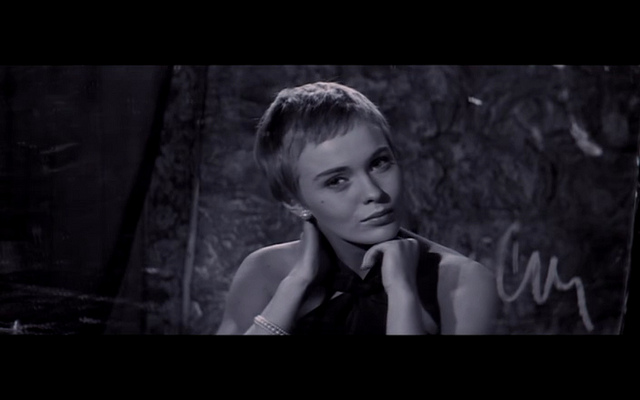
DVD/150: FROM THE JOURNALS OF JEAN SEBERG (Mark Rappaport, 1995)

Before the mendacious biopic SEBERG and excellent documentary JEAN SEBERG: ACTRESS ACTIVIST ICON, independant film-maker Mark Rappaport made Jean his second meditation on cinema: FROM THE JOURNALS OF JEAN SEBERG.

Casting Mary Beth Hurt is a master-stroke: facially similar, Hurt is also from Marshalltown, Iowa and actually had teenage Jean as a baby-sitter when small.

Through Rappaport's sly use of montage, Jean reflects on how she was exploited by Otto Preminger's humiliating treatment on the sets of SAINT JOAN and BONJOUR TRISTESSE and the bizarre way her second husband Romain Gary cast her in two films as a nymphomaniacal victim.

Through this, Rappaport addresses how male directors cast their actress partners as prostitutes or nymphos and how Hollywood morality influenced female characters' sexualty.

The most successful sequence connects the lives and careers of Jean with fellow actress activists Vanessa Redgrave and Jane Fonda - and why they "survived".

Shelf or charity shop?  Def Shelf.  Rappaport's theories might be a bit of a stretch at times - get this: Jean was married to Romain Gary who asserted that he was the illegitimate son of Russian actor Ivan Mosjoukine whose close-up from a silent film was used by film director/theorist Lev Kuleshov to prove how the viewer projects the emotion onto a scene - he intercut Mosjoukine's blank expression between shots of a dead woman, a child playing and food and his original viewers claimed the actor's expression changed every time - so by inter-cutting Jean's blank expression from A BOUT DE SOUFFLE's final scene, he links Jean to Russian revolutionary film-making... yeah right.  However at the film's climax thankfully he drops the tricks and allows us to focus on Mary Beth Hurt's emotional recounting of the FBI's 1970 campaign to discredit her and her subsequent miscarriage.  Although the film allows for humour and sarcastic takes on Hollywood, ultimately Rappaport's film leaves you sad for Jean, as it should do.