Wednesday, October 19, 2011

Sorry about that delay in blogging... life, you know...

Our second exposure to the Bard showed the truth in the old phrase of the mountain coming to Mohammad.

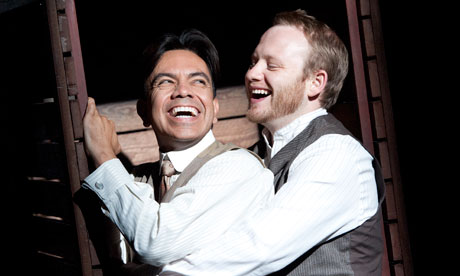
Sometimes you just gotta get out of town... so a few Saturdays ago found Owen and I sitting on a train chuffing merrily out of St. Pancras International to ... wait for it.... Sheffield. Sheffield yet! So what could get me to up sticks and venture north? Well, it was the news that the thrilling partnership of Clarke Peters and Dominic West which proved so successful in the epic US tv series THE WIRE was to be made flesh at the Sheffield Crucible in OTHELLO. There was no mention of a London transfer so a day-trip to the home of The Human League was a must.
It was also good to finally see inside the famous Crucible auditorium so beloved of the World Snooker Championships and it makes you understand how, with the right match, the atmosphere must be tense.

The theatre itself isn't all that exciting - it's form seems to echo so many regional late 20th Century builds, all concrete and large windows overlooking either the main road or the car park! But the place seemed very buzzy and busy, no doubt down to the excellent reviews the production had garnered the week before.

The actor Daniel Evans has landed the Artistic Director role at the Crucible and he made his Shakespeare directorial debut with this production. Surprisingly he made an excellent job of it - while playing up the - ahem - black comedy of such a hissable villain as Iago, Evans also gave us a thorough, uncluttered reading of the play with a momentum which moved smoothly but relentlessly ever-onward, like a shark honing in on it's prey.
Oddly enough, the play's final scene did dissipate this momentum but Shakespeare did rather prolong the end of his play - how many times *does* Desdemona have splutter to life after having been smothered? However by then Evans and his talented cast had done enough to deserve the ovation that they genuinely deserved.

Evans gave us a fairly traditional setting for his version of the play with doublets, jerkins and wide skirts a-plenty against Morgan Large's set comprising a large functional brick wall with central doors which with Lucy Carter's subtle lighting worked well in exterior and interior scenes.

I guess the best Shakespearean productions should seem to introduce the play to you afresh and this it certainly did. I can't remember laughing so much at the tale of the tragic Moor but I suspect a lot of that was down to the inspired central casting.
It's a shame that the exciting performances of Dominic West and Clarke Peters will not be seen by a wider audience but I feel very lucky to have done so. The chemistry revealed in THE WIRE was built on here and their scenes together fizzed and sparked as Iago teased and wheedled Othello from his benign married state into a jealous murderous husband.

Dominic West was the true star of the show, using a broad Yorkshire accent to suggest a hail-fellow-well-met character who secretly relishes the carnage his malicious lies provoke. No one is safe from him including his wife Emilia and here West was perfectly matched with Alexandra Gilbreath who brought an earthy wisdom to the role. As with the best performances, it was her a pleasure to watch her silent reactions to others as well as speaking her lines - her slow realization that she was an unknowing contributor to her husband's scheme was heartbreaking.
Clarke Peters came in for some unfairly critical reviews in the press but he gave a fine performance, becoming more and more unravelled as his jealousy took hold until his mania was scary to see. Peters is an actor who you instinctively can trust on stage and this performance proved again his wide-ranging versatility and powerful presence.

Desdemona is a sticky role but Lily James made a good fist of her inherent innocence and her scenes with Peters and Gilbreath gave her ample opportunity to show her versatile playing. In a small but impressive cast, special mention should go to Gwilym Lee as Cassio, Luciano Dodero as Montano and Leigh McDonald as the courtesan Bianca.

C'mon someone, film this production and give these fine actors the wider acclaim they deserve.
Oh and well done HMV Sheffield for stocking the dvd of Vanessa Redgrave in ISADORA which the HMV Piccadilly Circus haven't done!

Monday, September 26, 2011

Time to catch up on my last two theatre trips, both written by that promising Brummie William Shakespeare.

Both productions featured performances that had Must-See stamped on them but none more so than Kevin Spacey as RICHARD III - if ever there was a perfect marriage of actor and role this had to be it.
This production marked the end of the highly-publicised - and pretentiously titled - Bridge Project which featured Sam Mendes directing nine plays over the past 3 years which toured the world with a yearly company of actors drawn from the UK and the US. However none of the productions I saw seemed to be that successful with some remarkably ropey performances - mostly from the Americans to be honest.

The production was stark - each scene started with the first word of the scene projected on a scrim - and had a clunky stylised air such as certain doors that enclosed the playing space being marked with a X as another of Richard's victims bit the dust - we were treated to Gloucester being graphically drowned while others made do with just having their eyes closed by another company member. All very odd.
As with previous Bridge productions there were some remarkably dodgy performances - the prime suspects here were Chandler Williams as a Clarence who seemed to be channelling a bad Kirk Douglas impersonator, Michael Rudko as a dull Lord Stanley and Nathan Darrow as a dreary Henry, Earl of Richmond.

There were no particularly exciting male performers in the cast so let's move on to Spacey. As much as I enjoyed him I must admit that afterwards I felt a bit becalmed as he gave exactly the performance that I was expecting. The slithery delivery, the barnstorming theatricality, the glittering ambiguity... it was all there. To be honest though, nothing he did surprised me or made me see a hidden dimension to his character.

I must say Spacey's physicality was impressive with his twisted gait and calipered leg and, with his constant scampering around the stage, he had boundless energy.

In both acts Mendes and Spacey concocted indelible stage moments: in Buckingham's stage-managed attempt to 'persuade' Richard to accept the crown while he demurs to be left alone to his prayers, Mendes had him broadcast live on a tv screen seemingly shocked and tremulous to be interrupted praying, while at the same time surreptitiously pushing away the fake monks surrounding him. In the second act, as the Battle of Bosworth draws ever closer and Richard's paranoia increases he delivered his speeches in the ranting style of Gaddafi which really drove home the timelessness of the play.

His death scene - while physically impressive - rather defeated his performance. Mendes has the dead Richard hoisted aloft by his ankles, Mussolini-style, to sway above the stage while Henry delivers his speech to the glories of the Tudor age to come. All this did was to remind me of reports of Olivier's famous death scene in CORIOLANUS at Stratford in 1959 - and Olivier should never be allowed to enter people's minds when they are watching another actor play Richard III.
Oddly enough, for once the women ruled the roost - Haydn Gwynne (not an actress I usually warm to) was an impassioned Queen Elizabeth, Annabel Scholey was a forlorn Lady Anne and, in the real performance of the night, Gemma Jones gave us a thrilling Queen Margaret, haunting the stage in a top coat and wild hair. Her big scene where she denounces the Yorkist Queens was, for me, the highlight of the evening.I guess any time this play is performed it will always seem to mirror whatever despot is ruling somewhere in the world but with Gaddafi shrieking his revenge in a hidden location at all those seeking to overthrow him it made this 420 year old play remarkably contemporary.

Monday, September 05, 2011

Banderas is back... and Pedro's got him!

In news that will make any Almodóvar fan's heart leap up, he has reunited with his former protege for the first time since ATAME! in 1990. Antonio has gone on to a Hollywood and Broadway career but has seemed adrift in no-doubt profitable but increasingly treading-water jokey latino roles. Reunited with Pedro, it is almost a shock to see that he is capable of giving a multi-layered performance - charismatic, tortured yet deeply twisted.

Banderas plays Robert Ledgard, a respected plastic surgeon who has baffled his colleagues with what he has been working on so secretly in the hidden laboratory in his isolated mansion.

When he tells a conference that he has researched the invention of a new man-made skin which is soft to touch but resistant to fire, h
e is warned off by his superiors, all too mindful that he is probably still haunted by grief at the death of his wife in a car-crash and more recently, the suicide of his deranged daughter Norma.What is unknown to his colleagues is that he has gone beyond research. Locked away in a spartan bedroom in his mansion is a young woman named Vera, covered in a skin-tight bodysuit, that he has operated on for the past six years. Her only contact with the world is Ledgard and his housekeeper Marilla (Almodóvar diva Marisa Paredes) - who holds her own secret that Ledgard is her son.

This precarious world is shattered with the arrival of Marilla's second son Zeca who is on the run from the law after a failed robbery. Zeca spots Vera on a monitor and after tying up his mother, rapes the girl who he mistakes for Ledgard's wife. It turns out he and Ledgard's wife were running away together when the car crashed and Zeca escaped, leaving the wife to die in the conflagration. Ledgard returns and shoots Zeca dead. This triggers the all-important flashback that lets us know what exactly happened six years ago that led to the mysterious appearance of Vera in Legard's life.
Even by Pedro's standards, the plot is labyrinthine but you are swept along in his brio of telling a tall tale with the straightest of faces helped immeasurably by a committed cast and the combination of lush cinematography and a vivid, Hitchcockian score.

Since his stunning re-emergence with TODO SOBRE MI MADRE (All About My Mother), Pedro has proved himself to be among the greatest of directors working in cinema today, with a facility of drawing you deep within his screen-storytelling. I respond in different ways to his films: his films with female lead characters TODO SOBRE MI MADRE, VOLVER and LOS ABRAZOS ROTOS (Broken Embraces) I connect with immediately; his films with male lead characters HABLE CON ELLA (Talk To Her) and LA MALA EDUCACION (Bad Education) I have to allow to ferment and grow in my subconscious. The joy of Pedro's work is that his films allow this to happen.
Banderas' darkly menacing performance is complemented by those around him. Elena Anaya's Vera is initially seen as a mystery and it's a measure of her performance that with minimal dialogue you still stay intrigued in her which pays off at the end when she really comes into her own. It's always a joy to see Marisa Paredes and here she gives a sturdy, unflashy performance in a role that gives a core to the film - as twisted a core as that maybe.

Jan Cornet makes an impression as the young man in Vera's past and special mentions to Susi Sánchez as his mother, Bárbara Lennie as his shop assistant friend and especially Blanca Suárez as the tragic Norma.
Pedro's film - which echoes his own work as well as VERTIGO, FRANKENSTEIN and EYES WITHOUT A FACE - is given a glorious sheen by his cinematographer José Luis Alcaine whose lush and disturbing cinematography is one of the major triumphs of the film, allied to Alberto Iglesias' teasing and haunting score.

It's a mark of his taste as a filmaker that at the very end, when most film makers would go in for a big emotional screen moment, Almodóvar fades to black. Somethings are best left to the audience's imagination.

Wednesday, August 31, 2011

One of the most exciting nights in the theatre last year was our trip to Lincoln Center, NY to see Bartlett Sher's wondrous production of Rodgers & Hammerstein's SOUTH PACIFIC, marking it's first Broadway revival in 54 years! Luckily we had a chance to re-visit this production last week in the not-as-far Barbican Centre (and this time with no snowy streets outside!)Well swipe me if we hadn't booked for the opening night! Seeing a red carpet and autograph collectors should have tipped me off but it was only when we saw Rolf Harris, Barbara Windsor and Miranda Hart in the auditorium that the penny dropped! But we were there to see the show not the audience. There was an oo-er moment when Bartlett Sher stepped out on the stage and informed us that although Samantha Womack (née Janus) had broken her toe a day or so earlier she would be going on thanks to Dr. Theatre.

The production has been somewhat curtailed by being squeezed into the smaller stage and although the music still sounds glorious played live, the orchestra sounded slightly less encompassing than at Lincoln Center. However the production still thrills, delights and makes your jaw drop that it's score can contain so many classics that not only work as stand-alone classics but more importantly still manage to move the story forward.One of the production's biggest surprises was how well Samantha Womack coped with such a major musical role. The actress playing Nellie has songs that range from the broad comedy of HONEY BUN and I'M GONNA WASH THAT MAN RIGHT OUTTA MY HAIR to the big solos like A COCK-EYED OPTIMIST and I'M IN LOVE WITH A WONDERFUL GUY - oh and she has to go from comedy to drama quite abruptly. Although her voice isn't as strong as our NY Nellie - Laura Osnes - she certainly had a grip on the character and any reservations I had brought with me were soon forgotten.

We also saw finally Paulo Szot who played Emile originally at Lincoln Center and although he stopped the show dead with a stunning THIS NEARLY WAS MINE, I must admit I preferred our NY Emile, David Pittsinger. I am not sure whether it was down to him possibly being over-familiar with the part having played it off and on for such a long time or Pittsinger's more mature ruggedness being a better fit for the character but I was a bit underwhelmed by him. I must also admit that, akin to the recently-seen PYGMALION, a little more chemistry between Womack and Szot wouldn't have gone amiss. Another Walford escapee Alex Fearns plays the spivy Seebee Luther Billis and was quite effective in the role, making a real impression as a character and not just someone who moves the comedy along. The production has a major find in Daniel Koek as Lt. Joe Cable, nicely playing the character's shift from loner to lover and socking over YOUNGER THAN SPRINGTIME and YOU'VE GOT TO BE CAREFULLY TAUGHT with power and conviction.

We were lucky too that Loretta Ables Sayre has travelled with the show to reprise her wonderful performance as Bloody Mary. She is a magnetic performer and perfectly captures not only the character's humour but also her hard-edged survivalist nature - her version of HAPPY TALK turns the song not into just a cute throwaway number but a song sung with a growing desperation and underlying threat.There was good support from Nigel Williams too as the Captain Brackett and the ensemble work is consistently good.

If you want a great night out with a genuine musical triumph get along to the Barbican before October 1st - but also keep in mind the show will be touring after this date.

You'll laugh, you'll cry... I did.

Monday, August 29, 2011

My other belated theatre blog is for the latest production at the Donmar, Eugene O'Neill's 1921 play of redemption and a life on the ocean wave, ANNA CHRISTIE.
It's strange that it has taken this long for the play to appear at the Donmar as it seems a shoe-in for any smallish theatre needing a solid well-made prestige play - it also only has four major roles! It has not been seen in the West End since Natasha Richardson's award-winning performance nineteen years ago at the Young Vic - when she repeated the role the next year in NY opposite Liam Neeson it led to their marriage and her re-locating to live there.
The piece is most well-known for providing the vehicle for Greta Garbo's debut in talking pictures in 1930. Two years elapsed between the release of Al Jolson's THE JAZZ SINGER and the release of ANNA CHRISTIE and during that time Garbo had starred in 6 silent films as M-G-M searched for just the right film to launch their Swedish star onto the now listening public. But Anna's Swedish background gave Garbo the the perfect role and she went on to garner her first Academy Award nomination for her performance. Her opening lines, "Gimme a whisky, ginger ale on the side... and don't be stingy baby" have entered film history. But what of the Donmar production? The production is directed by Rob Ashford who was responsible for the theatre's 2009 revival of A STREETCAR NAMED DESIRE and both productions share the same downbeat spit-and-sawdust atmosphere - how different to his HOW TO SUCCEED IN BUSINESS WITHOUT REALLY TRYING which we saw earlier this year in New York!

O'Neill's play tells the story of Anna, a young woman who comes east to the docks of New York to find the father who entrusted her to relatives on a farm after the death of her mother while he worked on his coal barge. Old Chris is nervously excited about seeing her after so long, only knowing from her infrequent letters that she worked as a nursemaid in Minnesota. His drink-sozzled mistress Marthy knows better when she spots Anna enter the dockside bar and their wary, cagey conversation reveals that Anna was working in a brothel until arrested and sent to jail. All options shot, she now wants her father to support her. During a storm at sea, Chris and Anna rescue sailors from a shipwreck and the last one saved is Mat Burke, a belligerent Irish stoker whose rollicking Blarney steamrollers Anna into a love affair. When Mat and Chris battle for the right to 'own' Anna, she angrily denounces them both and the long line of men who have used and abused her. Confronted with the truth of Anna's past how forgiving will her father and lover be?

O'Neill certainly powers his plot along in only four scenes and, despite the clunky repetition of Old Chris' simile of "that old devil sea", his rangy and muscular dialogue still keeps you rolling with the punches. He certainly created one of the great female roles of the last century in Anna and it's a shame we have not seen more actresses have the opportunity to play her.
Ruth Wilson played her with Anna's raw nerves fully exposed: from her first appearance staring down the hungry looks of the bar-room men to her last, alone again but stronger than before, she delivered a powerful performance which would have been a great performance if she had found more space for Anna's humanity.

The performance of the evening however was from Jude Law as Mat. Proving to be as much of a force of nature as the storm in which he makes his first appearance, this was the best I have ever seen him on stage. Even if his brogue was tempest tossed from Kerry in Ireland to Kingston in Jamaica, Law gave such a bravura performance that you could not take your eyes off him. For once he gave a performance which justified his star status.
David Hayman wrestled with the potentially deadly role of the salty Sveedish sea dog and eventually managed to overcome the hurdy-gurdy accent and repetitive dialogue to give a well-rounded performance.

Jenny Galloway proved that when it comes to scene-stealing she's the best around. However she really needs to find a play that allows her the chance to do her larceny more than once - here as in CAUSE CELEBRE and AFTER THE DANCE she only appeared in one scene! Although not written by O'Neill it would have been nice if Ashford had interpolated the extra scene included in the 1930 film for Marie Dressler as Marthy when she turns up begging while Anna and Mat are in a Coney Island beer garden. The production was aided immeasurably by Paul Wills' adaptable set, Howard Harrison's evocative moody lighting and Adam Cork's sound design. All in all, another memorable Donmar visit.

Wednesday, August 24, 2011

It appears I have let a few theatre trips slip by unnoticed although it's certainly not because I disliked them.

A few weeks ago we went to see George Bernard Shaw's most popular play PYGMALION at the Garrick Theatre with the intriguing casting of Rupert Everett as Henry Higgins, Kara Tointon as Eliza Doolittle and Diana Rigg as Mrs. Higgins.
The production was directed and designed by Philip Prowse who used to be the artistic director of the Glasgow Citizens Theatre. Back in the day I saw a few of Prowse's London productions - although none which featured Everett who I have surprisingly never seen on stage before.

Prowse's productions always had a visual swagger but his directorial skills never seemed to come across as being particularly incisive or having much joy in them. Here though he gave us a production which moved with speed and a twinkle in the eye. Prowse's design was also slightly more restrained than usual - the only excess being a very obviously theatrical red swagged curtain.
I enjoyed Rupert Everett's bullish and bullying Professor Higgins, taking great delight in his challenge of turning a gauche cockney flower girl into a polite lady while blithely ignoring the fact that Eliza might have feelings as well as dropped aitches. He had good chemistry with Peter Eyre's humane Col. Pickering and in his scenes with Diana Rigg, as his quietly caustic mother, he showed that here was one woman he couldn't dominate. His handling of the final confrontation scene was expertly done as Higgins shifts from exasperated humour to a sniping combativeness.

Kara Tointon certainly made an impressive West End debut as Eliza but as seems to be the norm for all actresses playing this role, her Cockernee accent was totally over-the-top. I've never seen the text but even if the lines are written all Gawd Blimey it would be nice for a director just once to have the actress play the role in an ordinary London accent. She was very effective in the tea party scene where Eliza test-runs her 'proper' accent to the puzzlement of all present and she certainly held her own in the final argument with Higgins. The one thing lacking was any noticeable chemistry between the two leads. Needless to say Diana Rigg - who was herself an onstage Eliza in the 1970s opposite Alec McCowan - stole her scenes as Mrs. Higgins, quietly exasperated at her son's crassness but capable of cutting him to the quick with a polite put-down. It must be said however that Prowse did her no favours with some awful costumes! Michael Feast also had great fun as Eliza's guttersnipe father Alfred with a fine line in bristling indignation - especially when he is left a legacy that catapults him into the dreaded middle class.

I am not a Shaw lover to be honest - that thumping tone always finding it's way through the prose - but PYGMALION still knows exactly how to lull it's audience into social comedy security before challenging them with the debate about the war of the sexes.

Monday, August 01, 2011

Last week it was time to return to the Menier for the first time in over a year - since the debacle that was PARADISE FOUND in fact. It was to see another musical but this one actually lived up to it's hype, Stephen Sondheim's ROAD SHOW. It took a long time to get here.

In 1999 Sondheim and John Weidman (his book writer on PACIFIC OVERTURES and ASSASSINS) staged a workshop of the show under the title WISE GUYS with Nathan Lane and Victor Garber as the real-life brothers Addison and Wilson Mizner which foundered afterwards during a legal dispute with producer Scott Rudin.

But Sondheim, who had become intrigued with the story of the brothers as early as the 1950s, did not give up and in 2003 the show appeared in Chicago then Washington as BOUNCE with Richard Kind and Howard McGillin as the warring brothers with a supporting cast including Jane Powell as their mother, Gavin Creel as Addison's gay lover and Michelle Pawk as Wilson's mistress.Despite being directed by Sondheim's long-time collaborator Hal Prince, the show received middling reviews and never made it to Broadway although the score was recorded.

After the success of his minimalist SWEENEY TODD, director John Doyle was asked to work on the troublesome show with Weidman and the new revised ROAD SHOW opened in 2008 off-Broadway and won both the Obie and Drama Desk Awards for Best Lyrics.

The new production dropped the role of the mistress - and the interval - and concentrated more on the relationship between the brothers and their ever-present mother and father's ghosts. This is the version that has appeared at the Menier.John Doyle's production is staged traverse-style so the audience is fully involved with the action, mostly being pelted with dollar bills that are thrown around by the Mizners regularly, nicely illustrating their approach to money, especially Wilson's - it's only money, there's always some sucker to fleece it from.

The brothers are delightfully played by Michael Jibson as the quiet architect Addison and David Bedella as the devil-may-care Wilson, both in their own way obsessively chasing the road to fame and fortune promised them by their dying father. Again the closeness of the audience to the actors was rewarded by the subtle playing of Jibson in particular, as well as the always fine Gillian Bevan as Mrs. Mizner. Her solo number "Isn't He Something!" was performed beautifully, making the mother's love for her wastrel son fully believable.
Glyn Kerslake was effective as the Mizner's father, dying early but hovering around the action disapproving as his sons fail at his dreams for them and Jon Robyns was charismatic as Hollis the rich boy who is the love of Addison's life.

The ensemble did sterling work, Fiona Dunn in particular was great fun as a Florida snob who engages Addison to build her a dream house.

I wasn't a fan of Doyle's SWEENEY TODD but here his direction keeps the show moving while also illuminating the dynamic of the brother's relationship with small but telling touches.Although I liked the BOUNCE cast recording it never really settled in my mind but here the score struck me as the natural progression from ASSASSINS and PASSION. By turns melodic, funny, tart and insightful, the score also includes one of Sondheim's most lovely songs "The Best Thing That Ever Has Happened". Originally sung in BOUNCE by Wilson and his mistress, here the song has been moved to Addison and Hollis and makes much more sense dramatically.

I suspect ROAD SHOW will not get too many outings down the years but it is a worthy addition to Sondheim's body of work and, like it's odd central characters, is proof that there is always another chance when it looks like something has failed.

Wednesday, July 27, 2011

Last week it was time to meet again the tortured and torturing inhabitants of Anton Chekhov's THE CHERRY ORCHARD showing up again at the National's Olivier Theatre, ten years after Trevor Nunn's production starring Vanessa Redgrave.

The production reunites the team behind last year's re-discovery of Gorky's THE WHITE GUARD, director Howard Davies, adapter Andrew Upton, designer Bunny Christie, lighting designer Neil Austin and actor Conleth Hill. The production certainly has it's merits but for once Howard Davies' signature painstaking thoroughness doesn't quite suit this play.

Andrew Upton's version keeps poking you in the ribs with clunking modern terms - it certainly was a surprise for Lopakhin to blurt out "Oh bollocks" - but he didn't seem to bring much by way of insight.I have seen THE CHERRY ORCHARD a few times although it's not my favourite of Chekhov's handful of classic plays. All the components are there and there are certainly a remarkable number of roles for actors to get their teeth into, but somehow it doesn't quite engage me fully - although it features enough great Chekhov moments to make one seek it out again.

For me the problem is the dreaded second act when after a number of expositional conversations between characters, the act comes to a juddering halt when Trofimov, the eternal student, rails at the family and hangers on of Madame Ranyevskaya for their indolence and willful ignorance of the lives of the lower classes. It just goes on and on and on. And on.It's a production that probably would have worked better in the Lyttleton - there seemed to be an awful lot of stage to cover for the cast getting around Bunny Christie's faded dacha and this expanse of stage rather dissipated the tension that should grow during the third act party which culminates in Lopakhin's drunken appearance to announce to the stunned Ranveyskaya that he now owns her beloved Cherry Orchard. However despite these mis-steps, the great moments of the show worked their magic.

Most of these involved the heartbreaking character of Varya - in a lovely performance by Claudie Blakely - Ranyevskaya's older, practical daughter who has run the family home while it's fortunes have dwindled to zero and who has a wary but quiet affection for the equally shy Lopakhin. The painful fourth act scene when these two potential lovers attempt to voice their true feelings under the guise of small talk only to let the moment vanish for ever was profoundly moving. Their were fine supporting performances from Sarah Woodward as Charlotta - of the family, but not one of it - whose loss of security and home makes her one of Chekhov's most haunting figures, Kenneth Cranham's decrepit, tragic Firs, Tim McMullan's cadging friend of the family Simyonov-Pishchik and James Laurenson's permanently bewildered Gaev.

Conleth Hill and Zoe Wanamaker were both potentially exciting choices for Lopakhin and Ranyevskaya and while they both gave interesting performances neither banished memories of Roger Allam and Vanessa Redgrave in the 2001 production. In particular Zoe Wanamaker, so adept at playing clear-eyed, practical characters, seemed at times an odd fit for Ranyevskaya who simply refuses to see the woods for her cherry trees.